
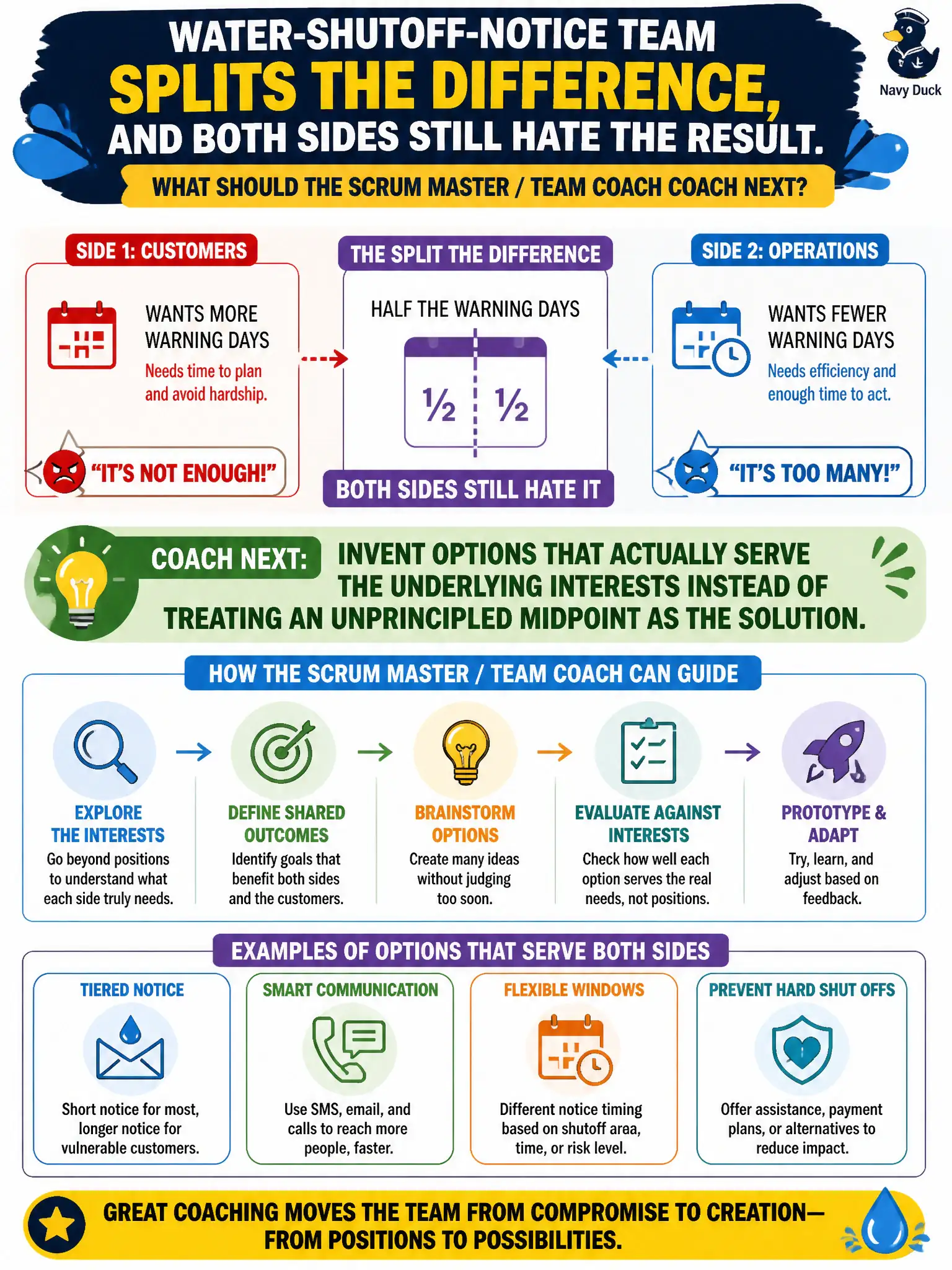
The water-shutoff-notice team splits the difference to half the warning days, and both sides still hate the result. What should the Scrum Master / Team Coach coach next?
Select an answer to reveal the explanation.
Short Explanation
Meeting in the middle of the river still drowns both hikers. Half the warning days pleased nobody because nobody's interest was served. Split-the-difference is not the same as solving.
Full Explanation
Unprincipled compromise—splitting warning days in half—often leaves both interests unmet. When the water-shutoff-notice team splits the difference to half the warning days and both sides still hate the result, the Scrum Master / Team Coach should coach inventing options that actually serve the underlying interests instead of treating an unprincipled midpoint as the solution. Resident due process and operational collection needs may be served by better notice channels, hardship pathways, or staged notices—not by arithmetic halfway that satisfies no one.
Declaring the midpoint a victory because compromise always equals interest-based solving fails by concept: compromise is not automatically interest-based. Having the director pick a number and forbid further discussion fails by concept by substituting authority for option generation. Adding the unused half-days as a PI stretch objective so the math looks fair fails by concept: cosmetic PI math does not fix unmet notice interests.
Exam caveat: SASM warns that splitting the difference can be a lazy substitute for interest-based options; principled outcomes beat midpoints. Legal notice minimums still apply—interest-based options must remain compliant for water-shutoff communications.
Operational check: reopen interests behind warning days, drop the midpoint-as-victory narrative, generate compliant options that serve due process and operations, pilot one timeboxed policy, measure resident comprehension and operational load, and verify satisfaction rises versus the hated half-days split.