
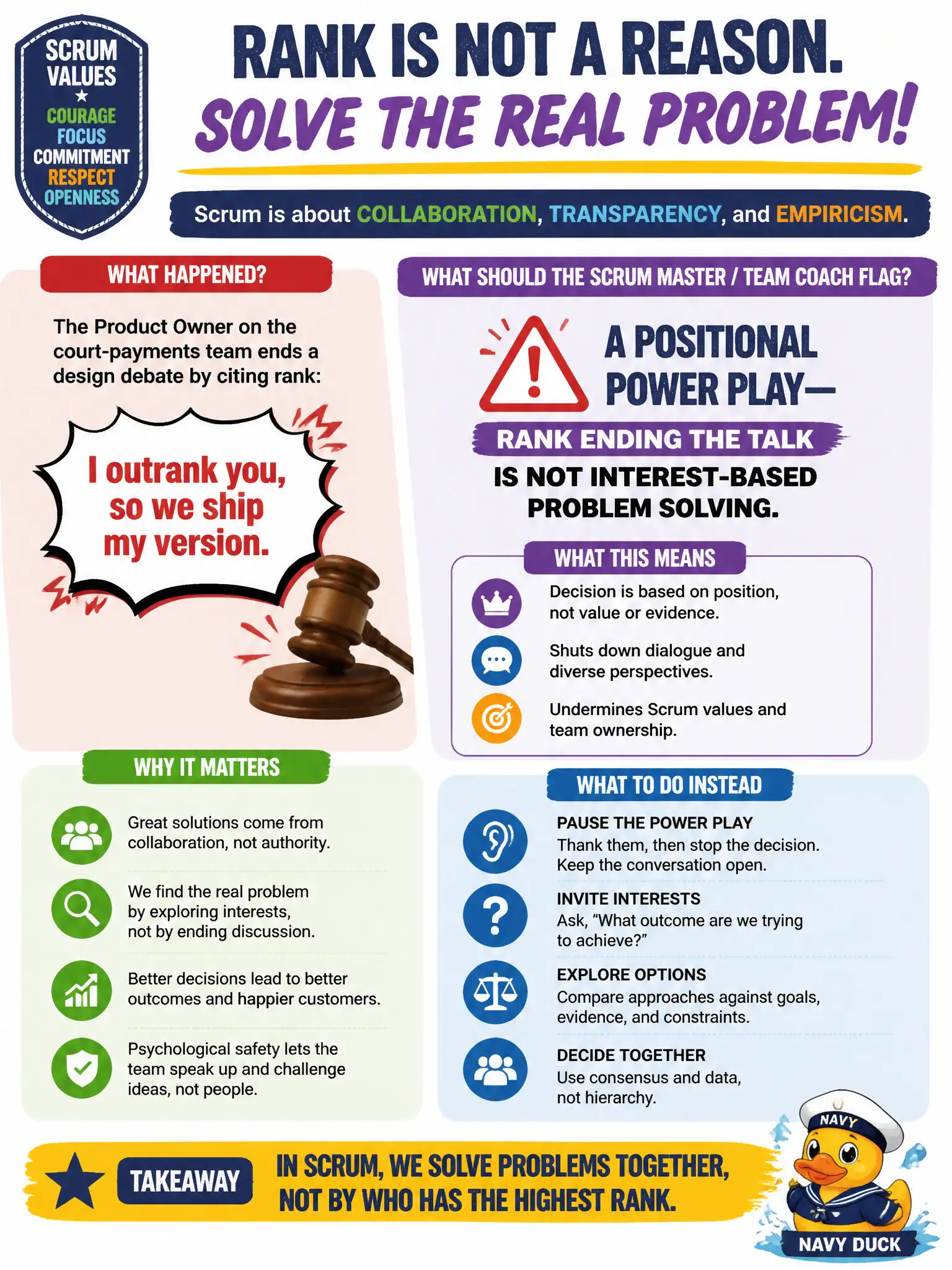
The Product Owner on the court-payments team ends a design debate by citing rank: "I outrank you, so we ship my version." What should the Scrum Master / Team Coach flag?
Select an answer to reveal the explanation.
Short Explanation
"Because rank said so" is a gavel, not a negotiation. Court-payments design still has interests under both versions. Rank shutting the room is a power play, not interest-based solving.
Full Explanation
Interest-based problem-solving does not end when the highest-ranking voice cites authority. When the Product Owner on a court-payments team ends a design debate by citing rank—"I outrank you, so we ship my version"—the Scrum Master / Team Coach should flag a positional power play: rank ending the talk is not interest-based problem solving. Court fee accuracy, accessibility, and auditability deserve interests, options, and criteria—not a rank trump card that silences clerks and developers.
Calling the move efficient servant leadership because rank is a SAFe Core Value fails by concept: rank is not a SAFe Core Value, and servant leadership is not rank closure. Calling it a successful interest-based close because someone decided fails by concept: a decision without interests is positional, not interest-based. Treating it as healthy positional bargaining that SASM recommends first fails by concept: SASM recommends interest-based approaches over premature positional power.
Exam caveat: SASM explicitly contrasts interest-based problem-solving with positional bargaining and power plays; "I outrank you" is a classic wrong pattern. Product Owners still decide backlog priority—design debates still benefit from interests and options before authority ends the conversation.
Operational check: interrupt the rank close, restate underlying interests for court payments, facilitate options and criteria, document the decision rationale, and confirm future design debates on the payments team do not end solely with hierarchical assertion.