
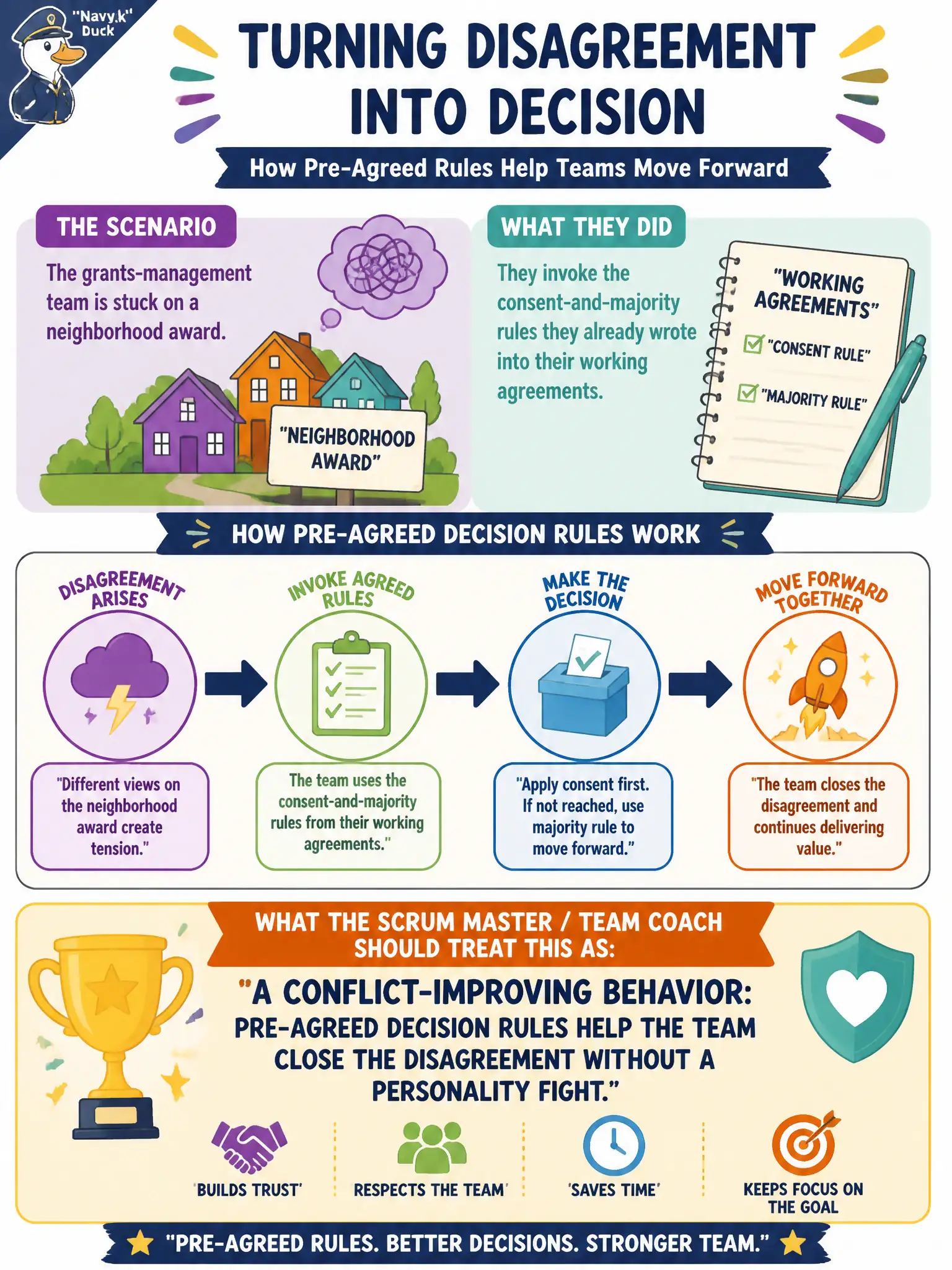
The grants-management team is stuck on a neighborhood award and invokes the consent-and-majority rules they already wrote into their working agreements. What should the Scrum Master / Team Coach treat this as?
Select an answer to reveal the explanation.
Short Explanation
A city council that already voted on its own rules does not reinvent voting mid-argument. Consent or majority, written when heads were cool, is how the grants team finishes a stuck call. That is containment, not weakness.
Full Explanation
When a grants-management team stuck on a neighborhood award invokes consent-and-majority rules already written into their working agreements, the Scrum Master / Team Coach should treat that as a conflict-improving behavior: pre-agreed decision rules help the team close the disagreement without a personality fight. Municipal grant choices are emotional; prior rules protect fairness and speed. Treating the moment as a stall that proves the team cannot decide—so the coach names the winning application—removes ownership and teaches dependency. Asking the Release Train Engineer to replace the team's rules with a train-wide funding decree escalates a team decision process into RTE policy. Discarding working agreements the moment a grant debate gets emotional throws away the very conflict infrastructure the team built. Exam caveat: SASM encourages using agreed decision rules in conflict; coach-as-decider, RTE decree, and abandoning agreements under emotion are distractors. Operational check: facilitate application of the written consent-or-majority rule, record the decision and dissent if any, confirm both camps can still work together on implementation, and revisit whether the rule needs clarification after the award cycle. Keep the working agreement visible during future grant debates.