
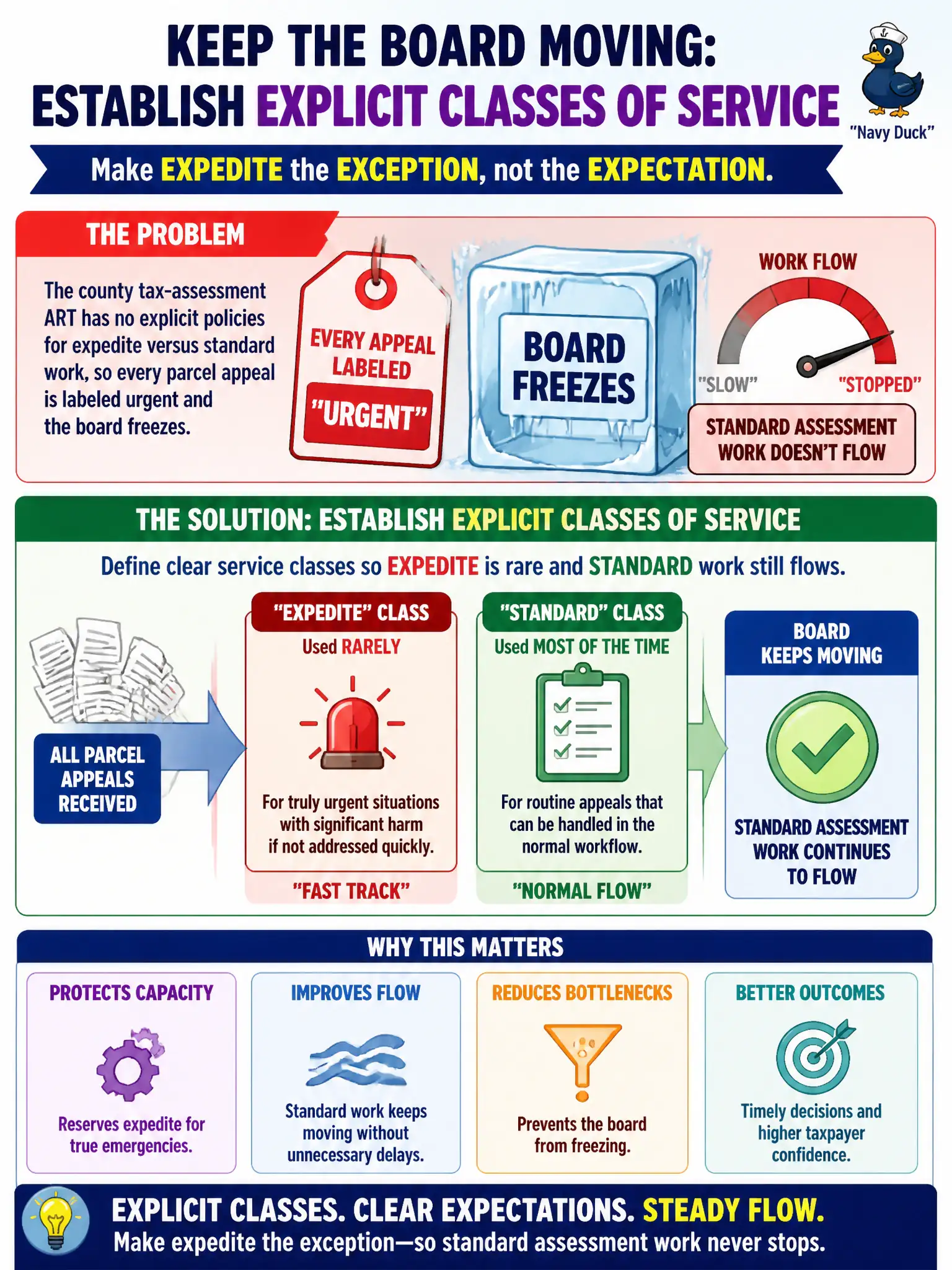
The county tax-assessment ART has no explicit policies for expedite versus standard work, so every parcel appeal is labeled urgent and the board freezes. What should the RTE establish?
Select an answer to reveal the explanation.
Short Explanation
If every car has a siren, nobody gets through the intersection. Classes of service are the traffic rules: a few true emergencies, and a normal lane that still moves. “Everything is urgent” is how the whole board freezes.
Full Explanation
Explicit classes of service so expedite is rare and standard assessment work still flows are what the county tax-assessment ART needs. Without policies distinguishing expedite, fixed-date, and standard work, every parcel appeal is labeled urgent, the board freezes, and predictability collapses for taxpayers and the assessor's office. Classes of service make entry criteria, WIP caps for expedite, and expectations visible. Declaring every appeal expedite destroys the class and recreates the freeze. Silent prioritization by whoever emails the assessor last is informal politics, not flow policy, and creates unfair civic outcomes. Freezing all standard valuation work until the next fiscal year abandons service levels for the majority of parcels to cope with unmanaged expedite demand. Exam caveat: true legal or safety-driven deadlines may be fixed-date class, not unlimited expedite; document the difference so Business Owners cannot redefine urgency weekly. Operational check: publish class-of-service definitions with expedite WIP limits, tag appeal cards accordingly, and review expedite percentage and standard flow time in ART Sync. Share the policy with county stakeholders so residents see consistent triage rather than a siren on every car at the intersection.