
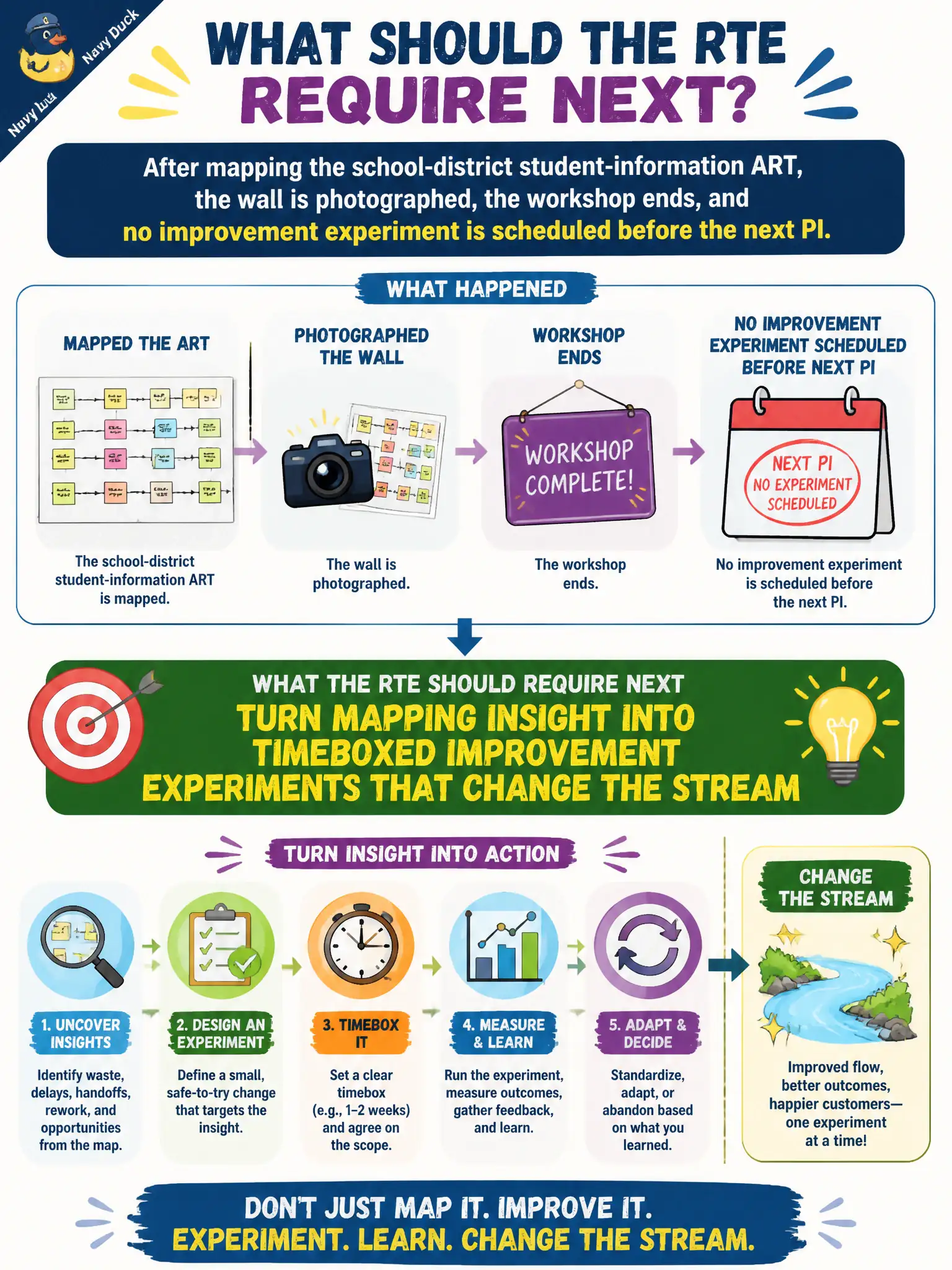
After mapping the school-district student-information ART, the wall is photographed, the workshop ends, and no improvement experiment is scheduled before the next PI. What should the RTE require next?
Select an answer to reveal the explanation.
Short Explanation
Photographing the map and going to lunch is a mural, not improvement. Mapping earns its keep when the student-information ART actually tries a change to a wait. Book the experiment in the next PI or the wall was just arts and crafts.
Full Explanation
Turn mapping insight into timeboxed improvement experiments that change the school-district student-information stream. Value stream mapping is an input to relentless improvement, not a deliverable that closes when the wall is photographed. A second workshop with a different color scheme before any change is delay dressed as analysis. Filing the map with the curriculum office as proof that analysis is complete archives learning. Waiting for a full reorganization so experiments have a "clean" organization postpones action indefinitely. Exam caveat: experiments should be small and reversible; mapping does not require boiling the ocean before a first trial. Operational check: before the next PI Planning, create owned experiments from the top waits, reserve capacity, define success measures, and review results at I&A so SIS changes for students and staff actually move. In municipal and civic service contexts, record the rationale in the ART working agreements or improvement backlog so future PIs preserve the control, and re-validate after the next Inspect and Adapt against resident-facing outcomes rather than activity theater. Confirm owners, success measures, and a re-check date so the practice remains inspectable.