
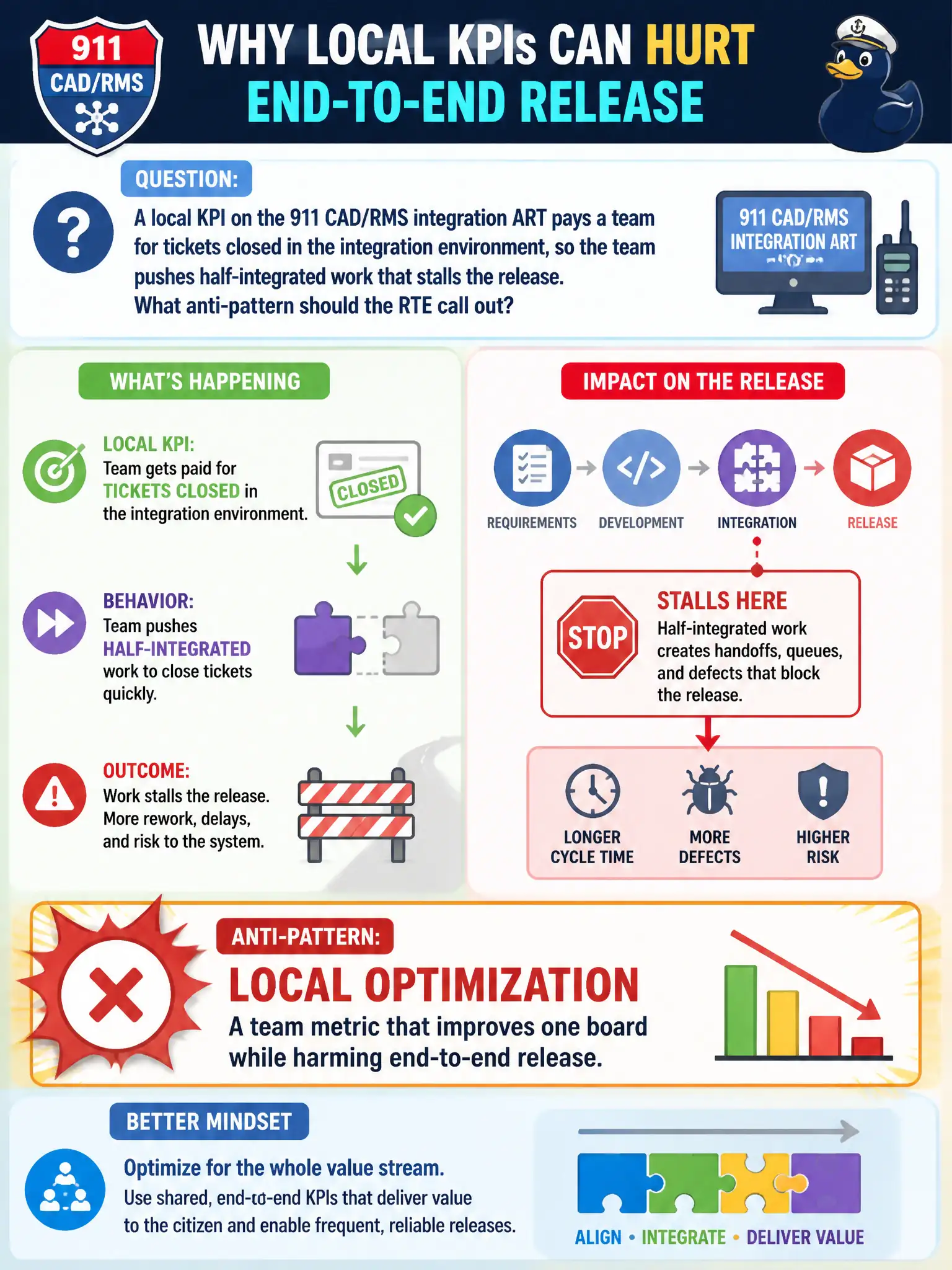
A local KPI on the 911 CAD/RMS integration ART pays a team for tickets closed in the integration environment, so the team pushes half-integrated work that stalls the release. What anti-pattern should the RTE call out?
Select an answer to reveal the explanation.
Short Explanation
Paying for tickets closed in integration is like paying the kitchen to plate food that never leaves the pass. The local board looks busy while dispatchers still wait on a release. That is local optimization wearing a KPI badge.
Full Explanation
Call out local optimization when a 911 CAD/RMS integration ART KPI pays for tickets closed in the integration environment while half-integrated work stalls release. Systems thinking watches for subunit measures that harm the whole. Under-utilization of the integration environment is not the problem to fix by keeping it busy at all costs. More individual stretch goals on the same ticket-close count intensify the anti-pattern. Claiming too few backlog tickets explain slow release misreads a handoff/quality problem as a volume problem. Exam caveat: intermediate environment metrics can exist if tied to releasable increments, not raw ticket closes. Operational check: replace the KPI with measures of integrated, releasable CAD/RMS increments and end-to-end lead time, and brief public-safety leaders that local board busyness is not dispatch readiness. In municipal and civic service contexts, record the rationale in the ART working agreements or improvement backlog so future PIs preserve the control, and re-validate after the next Inspect and Adapt against resident-facing outcomes rather than activity theater. Confirm owners, success measures, and a re-check date so the practice remains inspectable.