
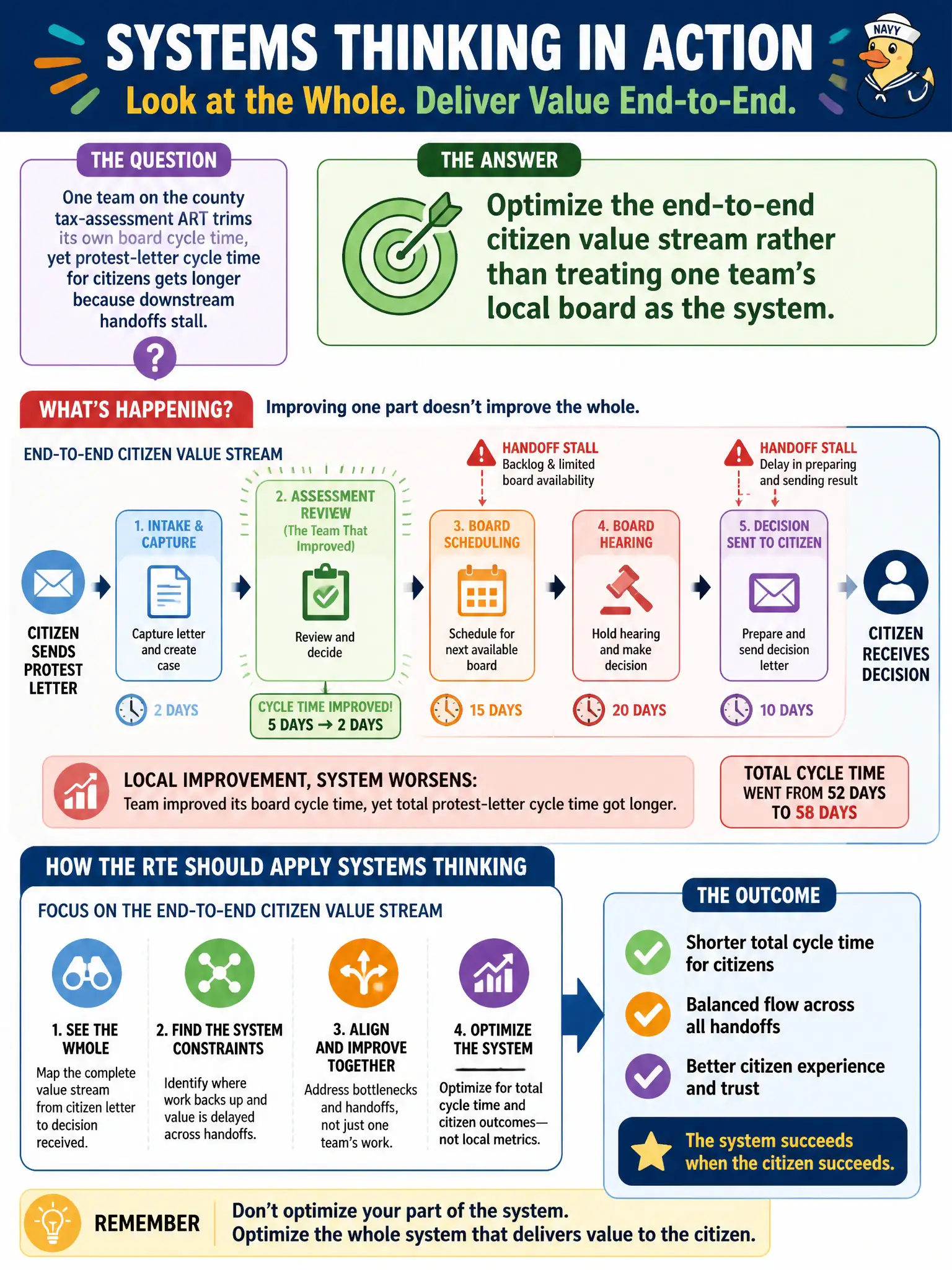
One team on the county tax-assessment ART trims its own board cycle time, yet protest-letter cycle time for citizens gets longer because downstream handoffs stall. How should the RTE apply systems thinking?
Select an answer to reveal the explanation.
Short Explanation
A sparkling local board with a slower citizen journey is like one clerk's window moving faster while the line at the next window doubles. Systems thinking judges the whole protest-letter path, not a single team's swim lane. Local speed that clogs the rest of the stream is not a win.
Full Explanation
Apply systems thinking by optimizing the end-to-end citizen value stream on the county tax-assessment ART rather than treating one team's local board as the system. Faster local cycle time that stalls downstream handoffs can lengthen protest-letter time for citizens. Rewarding the fast team so others copy the local optimization spreads the anti-pattern. Freezing downstream boards until queues equalize punishes the stream instead of redesigning handoffs. Splitting the fast team into a separate ART protects a subunit metric at the whole stream's expense. Exam caveat: local improvements are welcome when they do not increase end-to-end wait; validate with citizen journey measures. Operational check: measure protest-letter lead time end-to-end, map the stalling handoff, and fund a cross-team experiment so local board sparkle no longer degrades civic service. In municipal and civic service contexts, record the rationale in the ART working agreements or improvement backlog so future PIs preserve the control, and re-validate after the next Inspect and Adapt against resident-facing outcomes rather than activity theater. Confirm owners, success measures, and a re-check date so the practice remains inspectable.