
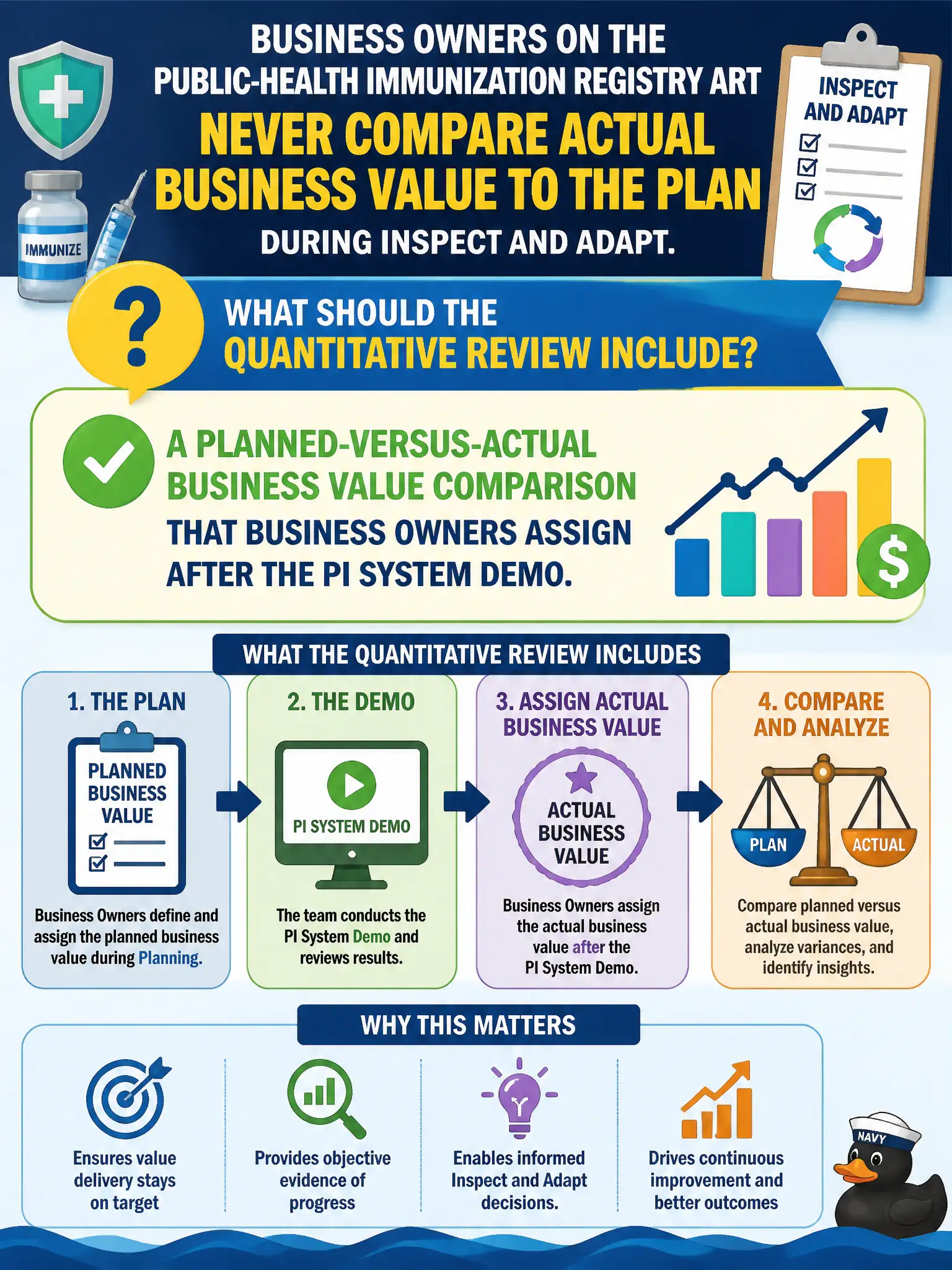
Business Owners on the public-health immunization registry ART never compare actual business value to the plan during Inspect and Adapt. What should the quantitative review include?
Select an answer to reveal the explanation.
Short Explanation
Story count is how many vials you labeled, not whether shots actually reached kids. Business Owners planned a value score at PI Planning; Inspect and Adapt is when they say what actually showed up. Compare plan to actual or the registry ART cannot tell a busy PI from a useful one.
Full Explanation
Include a planned-versus-actual business value comparison that Business Owners assign after the PI System Demo in the public-health immunization registry ART's quantitative review. During PI Planning, Business Owners assign planned value to PI Objectives; at I&A they assign actual value so achievement and predictability can be discussed. Counting closed registry stories is output, not business value. Postponing scoring to an annual public-health report breaks the PI learning loop. Developer self-scores so Business Owners need not attend remove the customer/owner voice. Exam caveat: actual value can be lower than plan without failure theater; the point is honest comparison and conversation. Operational check: after the demo, have Business Owners score actual value on the same objectives, compute achievement, and discuss gaps that affect clinic and resident immunization outcomes. In municipal and civic service contexts, record the rationale in the ART working agreements or improvement backlog so future PIs preserve the control, and re-validate after the next Inspect and Adapt against resident-facing outcomes rather than activity theater. Confirm owners, success measures, and a re-check date so the practice remains inspectable.