
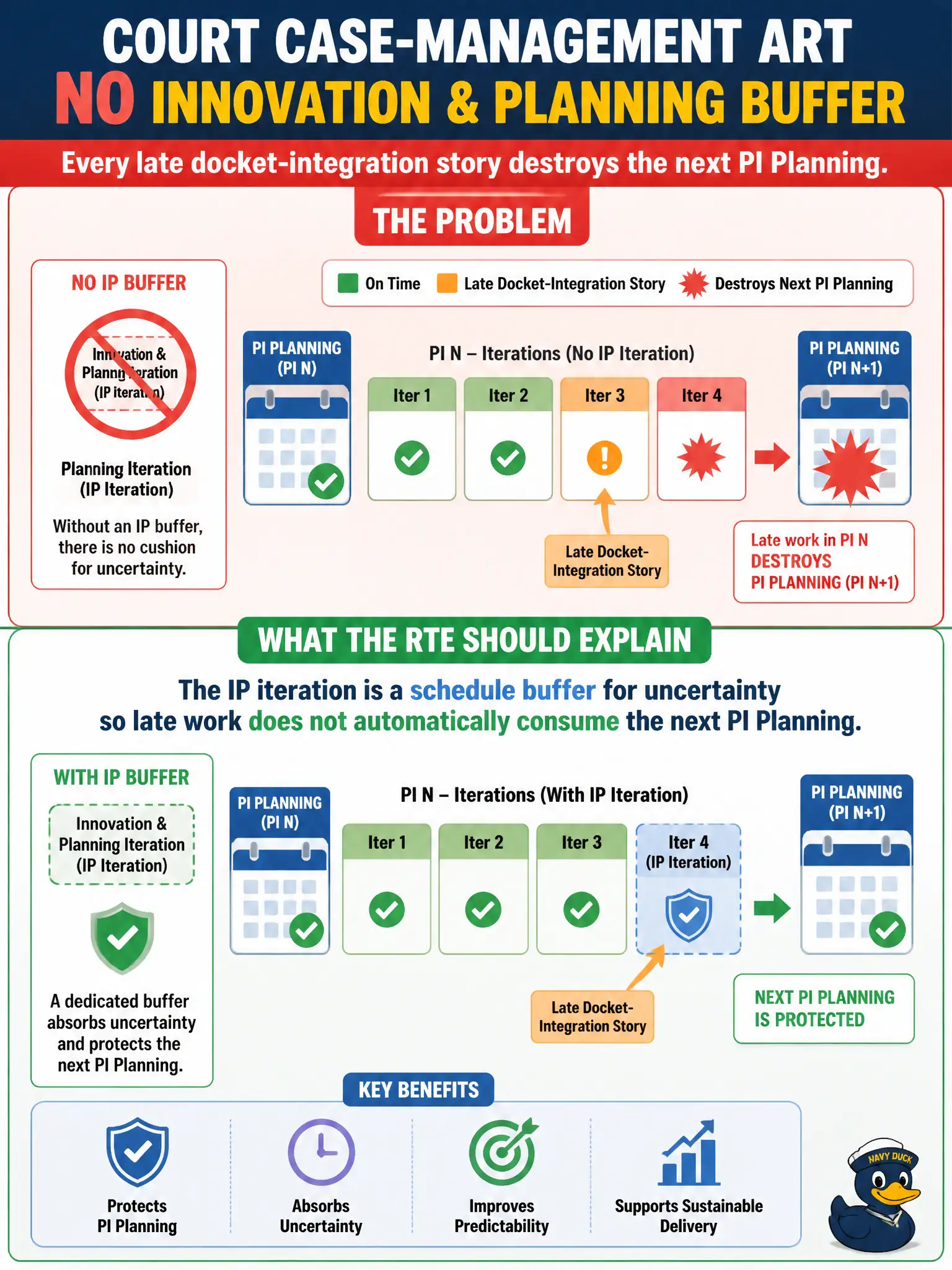
The court case-management ART has no Innovation and Planning buffer, so every late docket-integration story destroys the next PI Planning. What should the RTE explain?
Select an answer to reveal the explanation.
Short Explanation
A court calendar without slack turns one late filing into a wrecked next session. The IP iteration is that slack for the ART: a planned cushion so a slipped story does not eat the next PI Planning. Guard the buffer, or every delay becomes a planning crisis.
Full Explanation
Explain that the IP iteration is a schedule buffer for uncertainty so late docket-integration work on the court case-management ART does not automatically consume the next PI Planning. Without IP, unfinished work from the last development iteration eats time reserved for planning, I&A, innovation, and education. Triggering an emergency overtime sprint that replaces PI Planning until the backlog is empty destroys cadence. Hiding unfinished case-management work until after PI Planning conceals capacity truth. Dropping the PI cadence to plan week by week whenever a court filing deadline moves abandons the ART operating system. Exam caveat: true court-mandated dates may force re-planning of specific objectives, but that is not a reason to delete IP as a standing buffer. Operational check: keep IP on the calendar even when delivery is late, use part of it for critical unfinished integration plus I&A, and show bench stakeholders that protecting planning integrity improves long-term docket service reliability. In municipal and civic service contexts, record the rationale in the ART working agreements or improvement backlog so future PIs preserve the control, and re-validate after the next Inspect and Adapt against resident-facing outcomes rather than activity theater. Confirm owners, success measures, and a re-check date so the practice remains inspectable.