
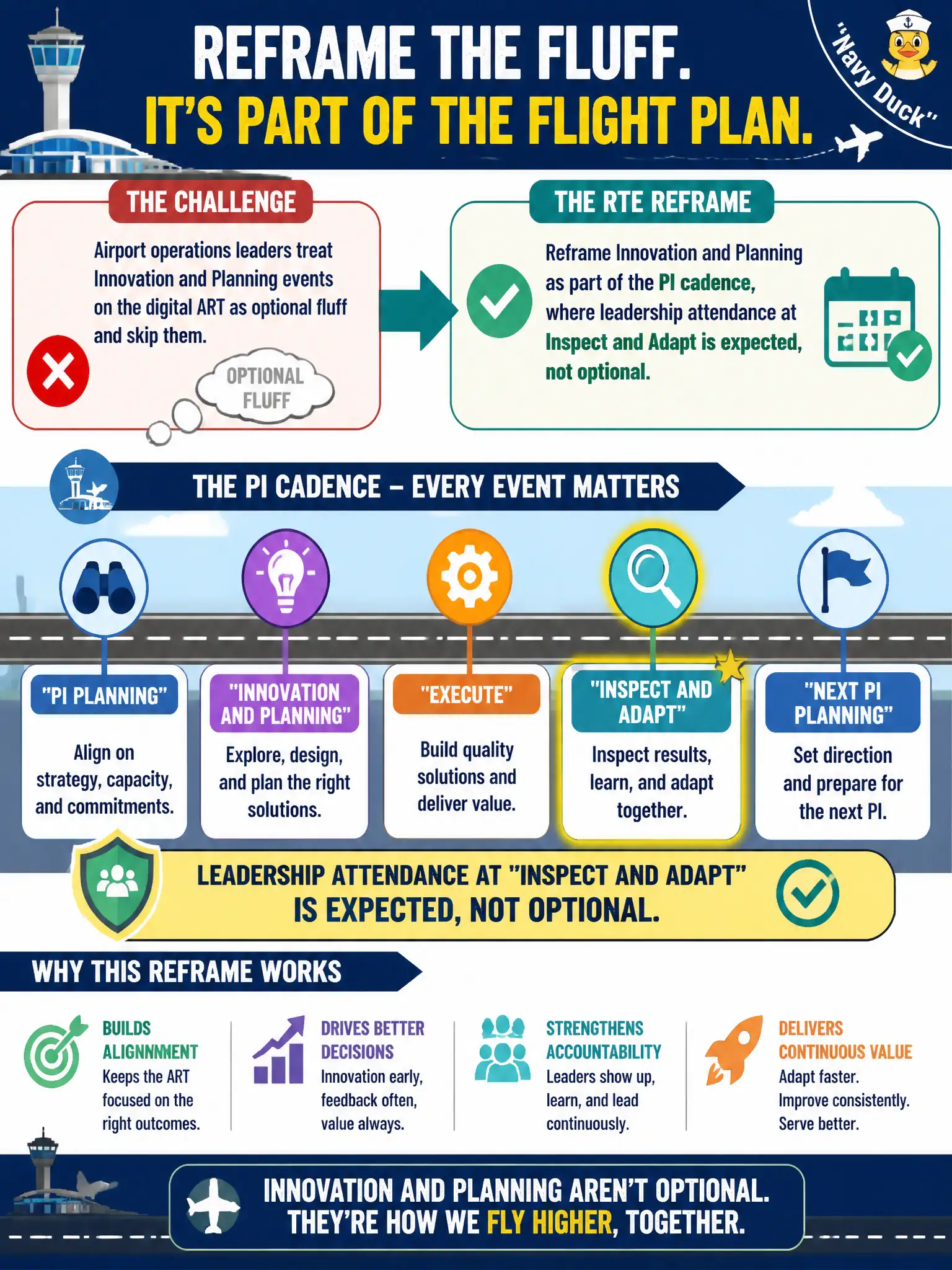
Airport operations leaders treat Innovation and Planning events on the digital ART as optional fluff and skip them. How should the RTE reframe those events?
Select an answer to reveal the explanation.
Short Explanation
IP is not a vacation week you can skip when the concourse looks busy. It is the last car on the PI train, and Inspect and Adapt needs the people who own the airport outcomes in the room. Treat it as optional and the next PI Planning starts without the learning the last PI already paid for.
Full Explanation
Reframe Innovation and Planning events on the airport operations digital ART as part of the PI cadence, where leadership attendance at Inspect and Adapt is expected, not optional fluff. IP holds innovation, continuing education, planning buffer, and I&A; Business Owners and other leaders belong at I&A to see the integrated solution, review measures, and sponsor improvement backlog items. Treating IP as makeup time for gate-display defects redefines the iteration as unmarked feature work. Calling it a training-only week leaders may ignore if dashboards look green removes outcome ownership. Using IP as a private team buffer so leaders never see improvement work breaks transparency. Exam caveat: not every leader attends every innovation spike, but I&A attendance for Business Owners is a standard expectation. Operational check: send I&A invitations with the PI calendar, track Business Owner presence, and escalate skipped IP/I&A as a cadence failure that harms the next PI Planning for traveler-facing airport systems. In municipal and civic service contexts, record the rationale in the ART working agreements or improvement backlog so future PIs preserve the control, and re-validate after the next Inspect and Adapt against resident-facing outcomes rather than activity theater. Confirm owners, success measures, and a re-check date so the practice remains inspectable.