
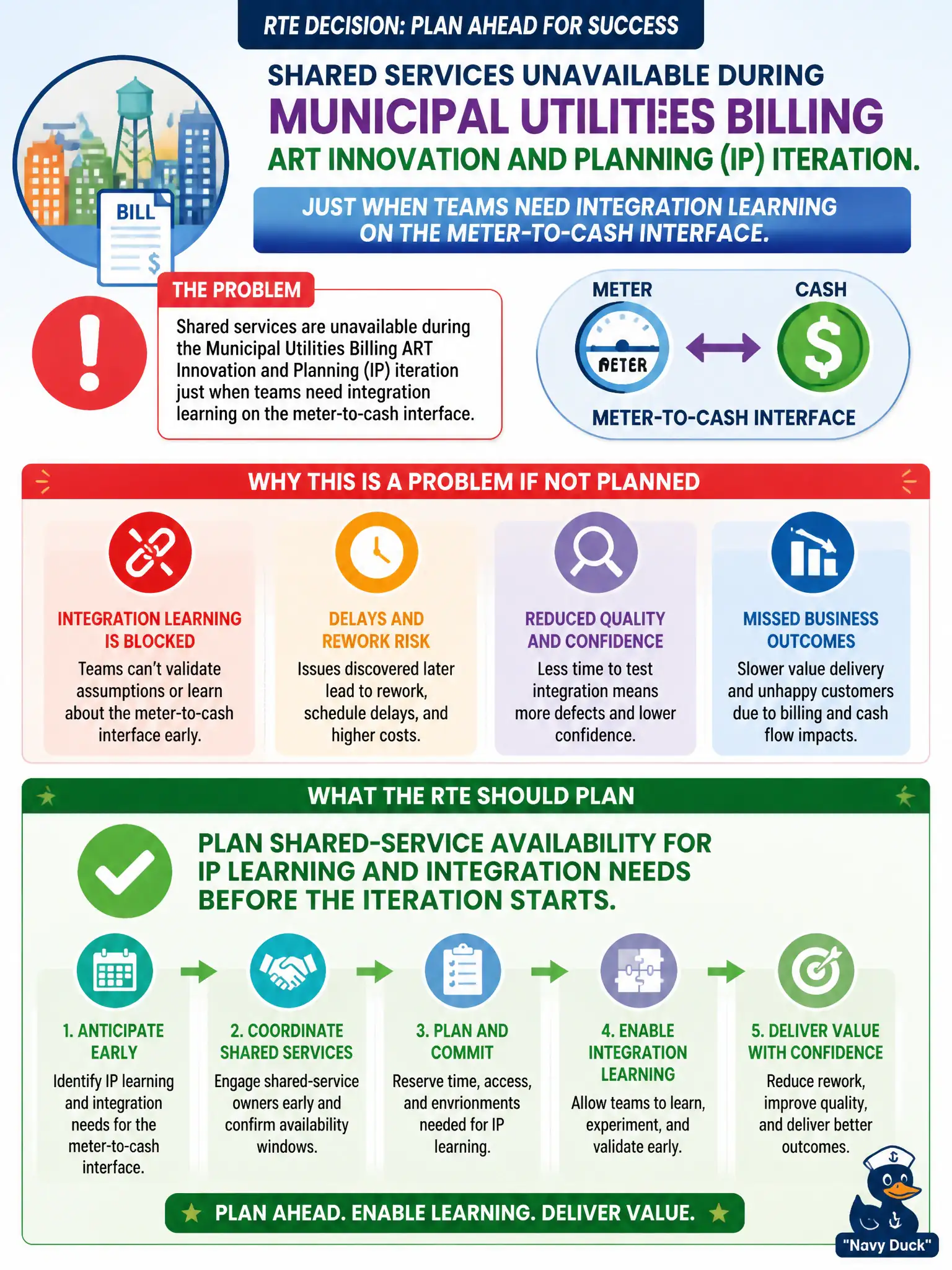
Shared services are unavailable during the municipal utilities billing ART Innovation and Planning (IP) iteration just when teams need integration learning on the meter-to-cash interface. What should the RTE plan?
Select an answer to reveal the explanation.
Short Explanation
Nobody can practice hooking the meter to the billing engine if the interface folks are dark all week. Book that capacity when the IP calendar is built. Surprise unavailability is how learning becomes a slide.
Full Explanation
Plan shared-service availability for IP learning and integration needs on the municipal utilities billing ART before the iteration starts. IP often includes meter-to-cash integration experiments and education that depend on specialists; those people must be scheduled as deliberately as for PI Planning. Hoping shared-service specialists answer chat during their own time off is not a capacity plan. Scheduling IP learning that needs no integration when the interface is the risk avoids the real uncertainty. Canceling IP because shared services cannot pair that week throws away the entire cadence instead of negotiating partial coverage or shifting the learning topic. Exam caveat: shared services may use a follow-the-sun or on-call model; the point is explicit commitment, not unlimited staffing. Operational check: during IP prep, book named shared-service hours for the meter-to-cash learning objectives, confirm backups, and escalate unavailability before IP week so ratepayer billing reliability experiments are not discovered as a mid-week surprise. In municipal and civic service contexts, record the rationale in the ART working agreements or improvement backlog so future PIs preserve the control, and re-validate after the next Inspect and Adapt against resident-facing outcomes rather than activity theater. Confirm owners, success measures, and a re-check date so the practice remains inspectable.