
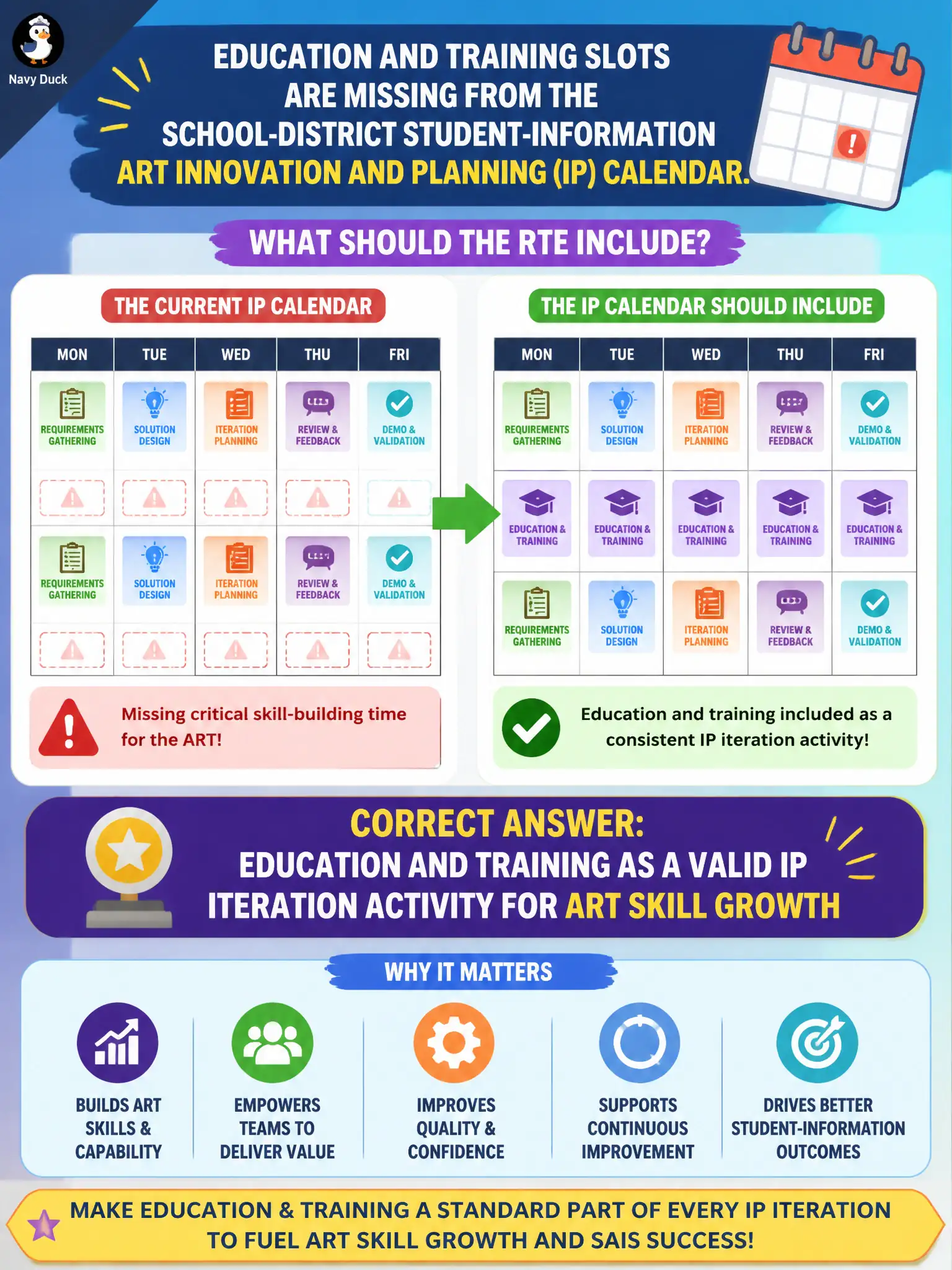
Education and training slots are missing from the school-district student-information ART Innovation and Planning (IP) calendar. What should the RTE include?
Select an answer to reveal the explanation.
Short Explanation
IP is also school for the school-system ART. If nobody books the training hour, the student-information crew stays stuck on last year’s screens. Learning is on-purpose work, not a hallway rumor.
Full Explanation
Education and training are a valid IP iteration activity for skill growth on the school-district student-information ART. Continuing education is an official use of IP; the RTE should reserve capacity for platform, accessibility, privacy, or SIS skills the train needs rather than treating IP as leftover feature carryover. Claiming training is never an IP activity contradicts SAFe's IP purpose. Banning skill growth so unmarked configuration work continues recreates a feature iteration. Vendor product demos with no ART learning objective are marketing time, not education. Exam caveat: training should have a clear learning objective and, where possible, a short application task; passive vendor pitches alone do not meet the intent. Operational check: put named training slots on the IP calendar with objectives, confirm attendance expectations with Scrum Masters, and ask teams to note one practice they will apply in the next PI's student-information work so district civic outcomes benefit from the learning. In municipal and civic service contexts, record the rationale in the ART working agreements or improvement backlog so future PIs preserve the control, and re-validate after the next Inspect and Adapt against resident-facing outcomes rather than activity theater. Confirm owners, success measures, and a re-check date so the practice remains inspectable.