
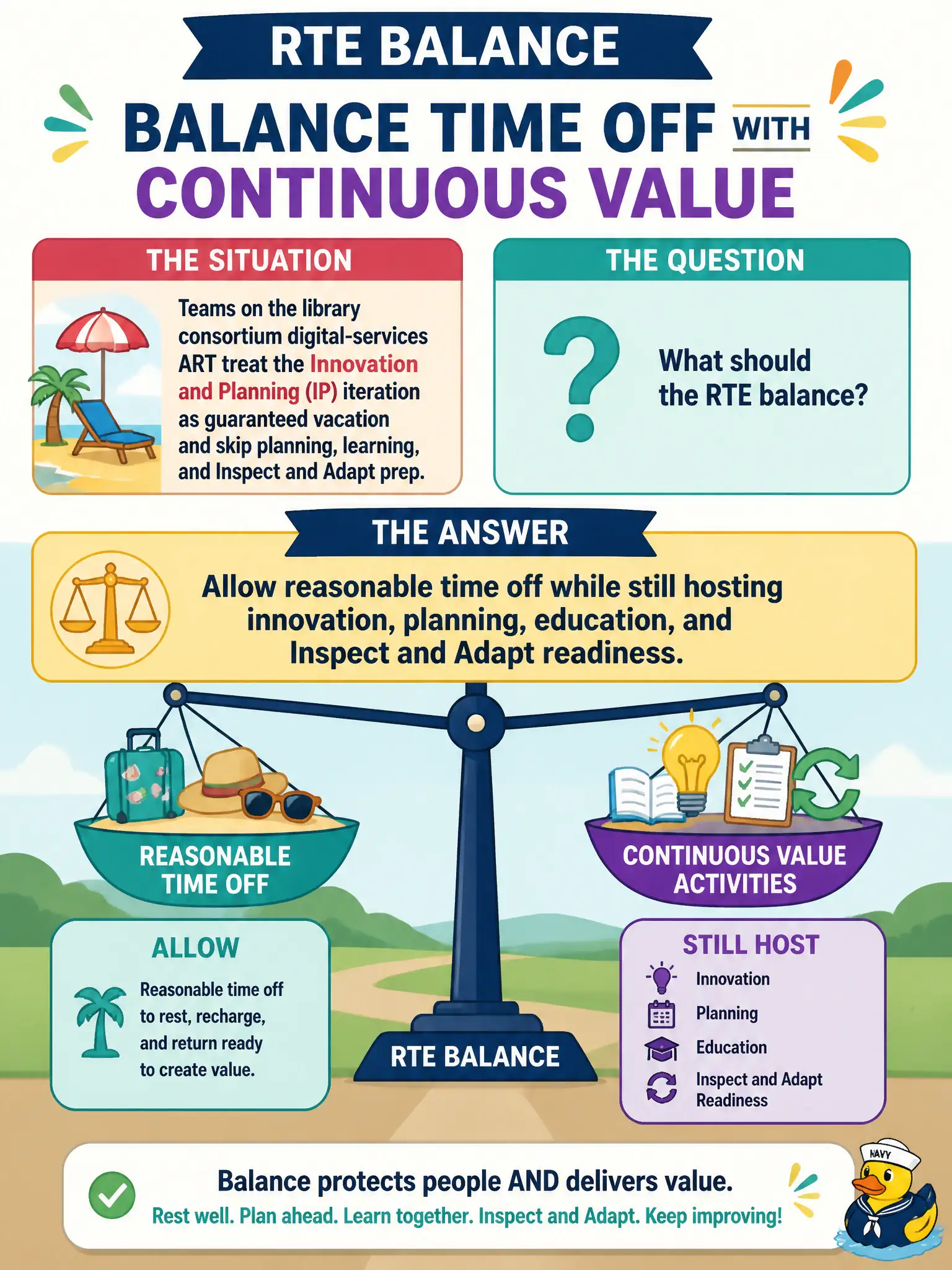
Teams on the library consortium digital-services ART treat the Innovation and Planning (IP) iteration as guaranteed vacation and skip planning, learning, and Inspect and Adapt prep. What should the RTE balance?
Select an answer to reveal the explanation.
Short Explanation
IP is not a two-week library closure sign. People can take a breather, sure—but the building still hosts the planning huddle, a learning hour, and Inspect and Adapt prep. Vacation-only IP leaves the next Planning Interval with no map.
Full Explanation
On the library consortium digital-services ART, the RTE balances reasonable time off during IP with continued hosting of innovation, planning, education, and Inspect and Adapt readiness. IP may include rest after a demanding PI, but it is not guaranteed vacation that cancels ART events. Converting IP entirely to unused PTO with no ART events leaves the next Planning Interval without a map. Banning all time off so IP is indistinguishable from a feature iteration ignores human sustainability and still misses IP's broader purpose if events are absent. Filling IP only with leftover catalog bugs while skipping Inspect and Adapt recreates a hardening week. Exam caveat: local labor policies and holidays still apply; the coaching point is ART-level purpose, not forbidding personal leave. Operational check: publish IP goals that state which days or hours hold I&A, learning, and planning prep; allow coordinated time off around those anchors; and verify Scrum Masters confirm their teams know the civic ART calendar before IP starts. In municipal and civic service contexts, record the rationale in the ART working agreements or improvement backlog so future PIs preserve the control, and re-validate after the next Inspect and Adapt against resident-facing outcomes rather than activity theater. Confirm owners, success measures, and a re-check date so the practice remains inspectable.