
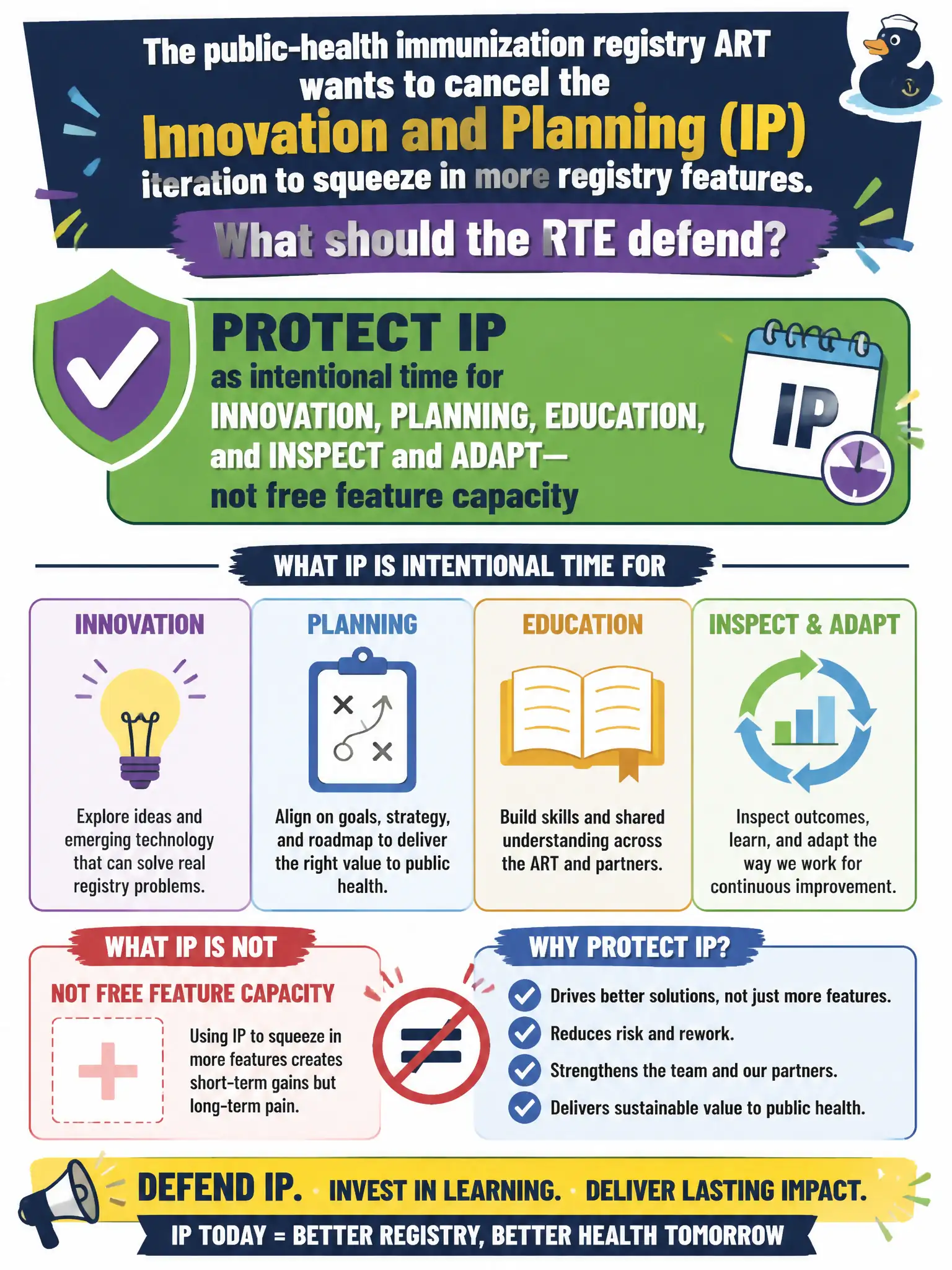
The public-health immunization registry ART wants to cancel the Innovation and Planning (IP) iteration to squeeze in more registry features. What should the RTE defend?
Select an answer to reveal the explanation.
Short Explanation
IP is the firehouse training day, not an extra ambulance shift. The ART still plans, learns, innovates, and inspects. Turning it into unmarked feature time is how the next PI starts tired and unprepared.
Full Explanation
The Innovation and Planning (IP) iteration is intentional capacity for innovation, planning, education, and Inspect and Adapt—not free unmarked feature time the public-health immunization registry ART can cancel to squeeze more registry stories. IP also buffers delivery variability so unfinished work does not automatically consume the next PI Planning. Canceling IP and treating the extra iteration as feature capacity removes that buffer and the improvement system. Keeping IP only if every hour is booked to production defects collapses the iteration into firefighting. Skipping Inspect and Adapt to start the next PI's features early abandons measurement and problem-solving the PI already earned. Exam caveat: critical production defects may consume some IP capacity, but they do not redefine IP's purpose or justify canceling I&A and planning prep. Operational check: publish an IP agenda with protected blocks for I&A, education or innovation, and next-PI prep; refuse a blanket conversion of IP into feature iterations; and brief public-health Business Owners that civic reliability includes learning time, not only more screens. In municipal and civic service contexts, record the rationale in the ART working agreements or improvement backlog so future PIs preserve the control, and re-validate after the next Inspect and Adapt against resident-facing outcomes rather than activity theater. Confirm owners, success measures, and a re-check date so the practice remains inspectable.