
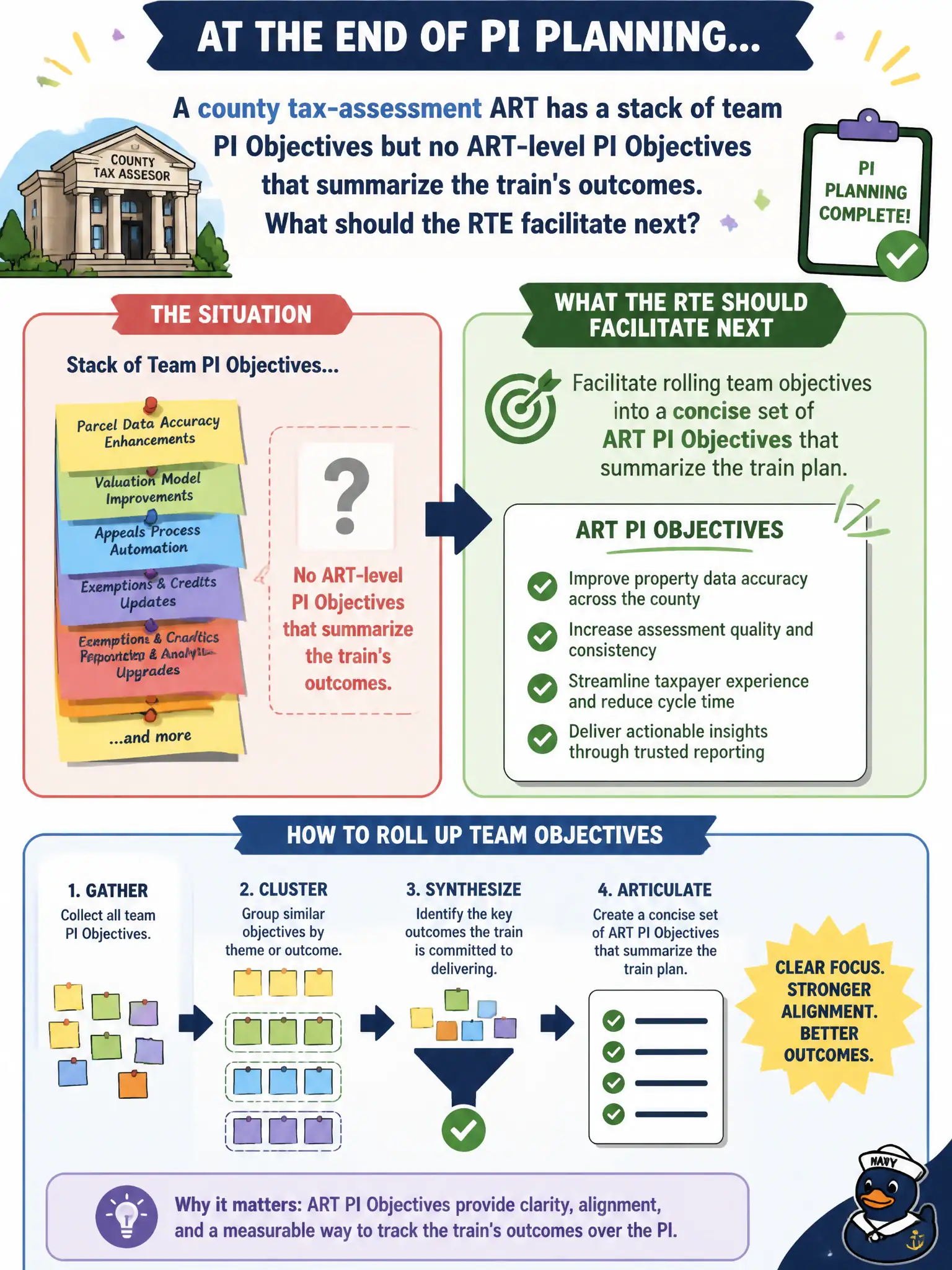
At the end of PI Planning, a county tax-assessment ART has a stack of team PI Objectives but no ART-level PI Objectives that summarize the train's outcomes. What should the RTE facilitate next?
Select an answer to reveal the explanation.
Short Explanation
Team objectives are the ingredients; ART PI Objectives are the meal on the menu. Assessors and Business Owners need the train-level summary, not a pile of team index cards.
Full Explanation
Team PI Objectives are team-owned commitments; ART PI Objectives summarize train-level outcomes Business Owners and leaders can track. At the end of county tax-assessment PI Planning, a stack of team objectives without ART-level wording leaves the train plan fragmented. The RTE should facilitate rolling team objectives into a concise set of ART PI Objectives that summarize the train plan. Publishing team lists as-is and skipping ART-level wording forces Business Owners to reconstruct the train narrative from dozens of cards. Replacing team objectives with a single tax-assessor slogan discards the team-level commitments that make the ART plan real. Waiting until Inspect and Adapt to invent ART objectives from whatever shipped is after-the-fact storytelling, not planning. County tax-assessment leaders and property owners need a train-level narrative of assessment outcomes, not a pile of disconnected team cards they must stitch together themselves. Exam caveat: ART objectives should trace to team work—they are summaries, not orphan slogans without owners. Operational check: before closing, draft ART PI Objectives in the room and map each to supporting team objectives on the tax-assessment plan. Validate each ART objective with Business Owners for assessable civic outcomes before the confidence vote closes.