
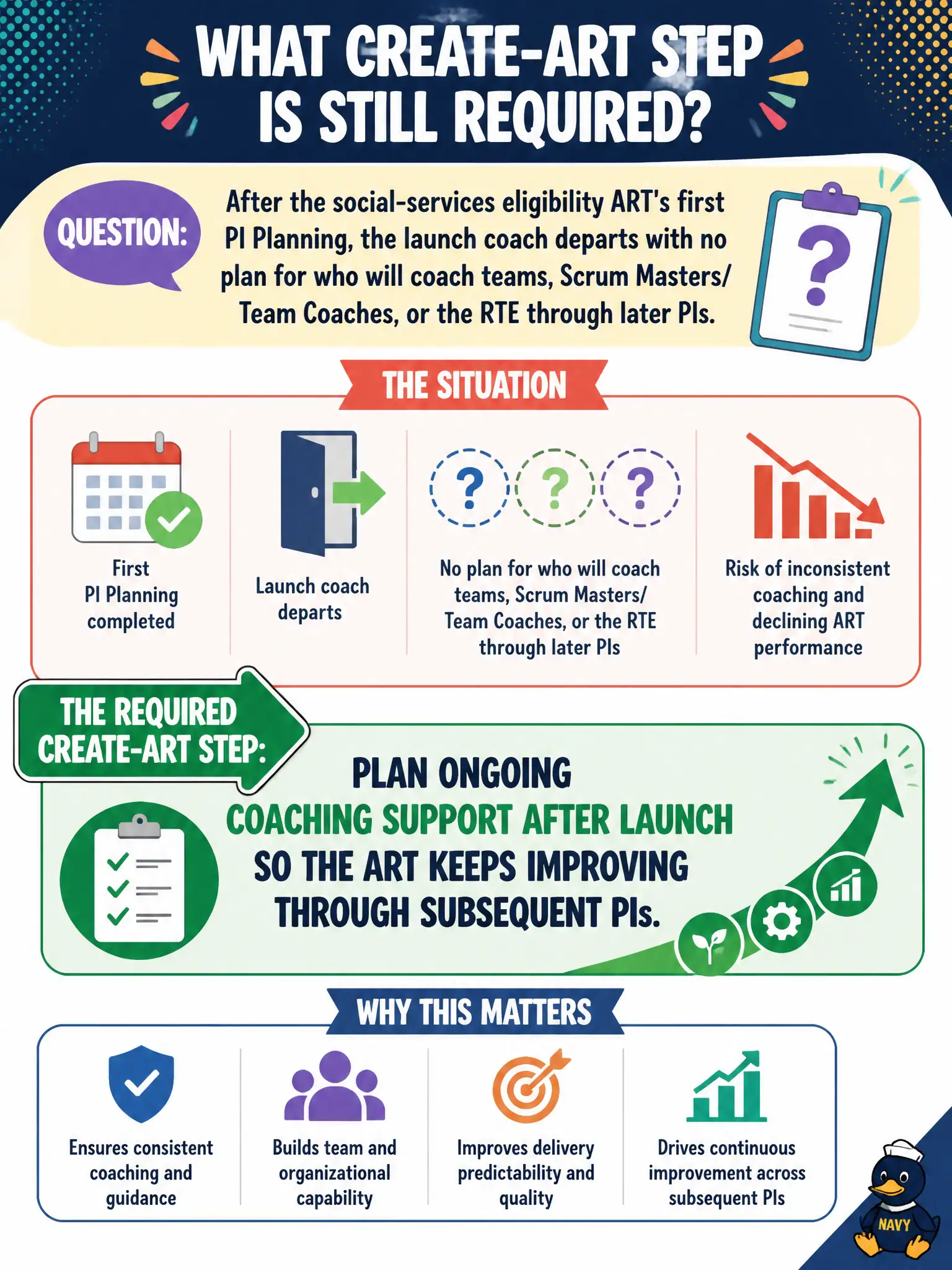
After the social-services eligibility ART's first PI Planning, the launch coach departs with no plan for who will coach teams, Scrum Masters/Team Coaches, or the RTE through later PIs. What create-ART step is still required?
Select an answer to reveal the explanation.
Short Explanation
Launch day is opening night, not the end of the season. If the coach walks out after PI Planning, the eligibility ART is left to improvise. Creating a train includes a coaching plan that lasts beyond the first event.
Full Explanation
Establishing an ART is not finished when the first PI Planning ends. Launch steps include planning ongoing coaching for teams, Scrum Masters/Team Coaches, Product Management, and the RTE through the early PIs. After the social-services eligibility ART’s first PI Planning, if the launch coach departs with no plan for who will coach whom afterward, the still-required step is planning ongoing coaching support so the ART keeps improving through subsequent PIs. Launch day is opening night, not the end of the season. Treating launch as complete and requiring each eligibility team to hire its own external project manager reintroduces predictive control and fragments coaching. Freezing coaching until the next fiscal year so benefits staff can “learn by surviving” abandons servant-leader development during the hardest early PIs. Converting the RTE role into a status-reporting PMO desk now that planning is done strips facilitation and coaching from the role the train still needs. Exam caveat: ongoing coaching can be internal RTE plus peer coaches; it need not be an expensive external army forever. Operational check: name coaching owners and cadence for the next two to three eligibility PIs, put those sessions on the calendar, and review Measure and Grow or qualitative facilitation signals each PI.