
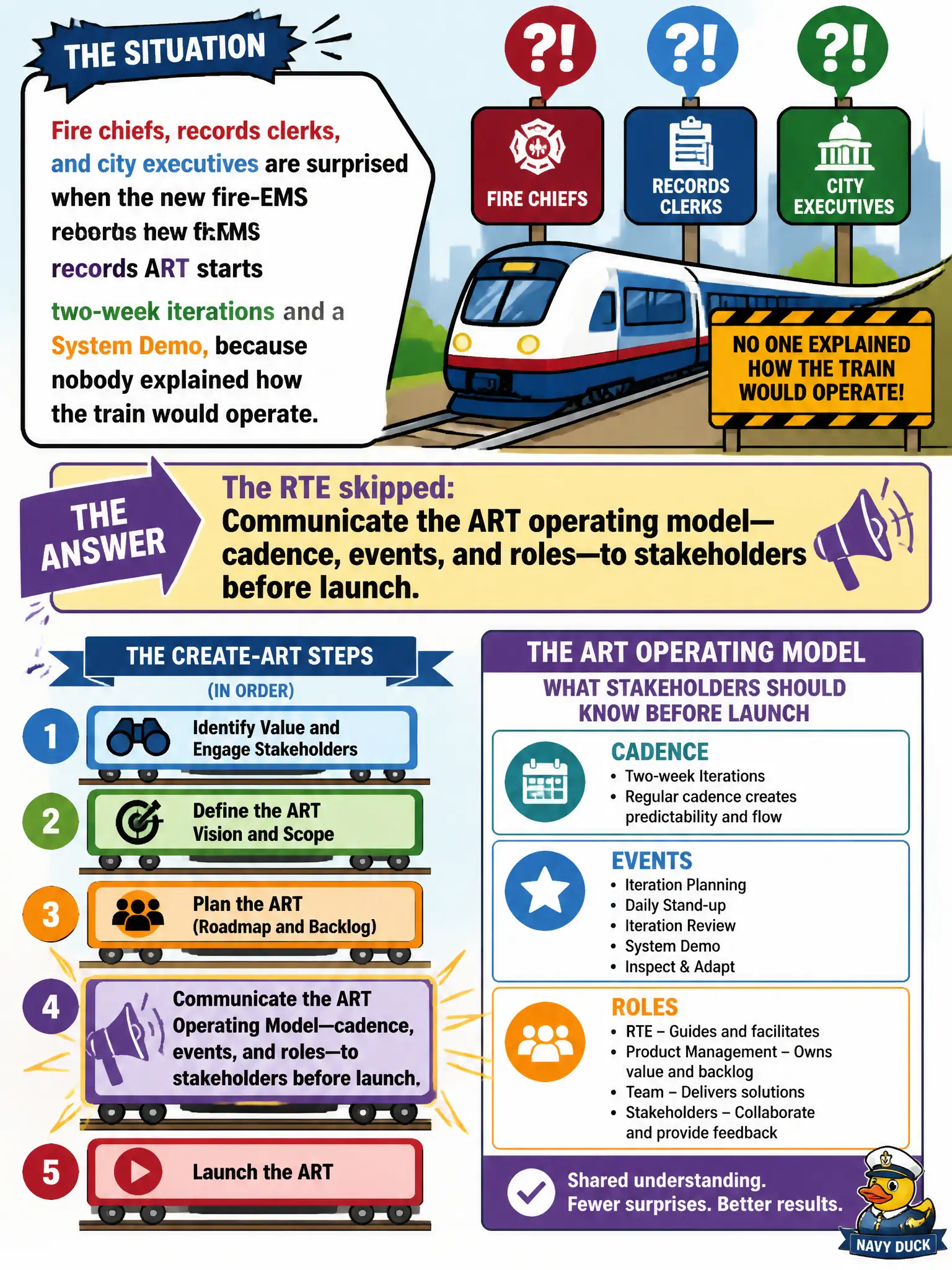
Fire chiefs, records clerks, and city executives are surprised when the new fire-EMS records ART starts two-week iterations and a System Demo, because nobody explained how the train would operate. Which create-ART step did the RTE skip?
Select an answer to reveal the explanation.
Short Explanation
If the fire chief learns the operating model the same morning as PI Planning, that is a communications miss, not a Lean technique. Creating an ART includes telling stakeholders how cadence, events, and roles will work. Surprise is not a coaching strategy.
Full Explanation
Stakeholder communication and preparation are part of launching an ART. When fire chiefs, records clerks, and city executives are surprised that the new fire-EMS records ART starts two-week iterations and a System Demo, the RTE skipped communicating the ART operating model—cadence, events, and roles—to stakeholders before launch. Leaders and operational partners need a clear picture before the first PI, not a surprise on opening day. Requiring every stakeholder to pass a Scrum Master exam before attending any ART event over-gates sponsorship and confuses stakeholder literacy with Scrum Master certification. Keeping the operating model secret until after the first Inspect and Adapt so surprise creates urgency is not a Lean technique; it burns trust in public-safety partners. Replacing stakeholder briefings with a signed change-control board charter that freezes records policy substitutes predictive control for operating-model communication. Exam caveat: communication can be a short briefing and one-pager; it does not require turning every chief into an SPC. Operational check: brief fire and EMS leaders on cadence, PI Planning, System Demo, and role boundaries, circulate a simple operating-model summary, and confirm questions are answered before the records ART’s first PI Planning.