
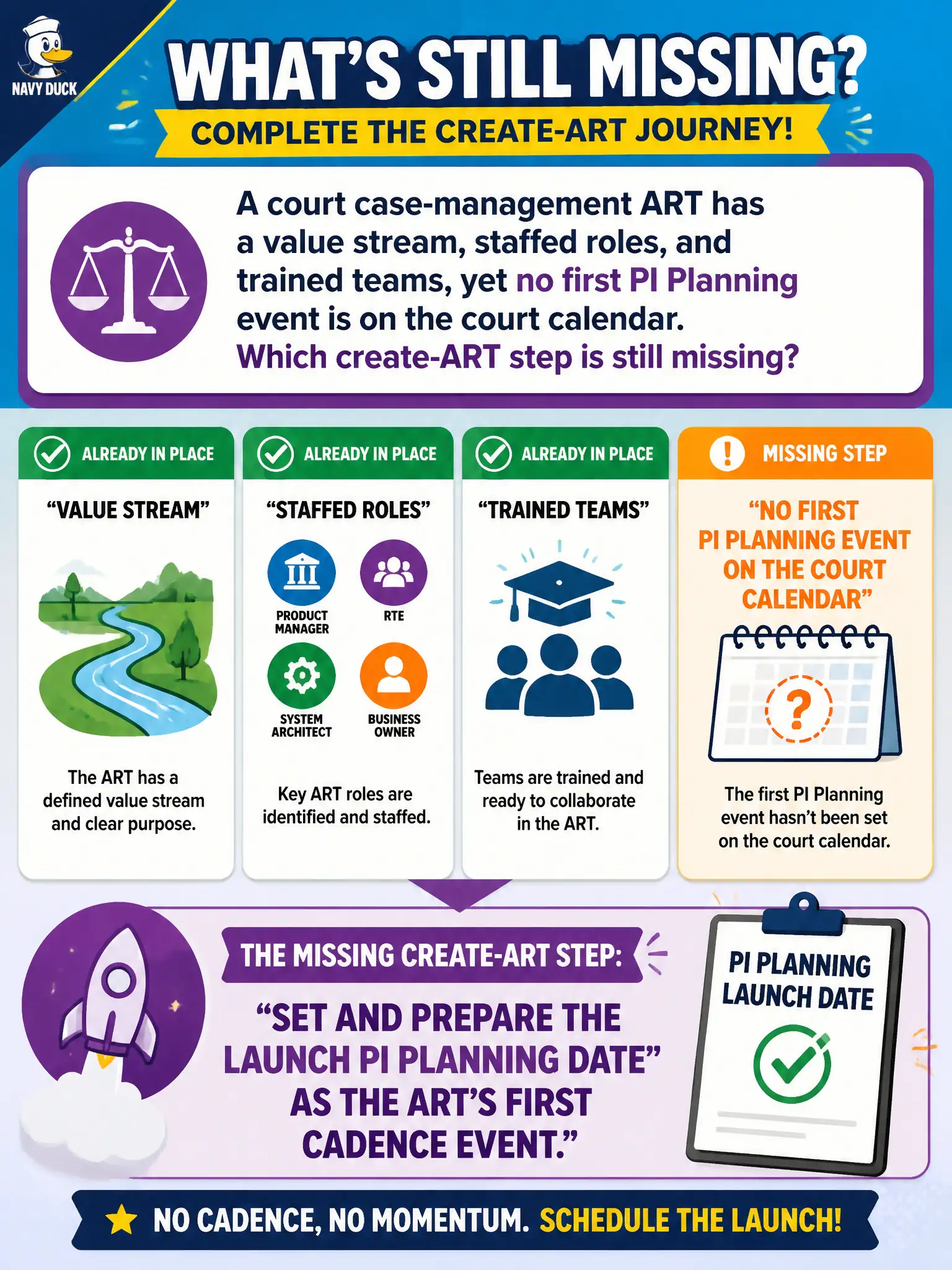
A court case-management ART has a value stream, staffed roles, and trained teams, yet no first PI Planning event is on the court calendar. Which create-ART step is still missing?
Select an answer to reveal the explanation.
Short Explanation
A train without a departure time is just people standing on a platform. Roles and training are useful, but the ART is not launched until the first PI Planning is dated and prepared. Put that event on the court calendar and treat it as the start of cadence.
Full Explanation
One of the steps to create an ART is to set the launch date and prepare the first PI Planning event—the ceremony that establishes cadence, synchronization, and a shared plan. When a court case-management ART has a value stream, staffed roles, and trained teams, yet no first PI Planning is on the court calendar, the missing step is setting and preparing that launch PI Planning date as the ART’s first cadence event. Staffing and training do not by themselves start the train. Waiting until every case type has a finished predictive work-breakdown before publishing any planning date recreates waterfall readiness gates. Substituting a monthly steering committee for PI Planning until clerks request a launch replaces ART cadence with committee governance. Letting each courtroom team pick its own start week so the train can form organically fragments synchronization that defines an ART. Exam caveat: the launch date can be ambitious, but it must be shared and prepared—not a vague aspiration. Operational check: place the first PI Planning on the court calendar, complete logistics and backlog prep, communicate the date to Business Owners and teams, and treat that event as the start of ART cadence. Keep the civic mission visible when applying the technique so resident-facing outcomes stay the measure of success.