
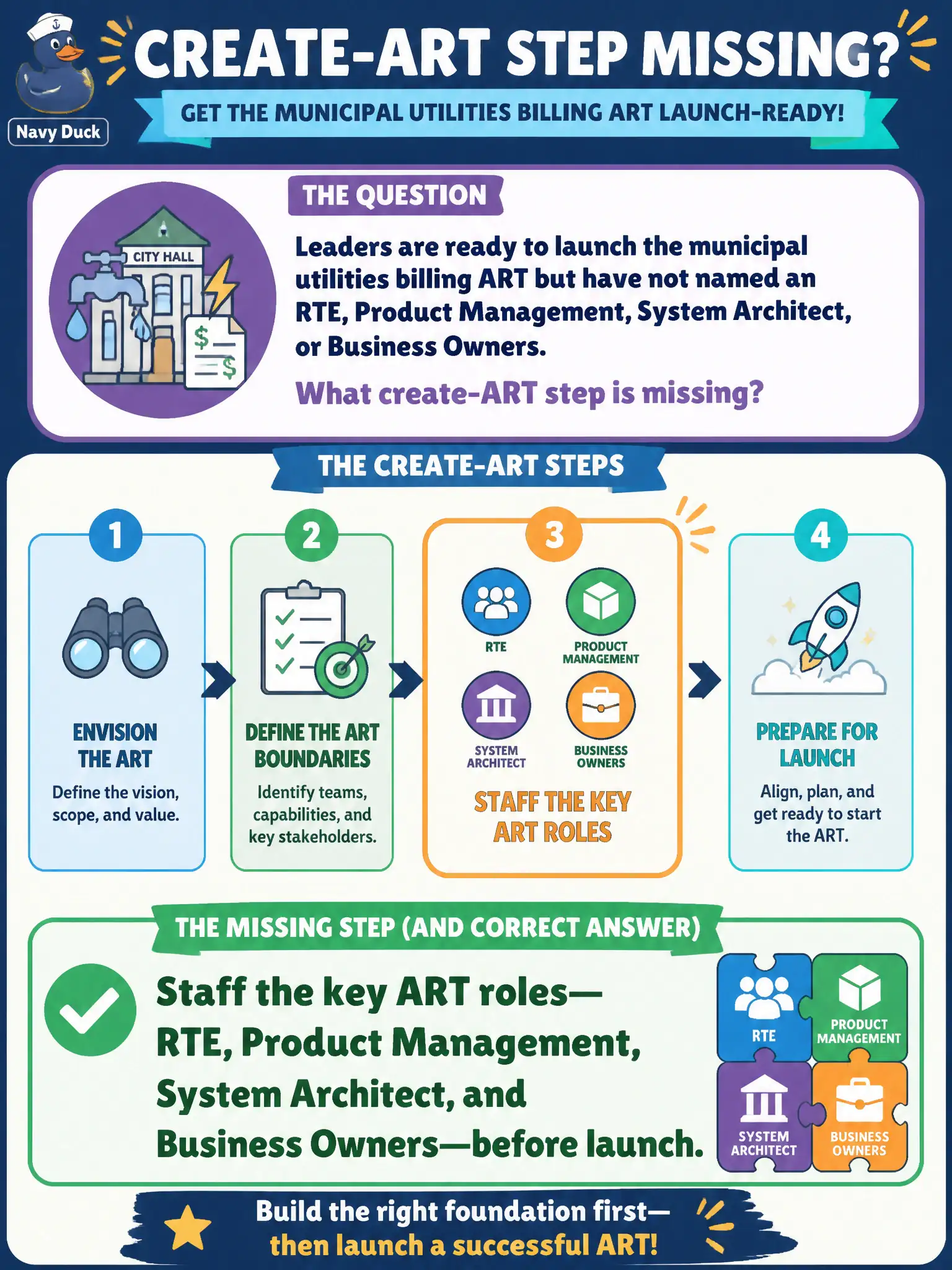
Leaders are ready to launch the municipal utilities billing ART but have not named an RTE, Product Management, System Architect, or Business Owners. What create-ART step is missing?
Select an answer to reveal the explanation.
Short Explanation
A billing train with no engineer, no product, no architect, and no Business Owners is a locomotive without a crew. Name the seats before the first PI Planning. Self-organizing the whole ART in the room is not a staffing strategy.
Full Explanation
Creating an ART includes staffing key roles: RTE, Product Management, System Architect/Engineering, and Business Owners, along with teams and Scrum Master/Team Coach and Product Owner roles. When leaders are ready to launch the municipal utilities billing ART but have not named those seats, the missing create-ART step is staffing the key ART roles before launch. Self-organizing the whole ART’s responsibilities during PI Planning is not a staffing strategy for a billing train that serves residents. Skipping named roles and letting teams invent ART responsibilities in the room forces governance to be improvised under planning pressure. Assigning only a project scheduler and treating SAFe role names as optional labels recreates a predictive PMO without Product Management, architecture, or Business Owner engagement. Waiting until after the second PI to name Business Owners so they are “not biased” delays the very stakeholders who should help set PI Objectives and accept value. Exam caveat: people can wear dual hats carefully, but the roles must still be named and understood before launch. Operational check: publish a role roster for the utilities billing ART with named humans for RTE, Product Management, System Architect, and Business Owners, confirm they understand event expectations, then proceed to training and first PI Planning.