
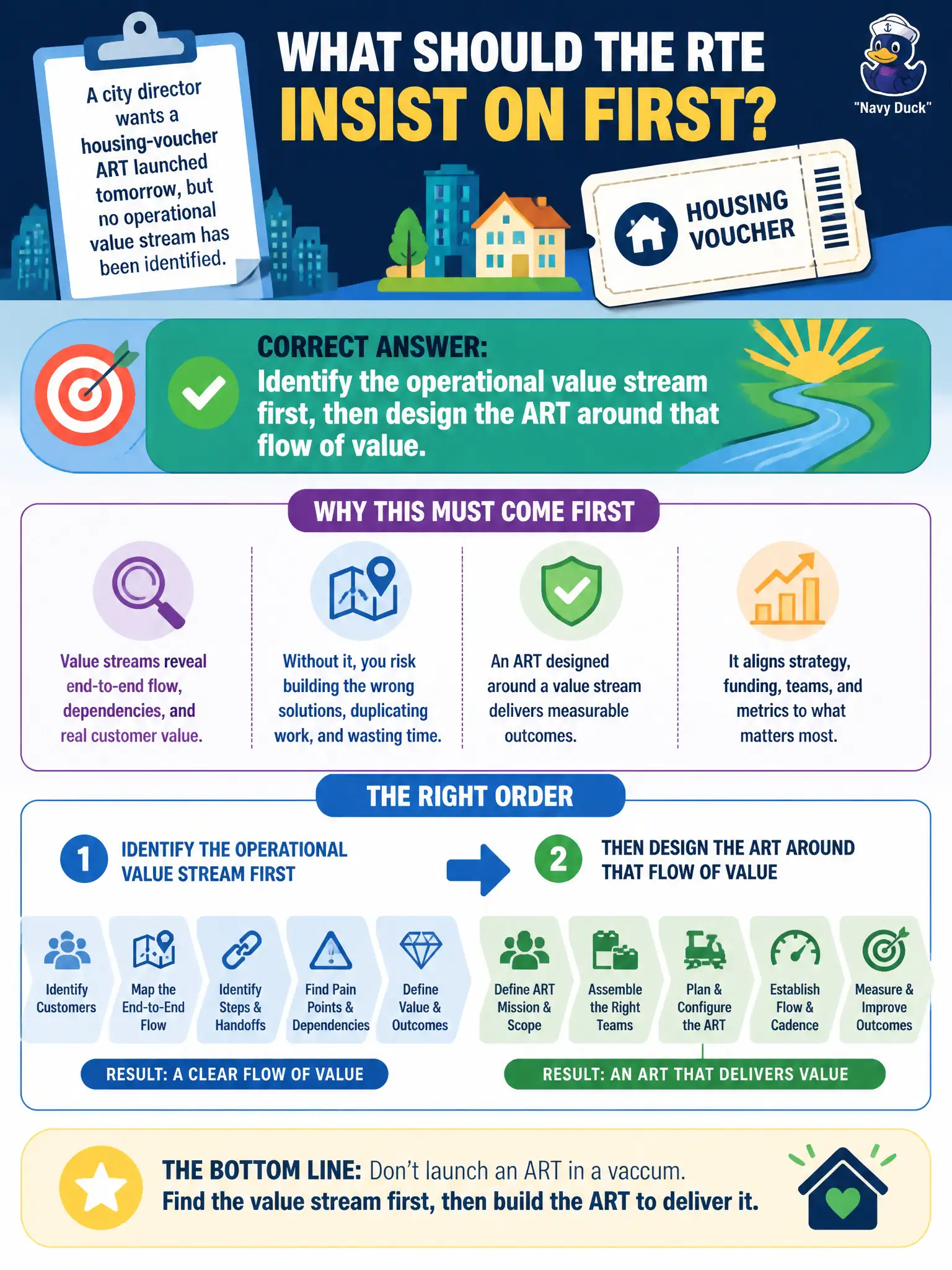
A city director wants a housing-voucher ART launched tomorrow, but no operational value stream has been identified. What should the RTE insist on first?
Select an answer to reveal the explanation.
Short Explanation
An ART with no value stream is a train with no track. Housing vouchers already move through a resident-facing flow—intake, eligibility, issuance, recertification—so map that operational value stream first, then wrap a train around it. Tomorrow’s PI Planning without that map is just a big meeting with a new label.
Full Explanation
Creating an ART starts with identifying the value stream the train will serve. When a city director wants a housing-voucher ART launched tomorrow but no operational value stream has been identified, the RTE should insist on identifying the operational value stream first, then designing the ART around that flow of value. SAFe organizes ARTs around a flow of value—typically a development value stream supporting an operational value stream such as voucher intake, eligibility, issuance, and recertification. Launching PI Planning immediately so the calendar does not slip produces a big meeting with a new label and no shared track. Forming teams from whoever is available in IT and naming the group an ART confuses staffing availability with value-stream design. Writing PI Objectives first and discovering the value stream after the first System Demo inverts the create-ART sequence and leaves objectives without a coherent mission boundary. Exam caveat: value-stream identification can be a focused workshop measured in days, not an excuse for endless delay, but it remains a prerequisite to naming and launching the train. Operational check: map the resident-facing housing-voucher operational steps, identify the supporting development value stream, propose ART boundaries against that map, then schedule launch activities.