
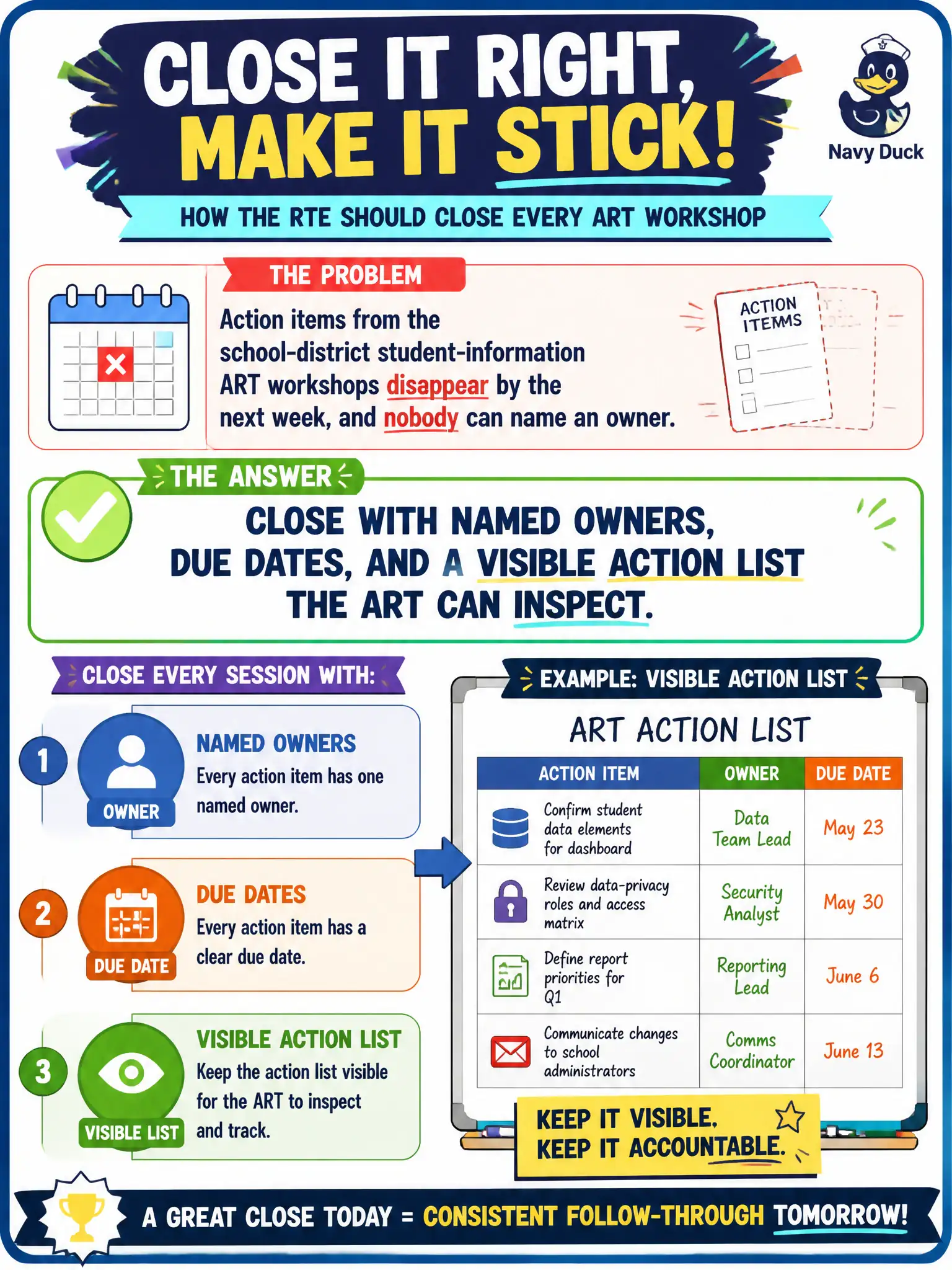
Action items from the school-district student-information ART workshops disappear by the next week, and nobody can name an owner. How should the RTE close each facilitated session?
Select an answer to reveal the explanation.
Short Explanation
A workshop with no owners is a pep rally. Before people leave the student-information session, write the action, the name, and the date where everybody can see it. Follow-up is part of facilitation, not a hope.
Full Explanation
Closing a facilitated session includes visible actions with owners and dates. On the school-district student-information ART, when action items disappear by the next week and nobody can name an owner, the RTE should close each facilitated session with named owners, due dates, and a visible action list the ART can inspect. Follow-through is part of facilitation, not a hope that memory will suffice for SIS cutovers, data fixes, and integration tasks that affect schools. Ending on a high-energy discussion and capturing actions later from memory almost guarantees loss and rework. Filing actions only in the RTE’s private notebook so they are “not lost” hides commitments from the people who must execute them. Converting leftover discussion into unowned PI Objectives without dates confuses unfinished workshop tasks with PI-level outcomes and still lacks ownership. Exam caveat: action lists complement, rather than replace, the Program Board and team backlogs; workshop actions should be linked to the right backlog or impediment path. Operational check: reserve the last ten minutes of every student-information workshop to confirm who does what by when and where the list lives, then review open actions at the next ART Sync.