
The library consortium digital-services ART tries to brainstorm catalog ideas and lock a decision in the same unstructured block of time, and the room stalls. What should the RTE separate?
Select an answer to reveal the explanation.
Short Explanation
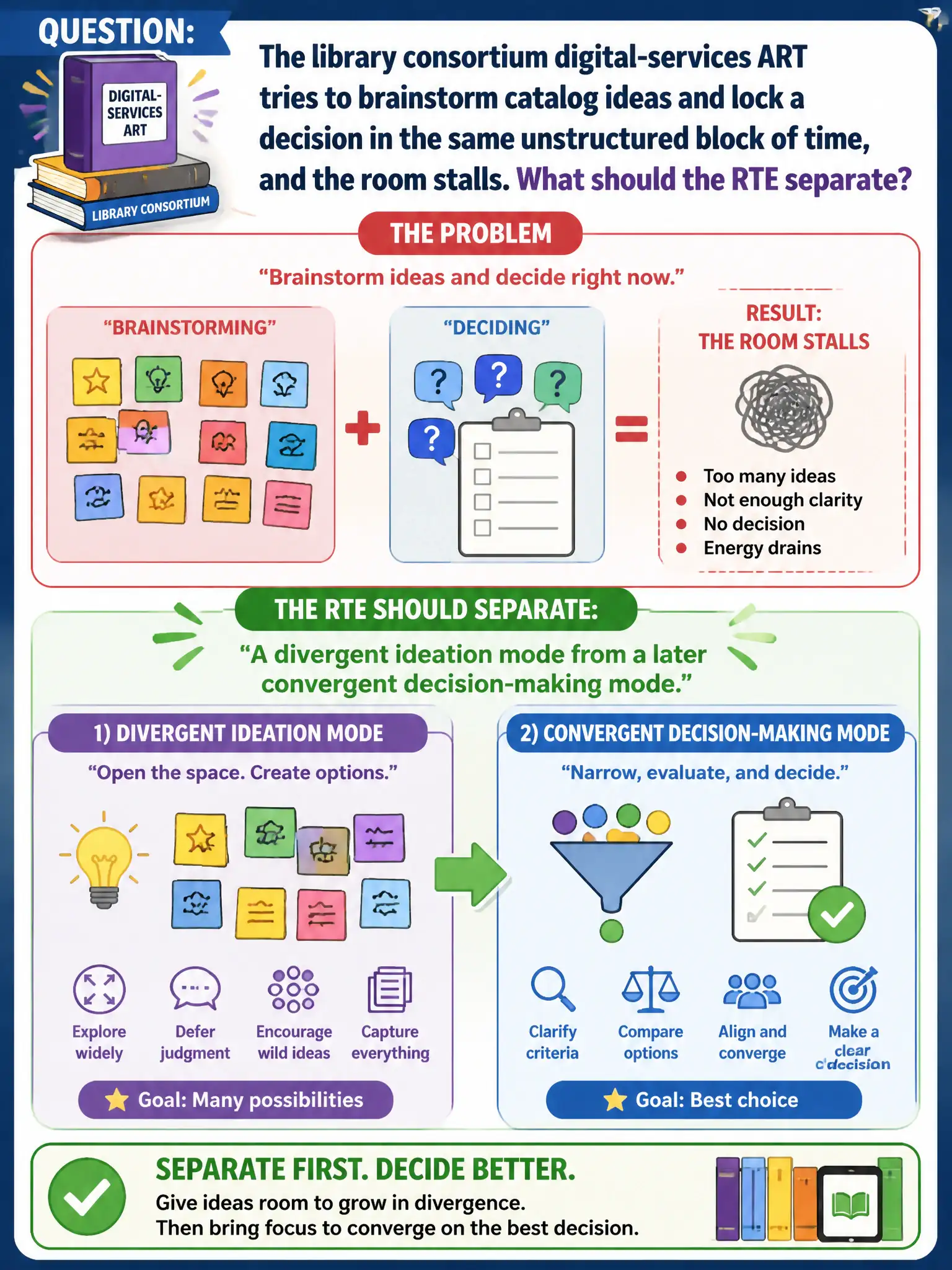
Brainstorming and deciding at the same time is like shelving books while the cart is still rolling in. First diverge—lots of catalog ideas, no judging—then converge to pick and sequence. Two modes, two signs on the wall, one library ART that can actually finish.
Full Explanation
Facilitators separate divergent ideation from convergent decision-making so groups do not critique ideas while they are still being generated, or generate more options after a decision is required. On the library consortium digital-services ART, when the room tries to brainstorm catalog ideas and lock a decision in the same unstructured block and stalls, the RTE should separate a divergent ideation mode from a later convergent decision-making mode. Explicit diverge-then-converge structure gives librarians space to invent, then a clear switch to choose and sequence. Keeping ideation and decision-making mixed so the meeting feels efficient is what causes the stall: judgment kills novelty early and novelty reopens settled choices late. Separating the librarians from the digital team so each group decides alone fragments the ART’s shared catalog mission. Separating the workshop from the ART calendar until a vendor picks the catalog design abandons facilitation and local ownership. Exam caveat: the modes can occur in one session if the facilitator marks the switch visibly; the requirement is separation of purpose, not necessarily two calendar invites. Operational check: post “diverge” then “converge” signs, timebox idea generation without critique, then switch rules for ranking and deciding—confirm the library ART leaves with both a captured idea set and a named decision.