
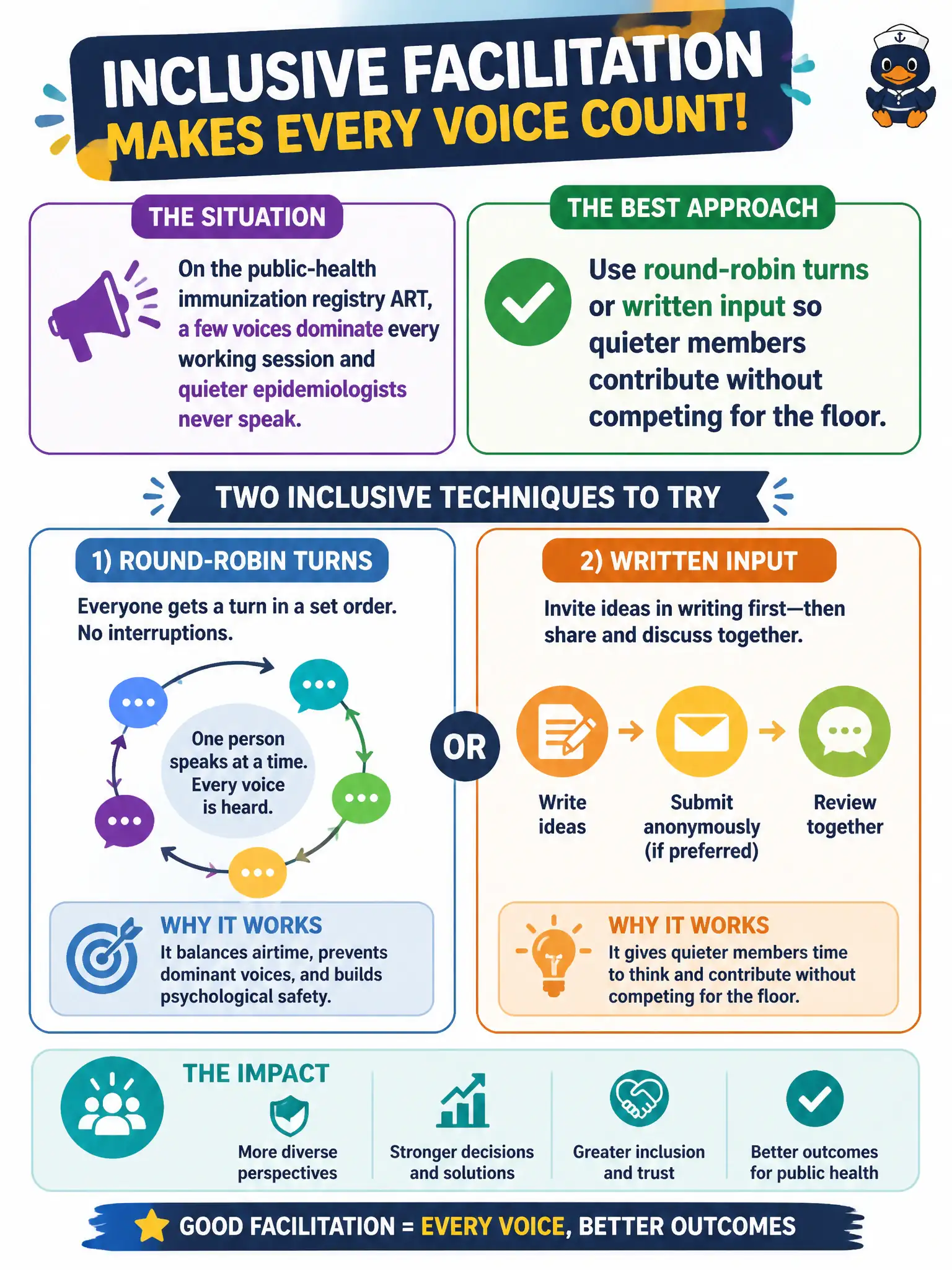
On the public-health immunization registry ART, a few voices dominate every working session and quieter epidemiologists never speak. Which inclusive facilitation technique should the RTE use?
Select an answer to reveal the explanation.
Short Explanation
The loudest epidemiologist is not the whole registry. Round-robin or a two-minute silent write gives the quiet folks a lane that does not require elbowing the mic. The goal is the idea, not the volume contest.
Full Explanation
Inclusive facilitation techniques such as round-robin and written input equalize airtime so expertise reaches the decision. On the public-health immunization registry ART, when a few voices dominate every working session and quieter epidemiologists never speak, the RTE should use round-robin turns or written input so quieter members contribute without competing for the floor. The goal is the idea, not the volume contest, and registry science and clinic operations expertise must enter ART decisions that affect residents. Asking quieter members to send private notes after the meeting so the live session stays fast excludes them from shaping the live decision and treats speed as more important than completeness. Giving speaking rights only to Product Management because they “represent the registry” conflates product authority with scientific and operational expertise. Shortening the meeting until only dominant speakers can fit their points encodes exclusion as efficiency. Exam caveat: inclusion techniques still need a timebox and a decision rule; they are not unbounded talking circles that abandon outcomes. Operational check: in the next registry workshop, run a two-minute silent write plus round-robin share before open discussion, and verify that at least one previously quiet epidemiologist’s point appears on the decision board.