
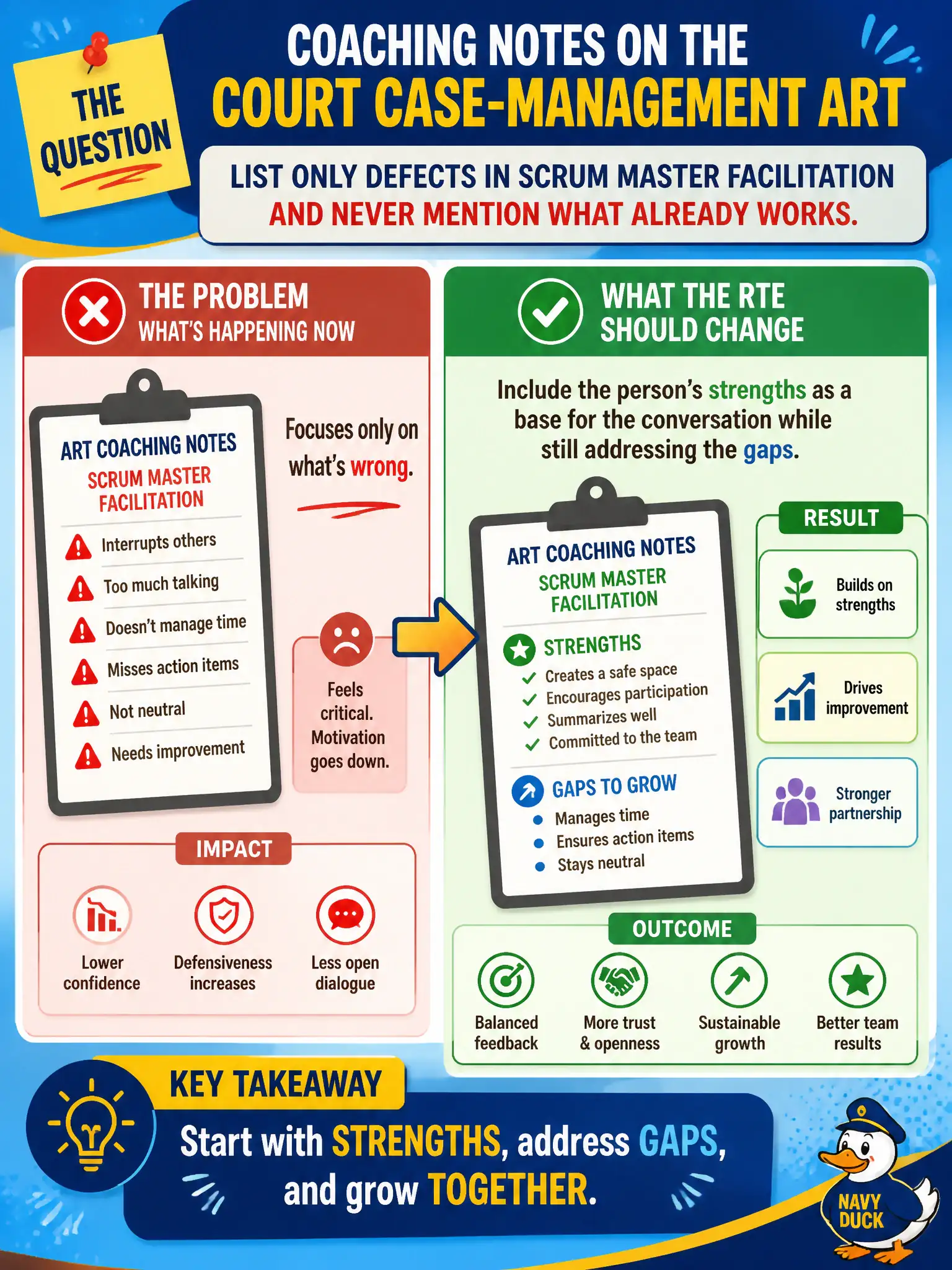
Coaching notes on the court case-management ART list only defects in Scrum Master facilitation and never mention what already works. What should the RTE change?
Select an answer to reveal the explanation.
Short Explanation
If every coaching note on the court ART reads like a punch list, people hide. Strengths-based coaching still names the gaps, but it starts from what already works so the person has something to build on. Fix the wobbly wheel without pretending the rest of the cart is scrap.
Full Explanation
Strengths-based coaching balances development areas with evidence of effective behavior. On the court case-management ART, coaching notes that list only facilitation defects and never mention what already works should change to include the person’s strengths as a base while still addressing gaps. Naming what works gives Scrum Masters something concrete to reuse under docket pressure and reduces defensive reactions that block learning. Keeping a deficit-only list so coaching stays “tough” reduces psychological safety and makes people hide problems rather than experiment in public ART forums. Stopping facilitation coaching to grade only feature throughput for docket teams confuses delivery metrics with coaching technique and ignores the Scrum Master’s actual development need. Replacing 1:1 coaching with a public ranking of Scrum Masters by defect count is shaming, not coaching, and poisons trust across the court ART. Exam caveat: strengths-based does not mean ignoring gaps; it means anchoring change in reusable effective behaviors while naming the gaps clearly and with impact. Operational check: open the next court ART 1:1 with two observed strengths, one specific gap with impact on case-flow or demo quality, and one agreed practice to try in the following ART Sync or System Demo, then inspect that practice afterward.