
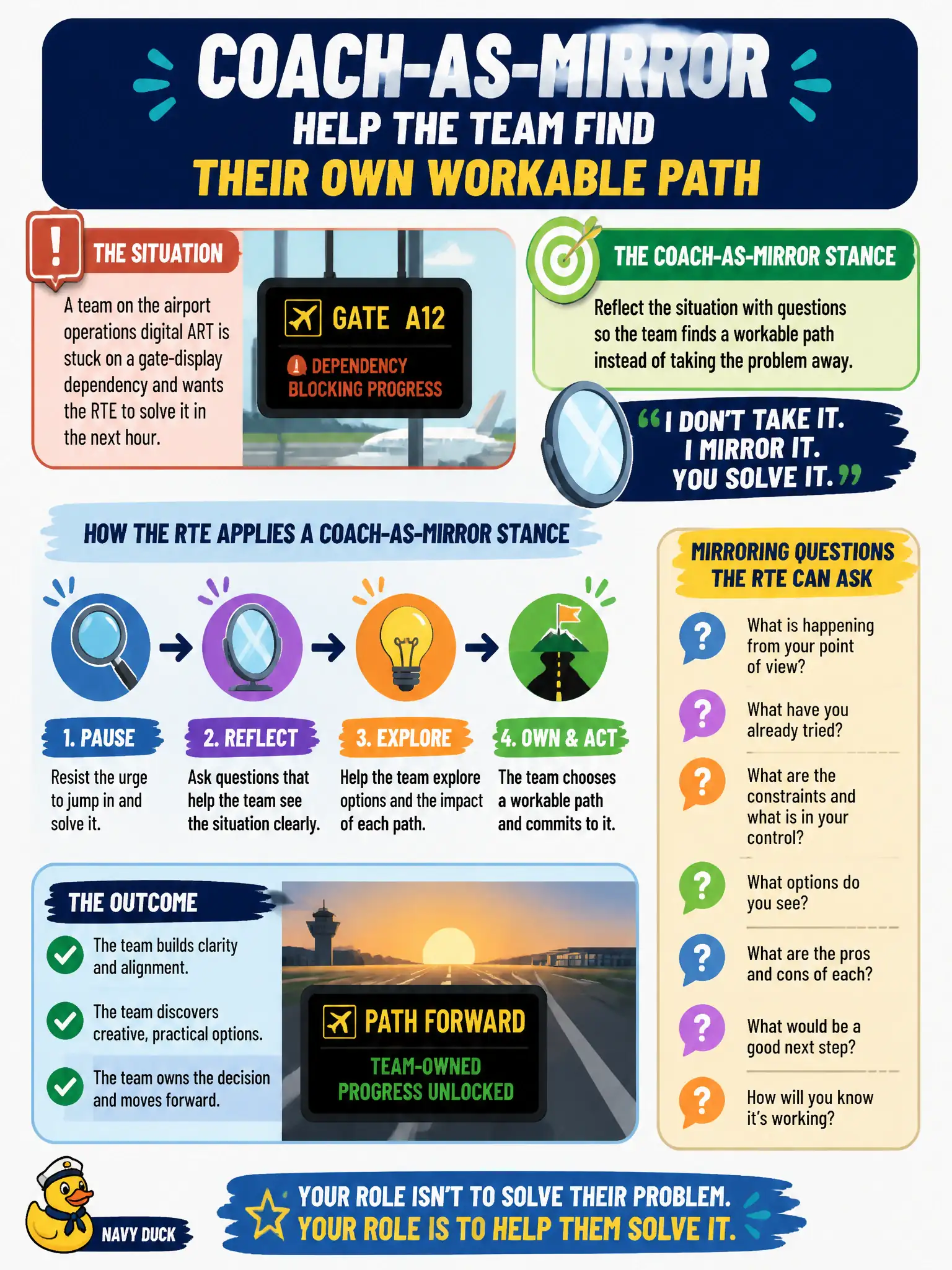
A team on the airport operations digital ART is stuck on a gate-display dependency and wants the RTE to solve it in the next hour. How should the RTE apply a coach-as-mirror stance?
Select an answer to reveal the explanation.
Short Explanation
The airport team wants a hero. The RTE’s job is more like a mirror than a tow truck. Ask what they already see, who else is in the dependency, and what they could try next—then they keep the problem and the learning.
Full Explanation
Coach-as-mirror techniques help teams see the system and generate their own next steps. On the airport operations digital ART, when a team is stuck on a gate-display dependency and wants the RTE to solve it in the next hour, the RTE should reflect the situation with questions so the team finds a workable path instead of taking the problem away. Inquiry keeps accountability with the people closest to the constraint while still allowing the RTE to remove true systemic impediments afterward if needed. Taking the dependency, rewriting the team’s PI Objective, and returning with a finished design creates short-term motion but trains learned helplessness. Escalating immediately to the airport director so the team no longer owns the constraint may be appropriate for a true organizational blocker, but as a first reflex it removes learning and ownership. Adding the item to the ART Kanban as RTE work and pulling it from the team’s backlog converts coaching into personal heroics. Exam caveat: mirror coaching is the stance for thinking problems; it is not a ban on RTE impediment removal when the team cannot cross an organizational boundary alone. Operational check: ask what is blocking, who owns the other side of the dependency, and what the smallest experiment is this iteration; capture the team’s chosen path on the airport ART board before offering to escalate.