
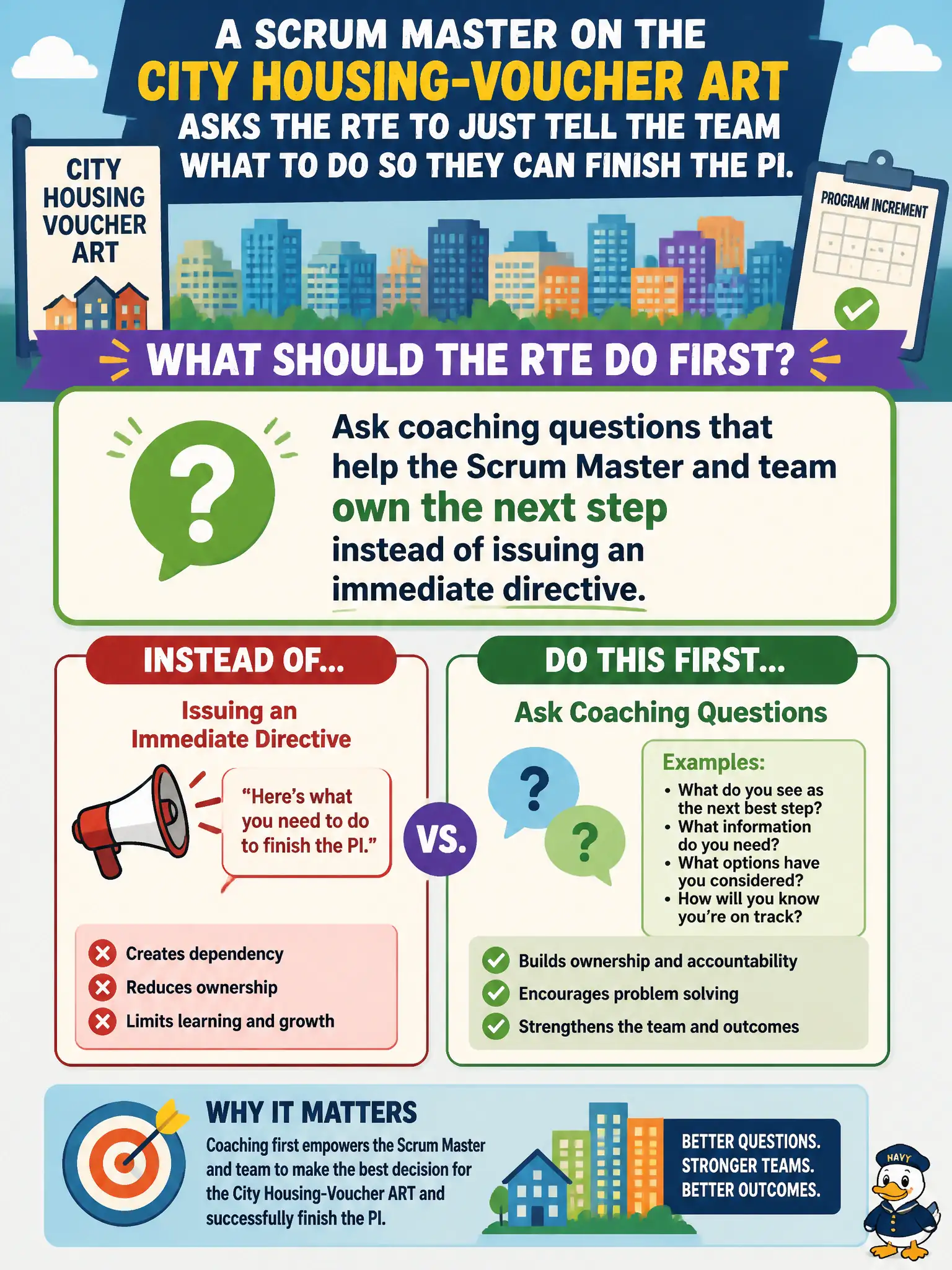
A Scrum Master on the city housing-voucher ART asks the RTE to just tell the team what to do so they can finish the PI. What should the RTE do first?
Select an answer to reveal the explanation.
Short Explanation
When someone on the housing-voucher train says “just tell us what to do,” it is a trap with a bow on it. Coaching is more like handing them the flashlight than driving the van. Start with questions that put ownership back on the Scrum Master and the team; a snap directive teaches them to wait for orders.
Full Explanation
RTE coaching on a city housing-voucher ART favors inquiry and ownership over command-and-control. When a Scrum Master asks the RTE to simply tell the team what to do, the first move is coaching questions that help the Scrum Master and team own the next step rather than an immediate directive. Powerful questions surface the real constraint—skill, dependency, clarity, or fear—and keep accountability with the people who must live with the outcome through the PI. Publishing a daily task list and requiring the Scrum Master to enforce it until velocity recovers teaches learned helplessness and converts servant leadership into task management. Removing the Scrum Master because they requested direction treats a coaching opportunity as a role failure and destabilizes the ART mid-PI. Converting the housing-voucher ART into a command-and-control project office abandons Agile team ownership just when empiricism is needed. Exam caveat: RTEs may still escalate systemic impediments or set boundaries, but directing day-to-day team work is not the default coaching stance. Operational check: in the next 1:1, ask what the team already tried, what evidence they have, and what experiment they will run this iteration; leave with a named owner and a visible next step on the housing-voucher board. Municipal benefits delivery improves when facilitators grow capacity instead of waiting for RTE orders.