
Two new Business Owners join the state DMV licensing ART and immediately reopen PI operating agreements the teams treated as settled. What should the RTE anticipate?
Select an answer to reveal the explanation.
Short Explanation
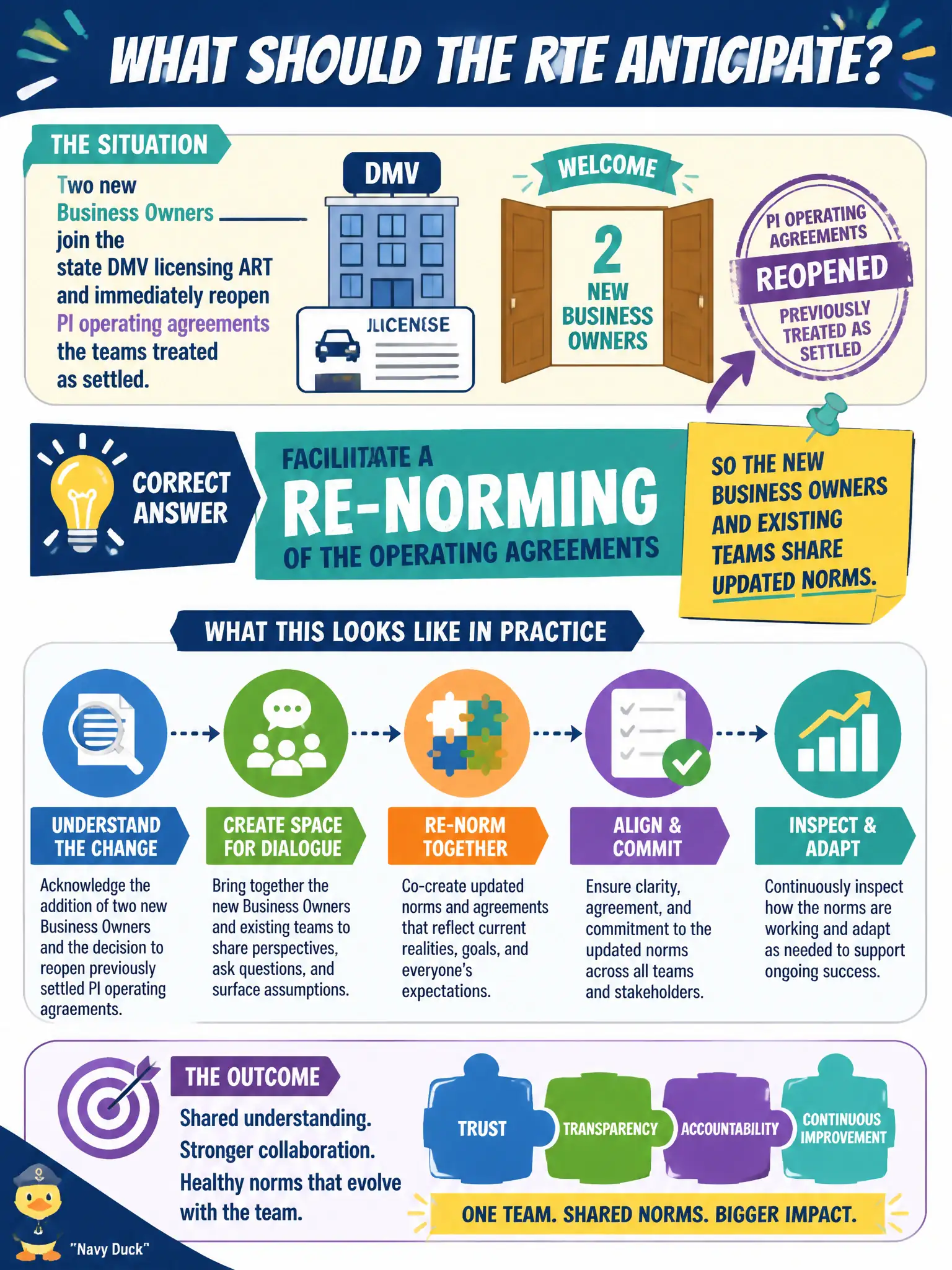
When new heavy-hitters walk into the DMV licensing train, yesterday’s handshake is not automatically today’s handshake. Groups re-form a bit; they have to re-norm the rules of the road. Treat the reopened agreements as a chance to rewrite the house rules with the new voices in the room, not as a mutiny.
Full Explanation
When influential new members join a municipal ART—especially Business Owners on a state DMV licensing train—group dynamics often regress until working agreements are renegotiated. The correct response is to facilitate explicit re-norming of PI operating agreements so new Business Owners and existing teams share updated norms. That preserves the ART design while restoring a living social contract for how the train plans, syncs, and decides. Freezing prior agreements and silencing new Business Owners until the next Inspect and Adapt treats yesterday’s handshake as immutable and undermines Business Owner engagement that SAFe expects during the PI. Dissolving the licensing ART because membership changed confuses role churn with value-stream redesign; membership turnover is normal and does not by itself invalidate ART topology. Escalating to Lean Portfolio Management for a binding policy that replaces ART-level agreements displaces local working agreements with portfolio edicts and skips facilitation. Exam caveat: forming–storming–norming is not a one-time ladder; re-norming after heavyweight joiners is expected coaching work, not proof the ART failed. Operational check: schedule a short facilitated agreements session, capture revised norms where the DMV ART can see them, and confirm both new Business Owners and team representatives can restate how decisions and dependencies will be handled this PI. In civic licensing operations, record the update in the ART’s operating-agreement artifact so future facilitators inherit the same rules.