
Housing prepares unit meshes so a later PreviewSurface network can read per-face identifiers for review viz. What should authors add now?
Select an answer to reveal the explanation.
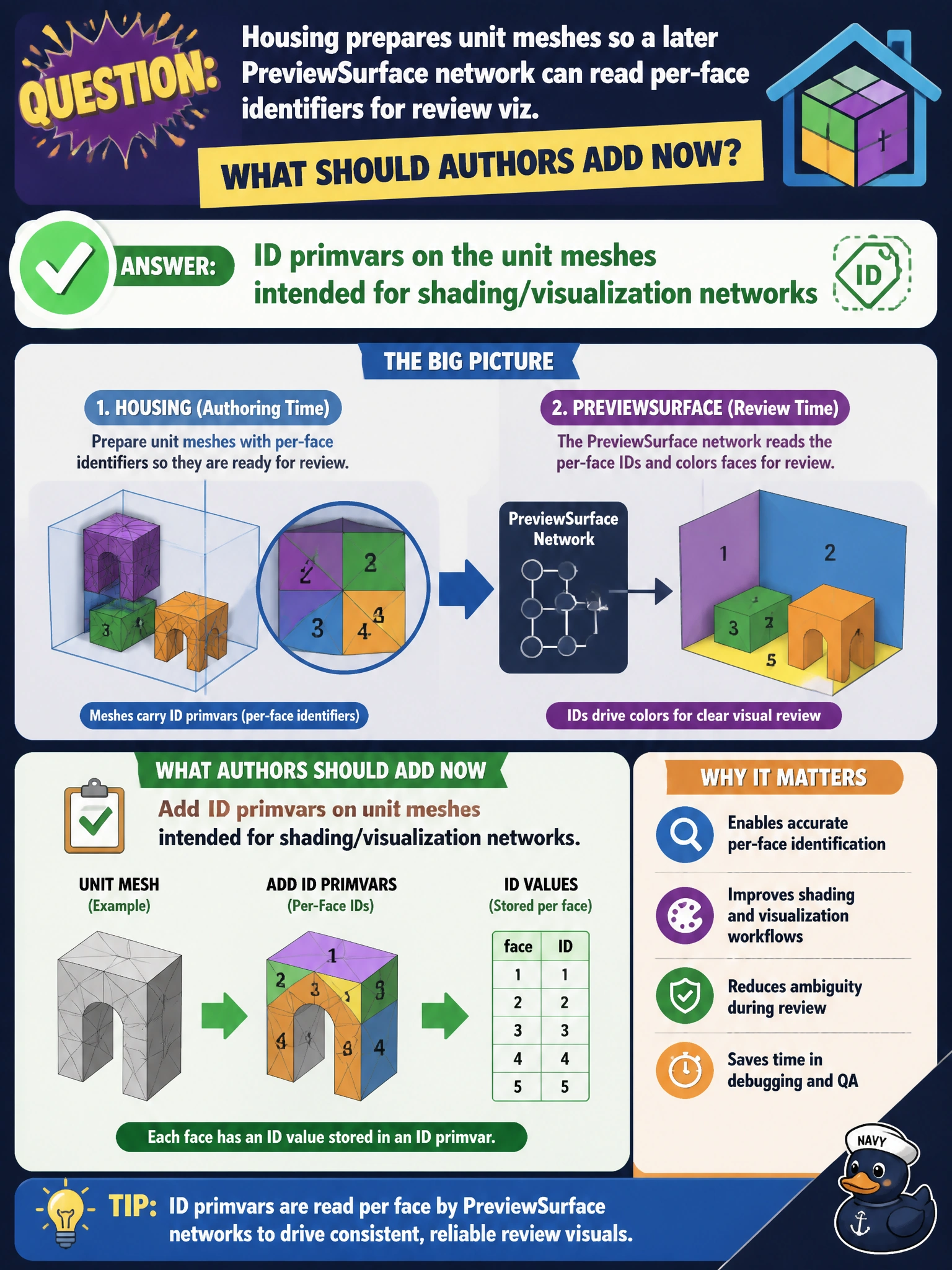
Short Explanation
Lay down the ID primvars like unit stickers before the shader crew arrives—PreviewSurface can read them later for review coloring. Empty extents alone will not feed the network.
Full Explanation
Housing review pipelines often delay full PreviewSurface wiring until viz engineers assemble shading networks, but authors must prepare the mesh data those networks will read. Adding ID primvars on the unit meshes intended for shading and visualization networks lays down per-face or per-element identifiers now so a later PreviewSurface graph can drive review coloring, selection highlighting, or finish classification without re-exporting geometry.
Only empty extents with no primvars give bounding boxes but no ID channels for shading networks to sample. Muting every material layer in the package hides looks and does not create the ID primvars housing review needs. Absolute Windows paths in place of mesh primvars confuse filesystem location with mesh attribute data and break portability besides failing to feed a primvar reader.
Exam caveat: ID primvars should be stable across LODs and unit variants when possible; if face IDs change after remeshing, networks that keyed off old IDs will mis-color units even though “ID primvars exist.” Document which primvar name the housing PreviewSurface template expects.
Operational check: author ID primvars on a sample unit mesh, confirm they appear in usda/usdcat, connect a temporary PreviewSurface reader that maps IDs to review colors, validate viz in the housing viewer, remove the primvars on a clone and confirm the network cannot classify faces, then keep ID primvars in the unit packaging checklist.