
During a planned site failure test, an administrator needs to recover protected AHV VMs from a Nutanix DR relationship that uses asynchronous replication with a 15-minute RPO. Which source provides usable recovery points for the failed site?
Select an answer to reveal the explanation.
Short Explanation
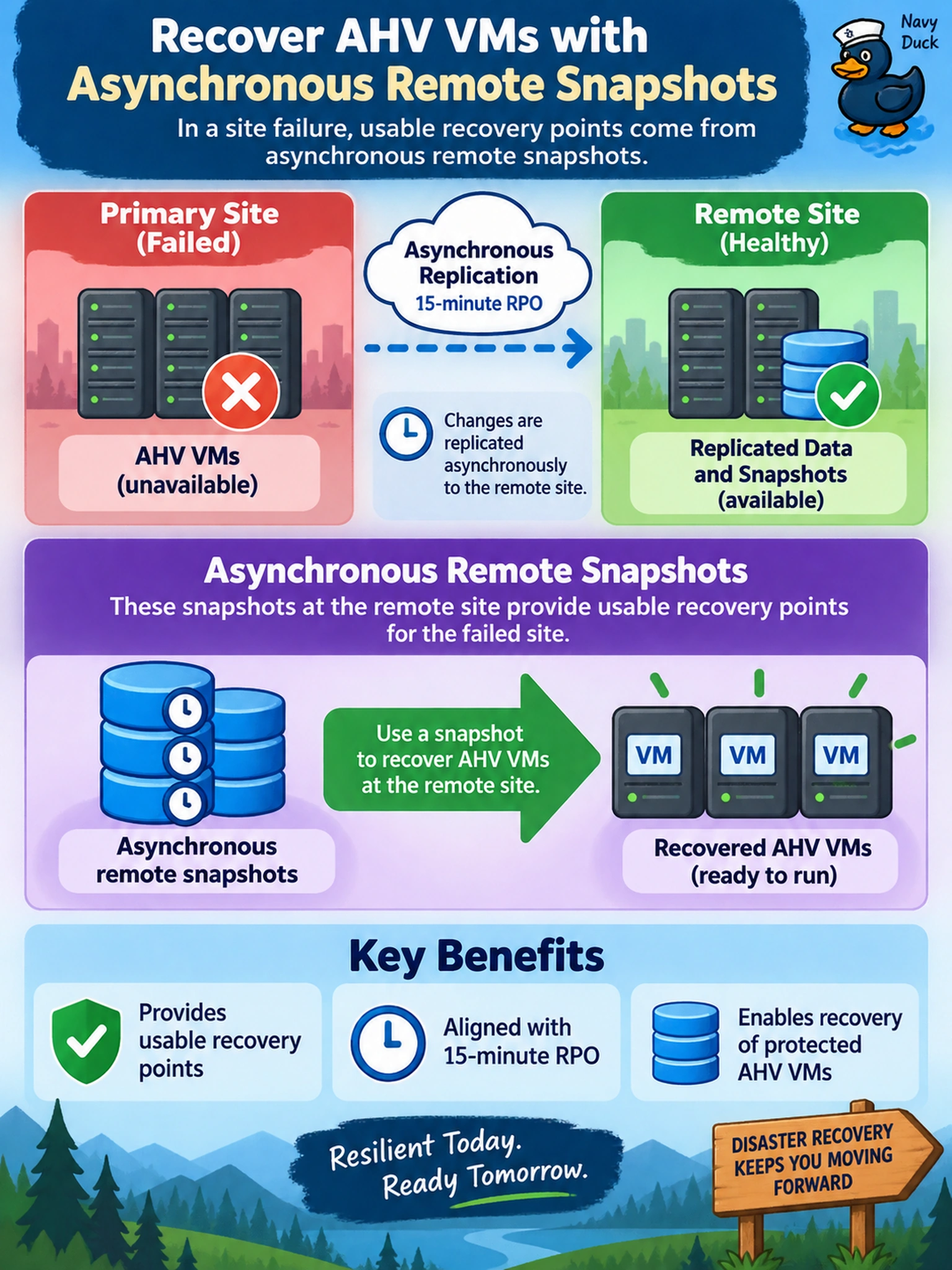
Think of asynchronous remote snapshots as copies you send across town every 15 minutes. If your site goes dark, you still have those copies to roll back to, but not the last few seconds. NearSync and Metro are tighter tools, not the async snapshot recovery path you are using here.
Full Explanation
Asynchronous protection domains create remote snapshots on the target cluster at the configured schedule, and those snapshots are the recovery points used when the source site is unavailable. During failover, an administrator selects a remote snapshot, restores or powers on the protected VMs from it, and accepts the data loss bounded by the replication interval. NearSync continuous journaling is a different mechanism that captures write activity more frequently to reduce recovery point objective, but it is not the asynchronous snapshot set being relied on in this scenario. Synchronous Metro availability mirrors data across sites with very low latency and supports near-zero recovery point objectives, so it is not the asynchronous snapshot source described. Local snapshots remain on the source cluster and cannot be used after total site failure because the cluster that stores them is unavailable. Exam caveat: distinguish recovery point source from replication mode; async snapshots are scheduled remote copies, while NearSync and Metro provide tighter consistency and different failover behavior. Operational check: verify remote snapshot age in Prism Central before declaring failover readiness, then test a recovery from the oldest acceptable snapshot to confirm the restore path works.