
An application uses a NearSync protection domain in Prism Central. After an unexpected site failure, you must tell the app owner what data loss to expect when recovering from the replicated copy. Which statement describes the recovery point objective?
Select an answer to reveal the explanation.
Short Explanation
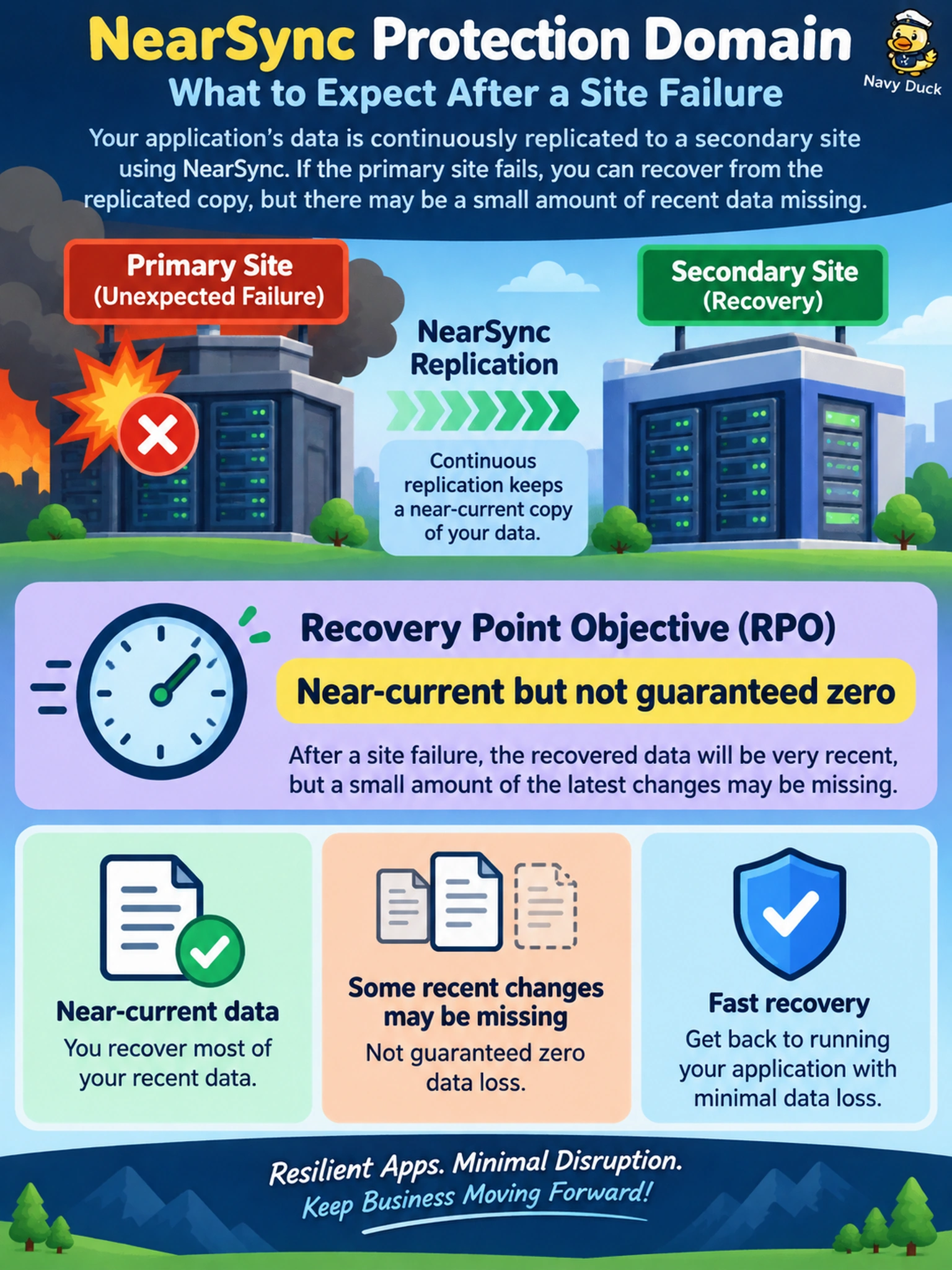
Think of NearSync like a very fast courier, not a synchronous mirror. It gets you very close to now, but the last few writes can still be in transit when the site drops. You should promise near-current data, not a guaranteed zero RPO.
Full Explanation
NearSync is a low-latency asynchronous replication mode designed to keep the recovery point close to the present by continuously transferring changed blocks between sites. Because it does not require the primary write path to wait for every remote acknowledgment, the replicated copy can lag by a small amount during bursts, network delay, or CVM processing, so the recovery point is near-current rather than mathematically zero. A zero RPO claim belongs to synchronous Metro availability, where writes are acknowledged only after the peer has persisted them, not to NearSync. An exact fixed age, such as one minute, is also incorrect because replication lag depends on write rate, network conditions, and cluster load, so the last recoverable point can be shorter or longer than a nominal target. Treating the recovery point as the last scheduled asynchronous snapshot is wrong when NearSync is enabled; snapshots are periodic points, while NearSync maintains a continuously replicated copy whose recovery point is tied to the latest replicated state, not the previous snapshot schedule. Exam caveat: do not conflate NearSync with Metro; NearSync is near-zero, while Metro provides zero RPO for supported workloads. Operational check: review the protection domain replication lag and last recovery point in Prism before reporting the expected data loss to the application owner.