
A production AHV cluster replicates to a remote Nutanix cluster over a constrained WAN. The business requires a 15-minute RPO, and replication traffic must not compete with production VLAN traffic. Which replication path should an administrator select?
Select an answer to reveal the explanation.
Short Explanation
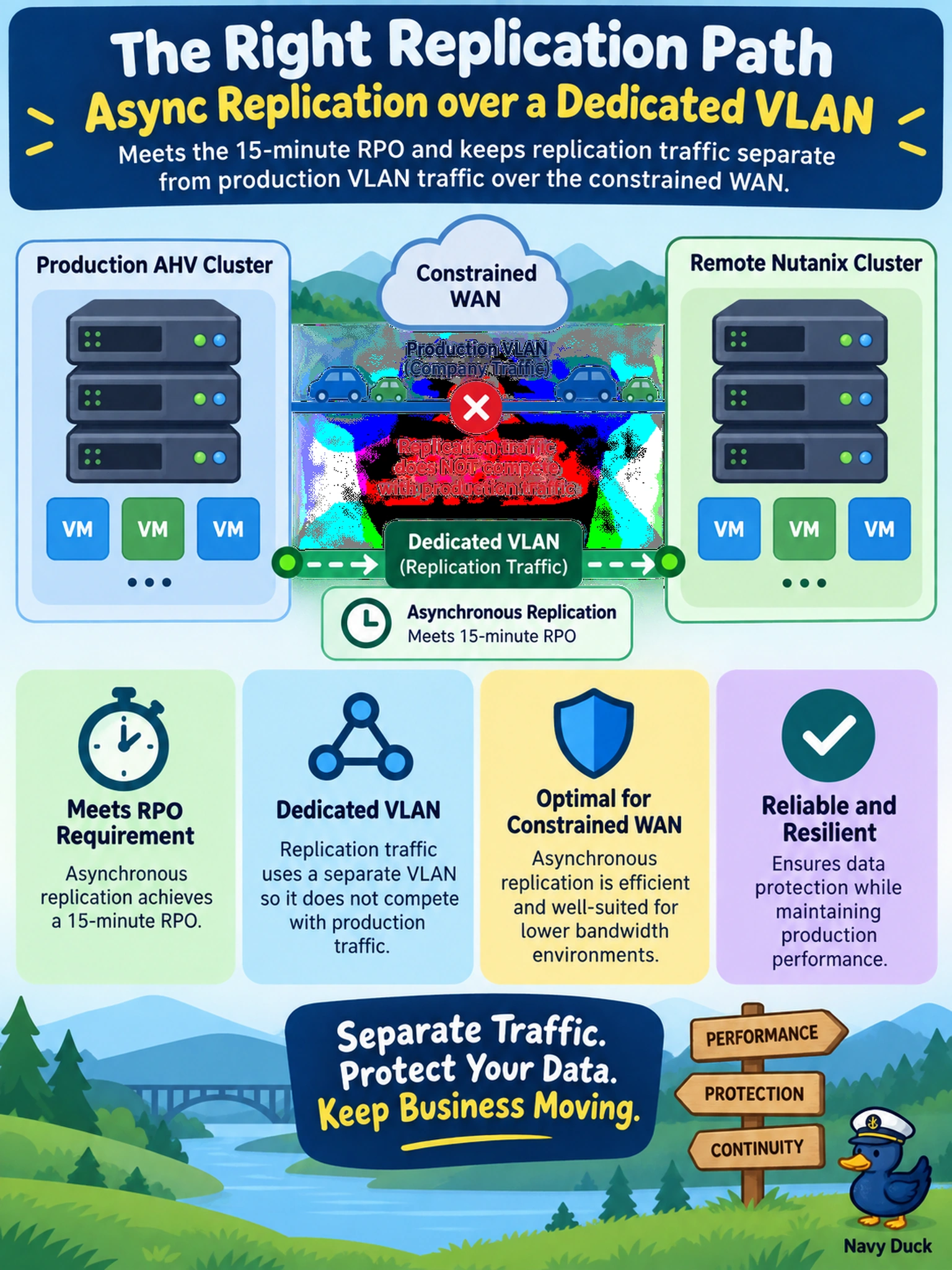
Think of replication traffic like a guest car: if it shares your driveway, it slows everyone down. A dedicated VLAN gives it its own lane, and async replication gives you the 15-minute RPO without demanding Metro-grade links. Pick async on a separate VLAN, and you meet the recovery target without fighting production traffic.
Full Explanation
Async replication schedules periodic data movement, so it can satisfy a 15-minute RPO without requiring the low latency and sustained throughput that synchronous modes demand. Placing that traffic on a dedicated replication VLAN isolates WAN and storage network bandwidth from production I/O, which is the key requirement when the path must remain predictable during normal operations. NearSync replication over a shared production VLAN may improve RPO, but it still consumes the same network segment as user and application traffic, so it does not provide the required isolation. Metro availability is intended for zero-RPO synchronous operation between sites with strict latency and bandwidth conditions; using it over a constrained production path is unsuitable and does not solve traffic separation. Async replication on the production VLAN can meet the time target, but it competes with production traffic and can cause contention or throttling that degrades both workloads and recovery consistency. Exam caveat: match the recovery objective first, then choose the network path that protects production traffic from replication load. Operational check: verify the replication VLAN or VLAN tag is configured on both sites, confirm async schedule intervals meet the RPO, and monitor WAN utilization during replication windows.