
Your AHV clusters in Site A and Site B are configured for Metro Availability with active-active VMs. During maintenance, the inter-site network partitions. You must prevent both sites from continuing to write to the same VMs. Which configuration provides the required protection?
Select an answer to reveal the explanation.
Short Explanation
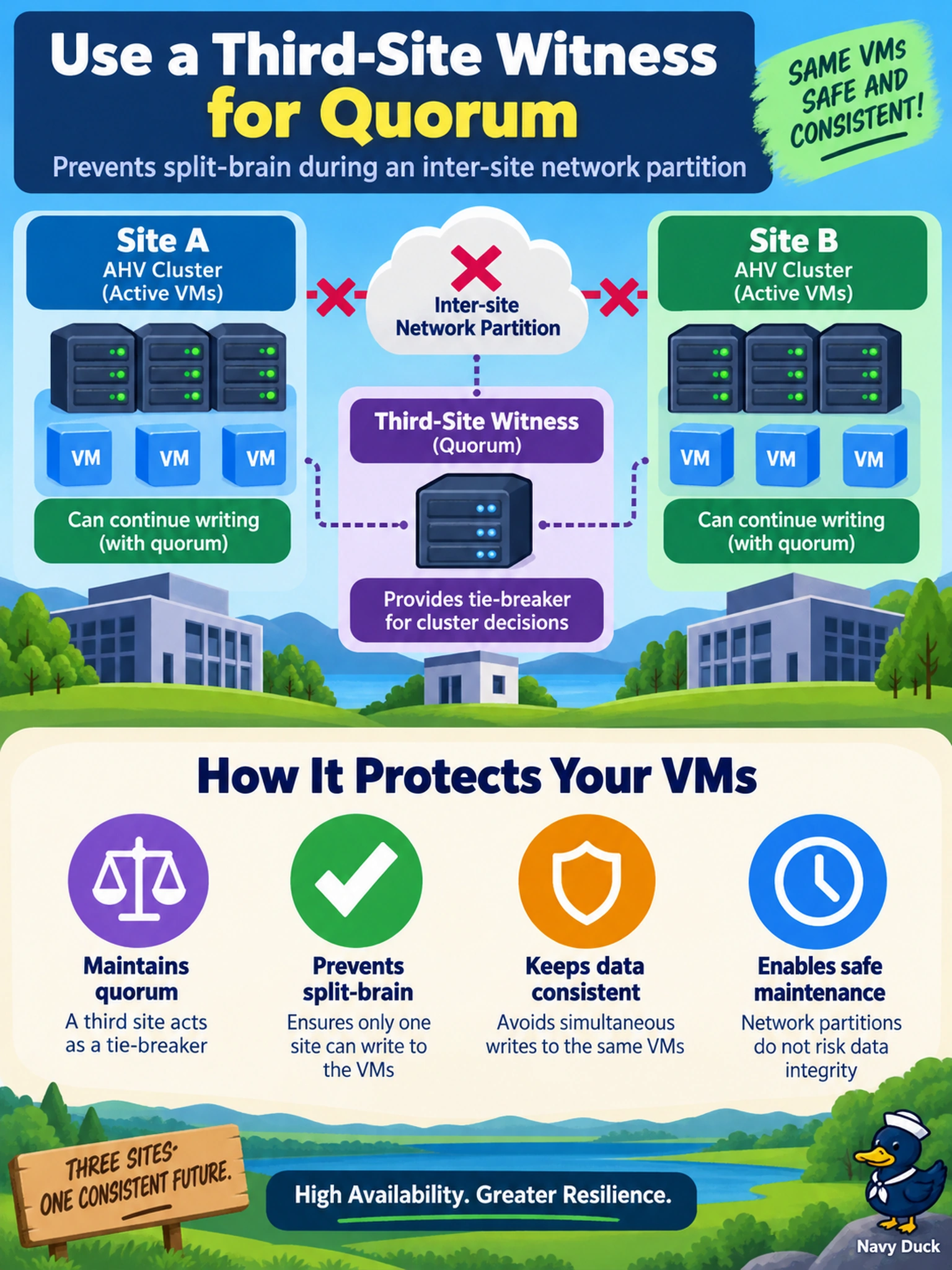
Think of Metro like two people writing in the same notebook. If the phone line drops, you need a third referee to decide who keeps writing; that's the witness. Without it, both sites might write and you get split-brain data loss.
Full Explanation
Metro Availability keeps the same VM available at two sites, so a partition creates a split-brain risk: both clusters may decide the peer is unavailable and resume writes. A third-site witness supplies quorum, allowing only the site that can reach the witness to continue accepting writes while the other is fenced. This is the control that prevents unsafe concurrent writes and possible data loss. The witness is not a data copy; it is a tie-breaker that determines which Metro site may remain active when peer connectivity is lost. NearSync is a low-RPO asynchronous replication method; it reduces recovery point objective but does not provide synchronous tie-breaking between two active sites. Increasing asynchronous replication bandwidth only affects replication lag and cannot prevent both sites from accepting writes during a partition. Host anti-affinity rules influence VM placement on hosts or clusters, but they do not establish a quorum decision for Metro failover. Exam caveat: Metro availability depends on quorum and witness health, not just replication speed. Operational check: verify the witness is reachable from both Metro sites and review Metro health before maintenance.