
A protection domain uses async replication with snapshots every 1 hour. The most recent snapshot replicated 20 minutes after creation. What approximate RPO should you quote?
Select an answer to reveal the explanation.
Short Explanation
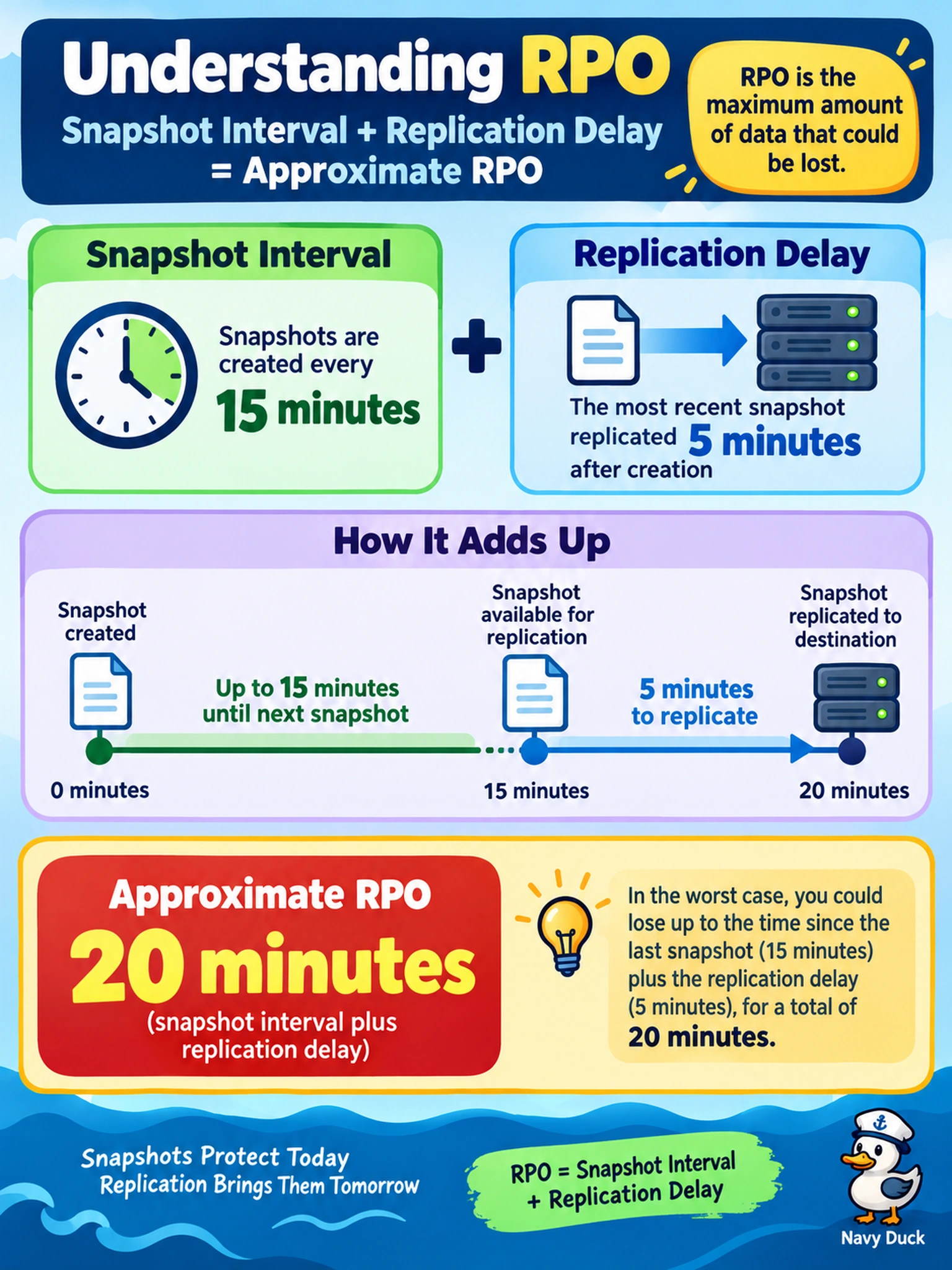
Think of async RPO as the worst-case gap: the time since the last snapshot plus the time that snapshot took to reach the other site. With hourly snapshots and a 20-minute copy, you're looking at about 80 minutes. Don't quote just the schedule while the replica's still in transit.
Full Explanation
Async replication in Nutanix protection domains is driven by scheduled snapshots, and the recovery point you can actually use after a site loss is the most recent snapshot that has finished replicating to the remote cluster. With a one-hour schedule, a write made just after a snapshot isn't captured until the next one, up to 60 minutes later. That snapshot then needs about 20 minutes to reach the remote site, so in the worst case the newest usable remote recovery point is about 80 minutes old. Quoting only the 60-minute interval assumes the snapshot is available at the DR site the instant it's taken, which ignores transfer time. Quoting only the 20-minute replication delay assumes snapshots are continuous, which is not how scheduled async works. Doubling both values has no basis in the replication model. Note that one hour is the shortest async schedule; tighter RPOs move to NearSync, which ships lightweight snapshots every 1 to 15 minutes. Exam caveat: if the stem gives replication lag, add it to the interval; if it gives only the schedule, the interval is the baseline. Operational check: review the protection domain schedule and recent replication durations in Prism, then compare the calculated worst case with the business RPO.
Prefer to study offline? Printable PDF study book + test engine ($7.50, unofficial). These questions stay free here.