
An administrator must replicate a protection domain to a remote Nutanix site over a WAN link with 80 ms latency. The business tolerates a 15-minute RPO and cannot accept a synchronous commit path. Which replication mode best fits this DR design?
Select an answer to reveal the explanation.
Short Explanation
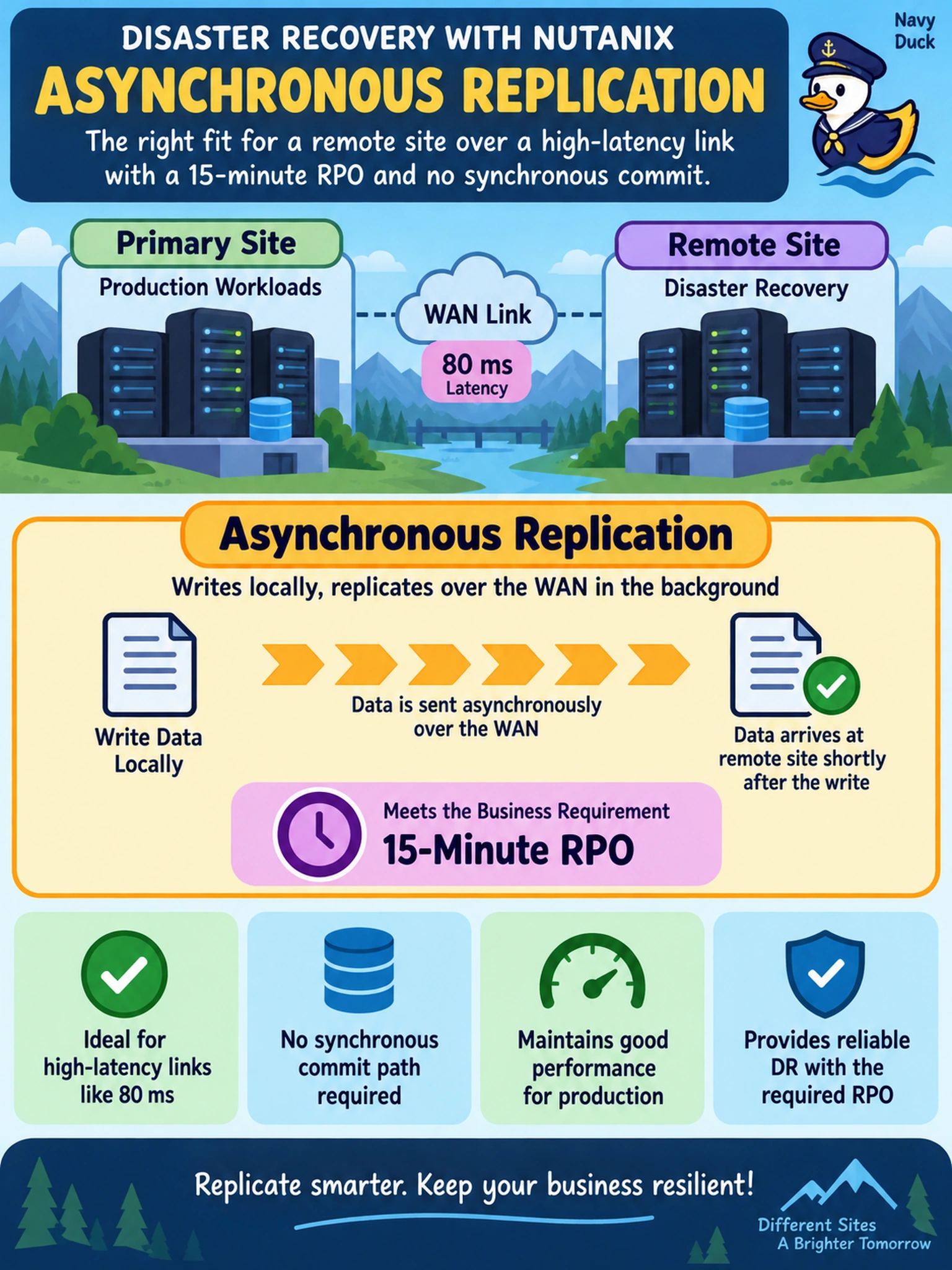
Think of async like emailing a copy: the app doesn't wait for the far site to acknowledge before moving on. That makes it tolerant of high latency and larger RPOs, while NearSync and Metro expect much tighter round-trip times. You pick async when distance and latency are real constraints.
Full Explanation
Asynchronous replication sends write acknowledgements back to the primary AHV workload without waiting for a durable acknowledgement from the remote site, so the primary path is constrained by local storage latency rather than WAN round-trip time. That makes it suitable for high-latency links and relaxed RPOs, because replication can continue even when the remote site is slower. NearSync replication is designed for much lower RPOs and requires a tighter network path; its acknowledgement model is closer to synchronous behavior and is not intended for high-latency WAN links with relaxed RPOs. Metro availability provides synchronous replication between sites for continuous availability, which depends on low latency and strict network requirements; using it across a distant WAN would degrade VM performance or cause write pauses. A witness-based quorum design does not remove the need for low latency in Metro, because the data path still requires synchronous replication. Exam caveat: choose the mode by latency, RPO, and distance, not by whether a remote site exists. Operational check: confirm measured RTT and application RPO before selecting the replication mode.