
A team is creating a Nutanix protection domain for a multi-tier application that includes web, application, and database virtual machines. They must ensure that local snapshots and remote replication can recover the application as a coordinated set. How should the virtual machines be grouped into the protection domain?
Select an answer to reveal the explanation.
Short Explanation
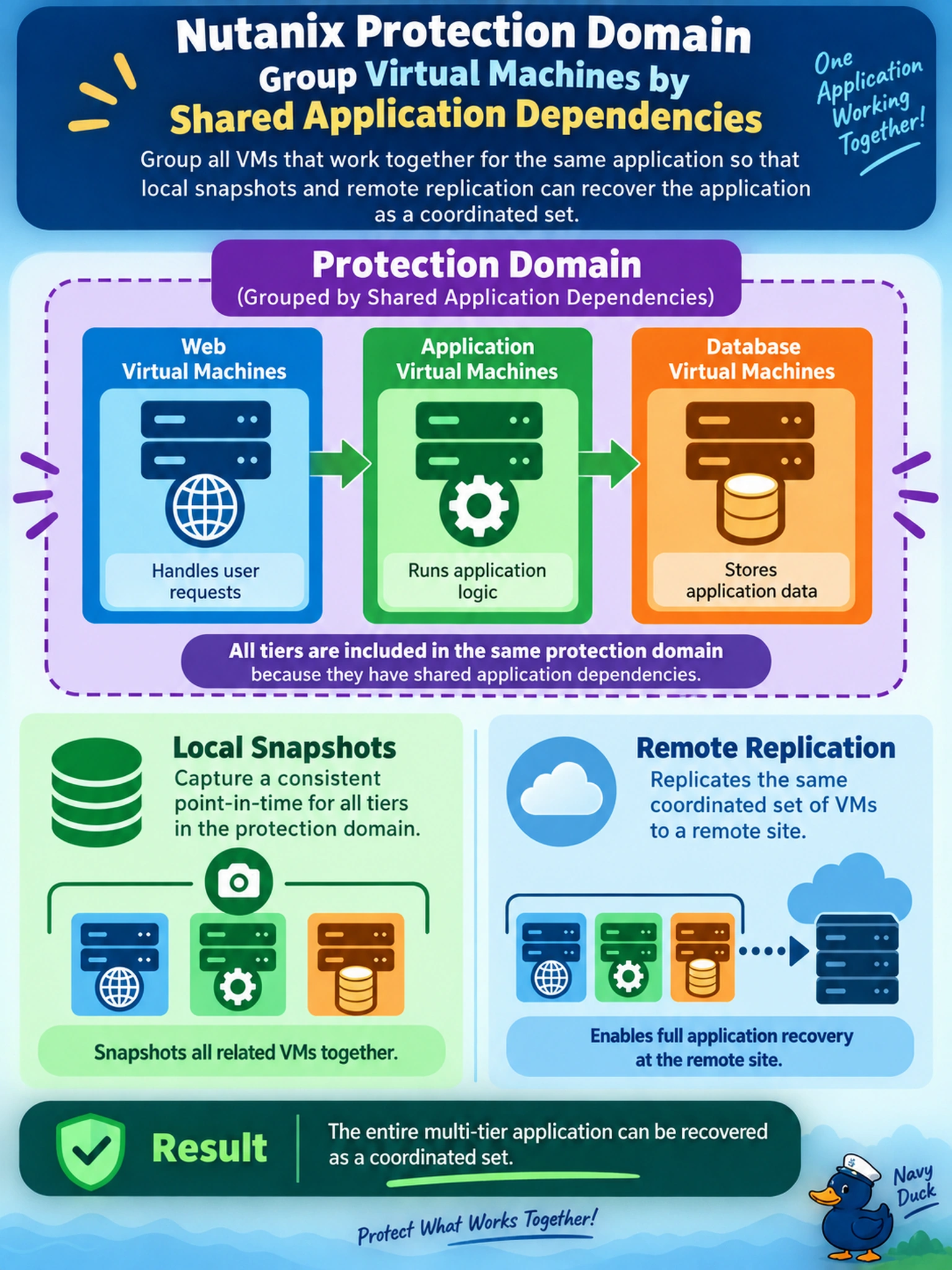
Think of a protection domain like a family photo: you want the people who move together in the frame. If you group VMs by name or OS, you'll capture strangers and miss the database that the app really needs. You group by dependency so snapshots and failover recover the whole app as one unit.
Full Explanation
A protection domain is a recovery and replication boundary: the VMs inside it are snapshotted, replicated, and recovered as one coordinated set. For a multi-tier application, the web, application, and database VMs share a recovery dependency because the front-end tiers are not useful without the data tier they serve. Grouping by shared application dependencies creates one recovery boundary for local and remote snapshots, so a recovery point contains the members that belong together. Naming or template grouping is administrative, not dependency-based; names change, templates are reused, and unrelated systems can share prefixes. OS grouping reflects similar guest images, not data relationships, so a Linux web server may belong to a different application than a Linux database. Host or CVM grouping reflects current placement, which can move for load balancing or maintenance, and does not describe which workloads must fail over together. Exam caveat: protection domains provide coordinated recovery for members, but application consistency may still require quiescence or application-aware processing where supported. Operational check: inventory each application, identify VMs that must fail over together, then validate that every dependent VM is in the same protection domain and unrelated VMs are excluded.