
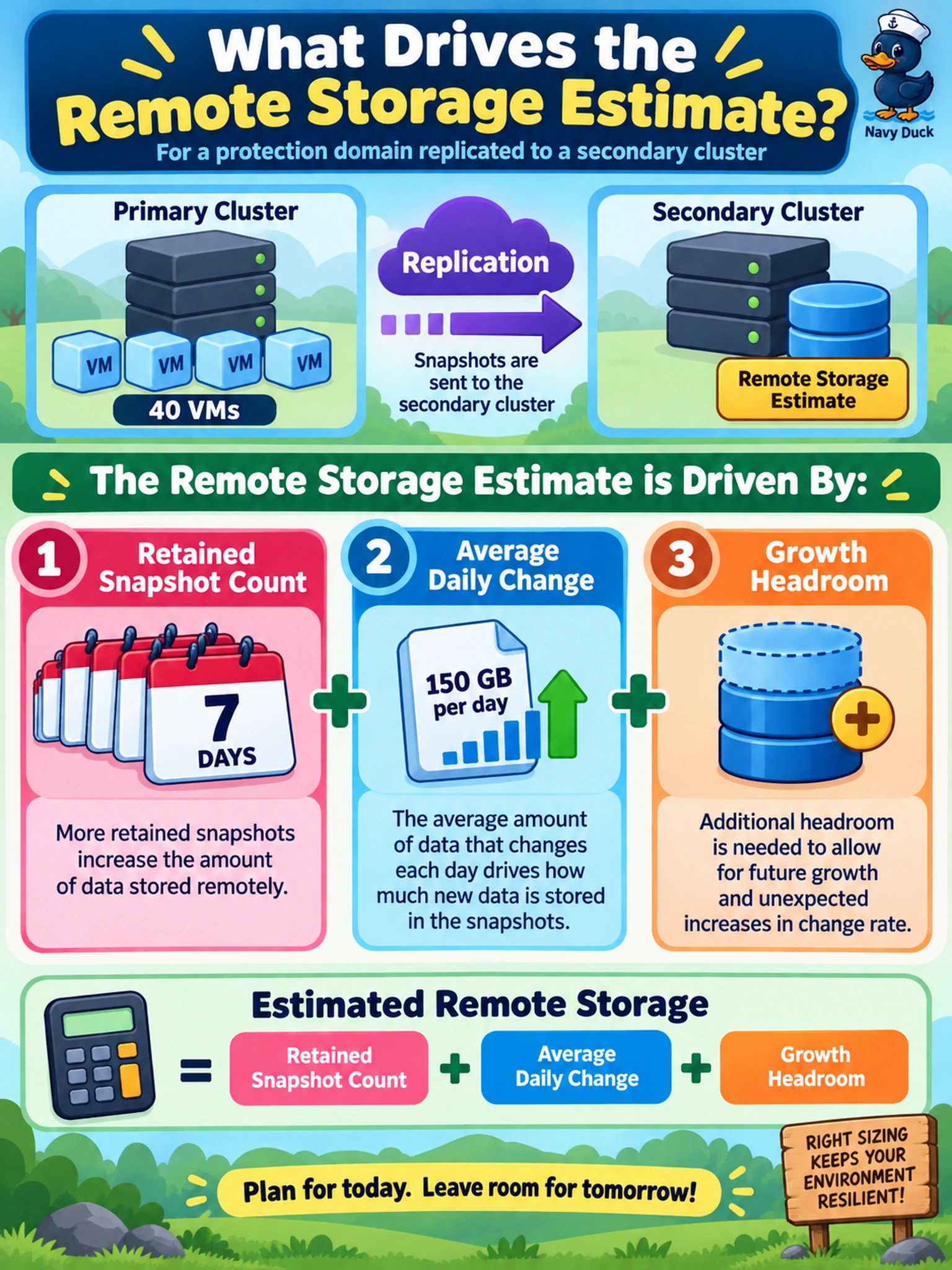
A Nutanix admin designs remote capacity for a protection domain replicated to a secondary cluster. The PD contains 40 VMs, daily snapshots retained for 7 days, and the workload reports 150 GB/day change. What should drive the remote storage estimate?
Select an answer to reveal the explanation.
Short Explanation
Think of remote snapshots like a photo album: you're paying for the pictures you keep, not just the people in the photos. If you retain seven days of changes, you need enough space for those daily deltas plus room for the album to grow. Don't just look at the current VM size and call it good.
Full Explanation
Remote protection capacity is a retention calculation, not a copy of the source footprint. When a protection domain replicates asynchronously, each remote snapshot represents data that changed since the previous snapshot, so retained snapshot count, average daily change, and growth headroom drive secondary storage use. If the workload changes 150 GB daily and seven snapshots are retained, the remote site must hold those deltas plus margin. Capacity planning that uses only the protected VMs' current logical size is wrong because snapshots are not free metadata references; retained snapshots can reserve changed blocks. Sizing from the source cluster's total provisioned capacity is wrong because replication does not require the remote site to mirror unused provisioned space or unrelated local disks. Sizing from VM count multiplied by CVM memory is wrong because CVM memory is not the capacity driver for snapshot retention; storage deltas and retention are. Exam caveat: exam questions may use logical size, provisioned size, or change rate as decoys, so distinguish remote snapshot capacity from source cluster sizing. Operational check: calculate retained snapshots times observed daily change, add growth margin, and compare against remote container free capacity.