
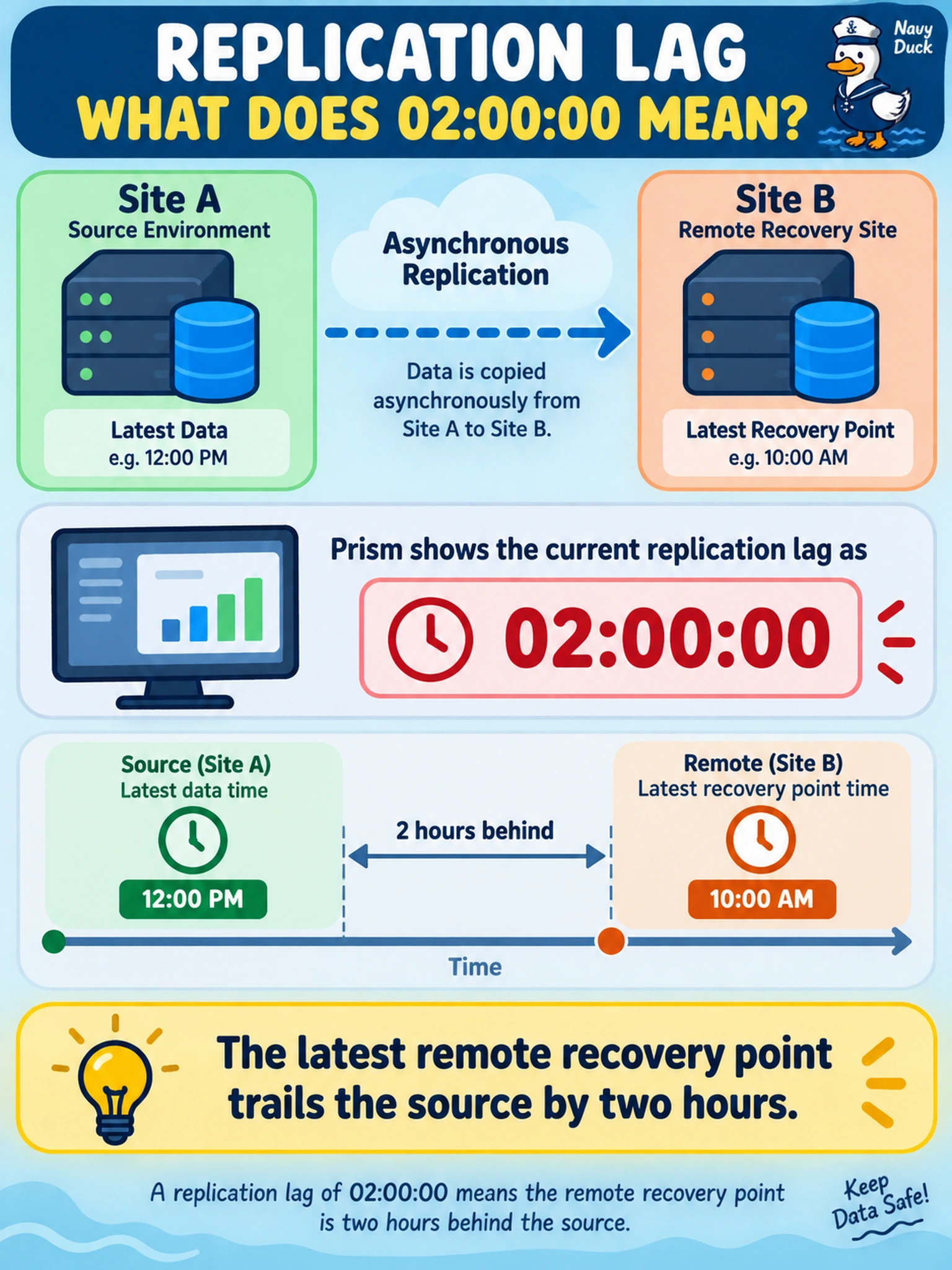
Your protection domain replicates asynchronously from Site A to Site B. Prism shows the current replication lag as 02:00:00. What does this value indicate about the remote recovery state?
Select an answer to reveal the explanation.
Short Explanation
Think of replication lag as the distance between where your source just saved and where the remote copy last caught up. If it says two hours, your remote snapshot is two hours behind, not the next sync timer or a clock skew. You're measuring recovery-point gap, not how long the job will take.
Full Explanation
In a protection domain, replication lag is a recovery-state measurement. Each source-side snapshot or consistency group creates a local recovery point; async replication sends those changes to the remote cluster, where a matching remote recovery point is produced. The lag value is the time distance between the newest usable local recovery point and the newest usable remote recovery point. A large value means the remote copy is older, so failover would roll the workload back to that older state. It is not a queue-depth-only metric, a next-run timer, or proof of clock skew. A remote site cannot have more recent recovery state than the source in a simple source-to-target replication relationship, so the idea that it has received more snapshots than the source is conceptually reversed. A future completion interval describes scheduling or transfer behavior, not the existing recovery-point gap. A time offset between CVMs may confuse log timestamps, but replication lag is computed from recovery-point sequence and timestamps, not from comparing host clocks. Exam caveat: distinguish replication lag from transfer throughput, RPO target, and next replication schedule. Operational check: compare the latest local snapshot timestamp with the corresponding remote snapshot timestamp for the same protection domain, then verify NCC or Prism replication status for health.