
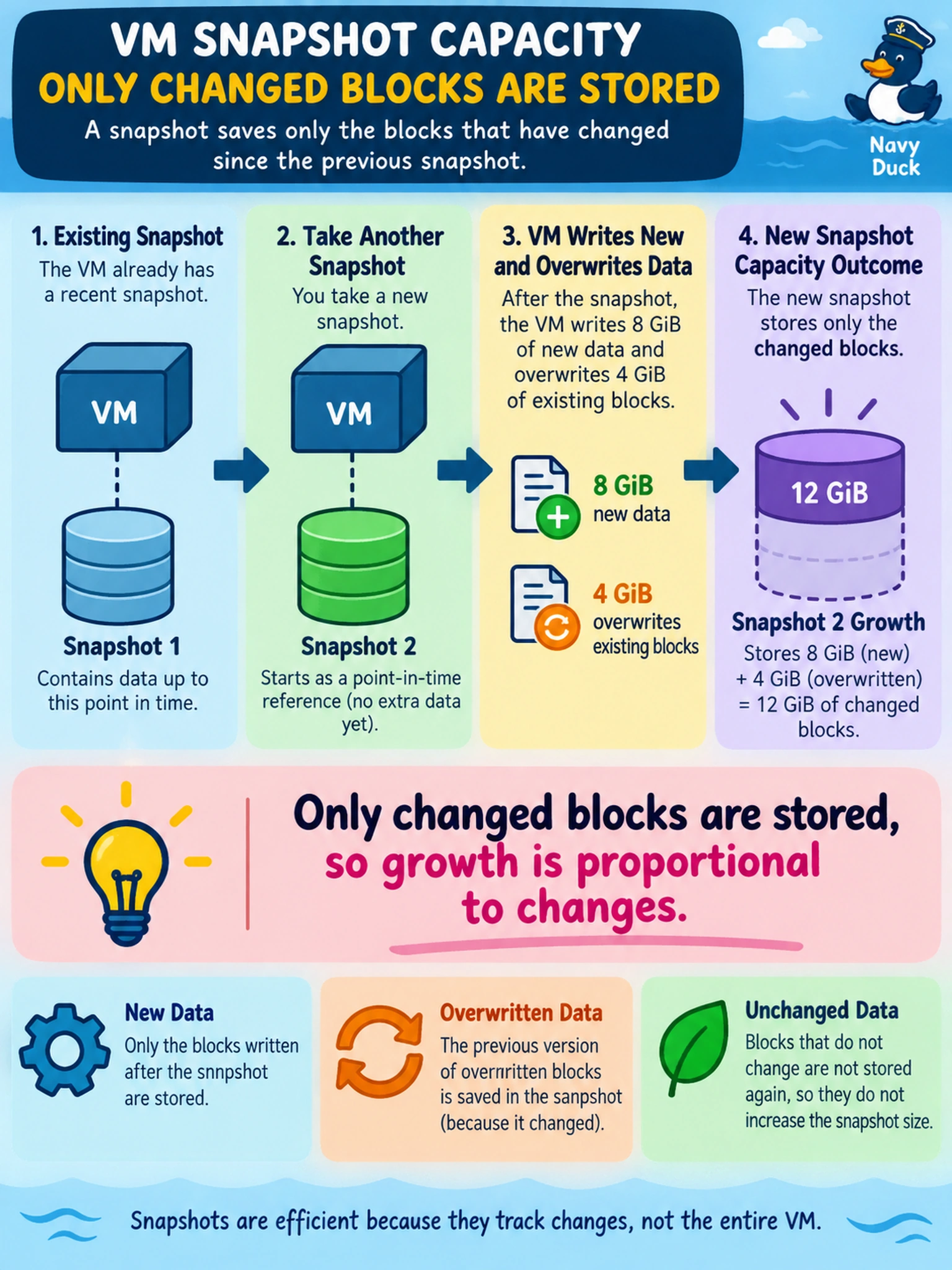
A VM in a protection domain already has a recent snapshot. You take another snapshot, then the VM writes 8 GiB of new data and overwrites 4 GiB of existing blocks. Which capacity outcome should you expect from the new snapshot?
Select an answer to reveal the explanation.
Short Explanation
Think of snapshots like a stack of sticky notes, not photocopies of the whole binder. You only add the pages that changed, so capacity tracks the delta, not the VM size.
Full Explanation
Nutanix snapshots are implemented as space-efficient point-in-time constructs. Once a baseline exists, subsequent snapshots reference the unchanged blocks from earlier state and allocate capacity only for blocks that change afterward. That is why a snapshot taken after a VM has already been protected does not consume a full VM copy when the workload later writes new data or overwrites existing blocks; the capacity growth follows the amount of changed data. A full-copy model would be wrong because it assumes every snapshot duplicates the entire provisioned volume, which contradicts the incremental behavior and would make frequent snapshots impractical. A used-capacity full-copy model is also wrong for the same reason: it treats the snapshot as a separate complete image based on current used space rather than as a delta against prior state. A metadata-only model is wrong because unchanged blocks may still be referenced, but changed blocks must be persisted somewhere; snapshots are not merely bookkeeping entries. Exam caveat: do not assume the first snapshot after protection is always zero-cost, because baseline behavior depends on implementation and timing. Operational check: review snapshot growth over a fixed write window and compare it to the amount of changed blocks rather than to VM provisioned size.