
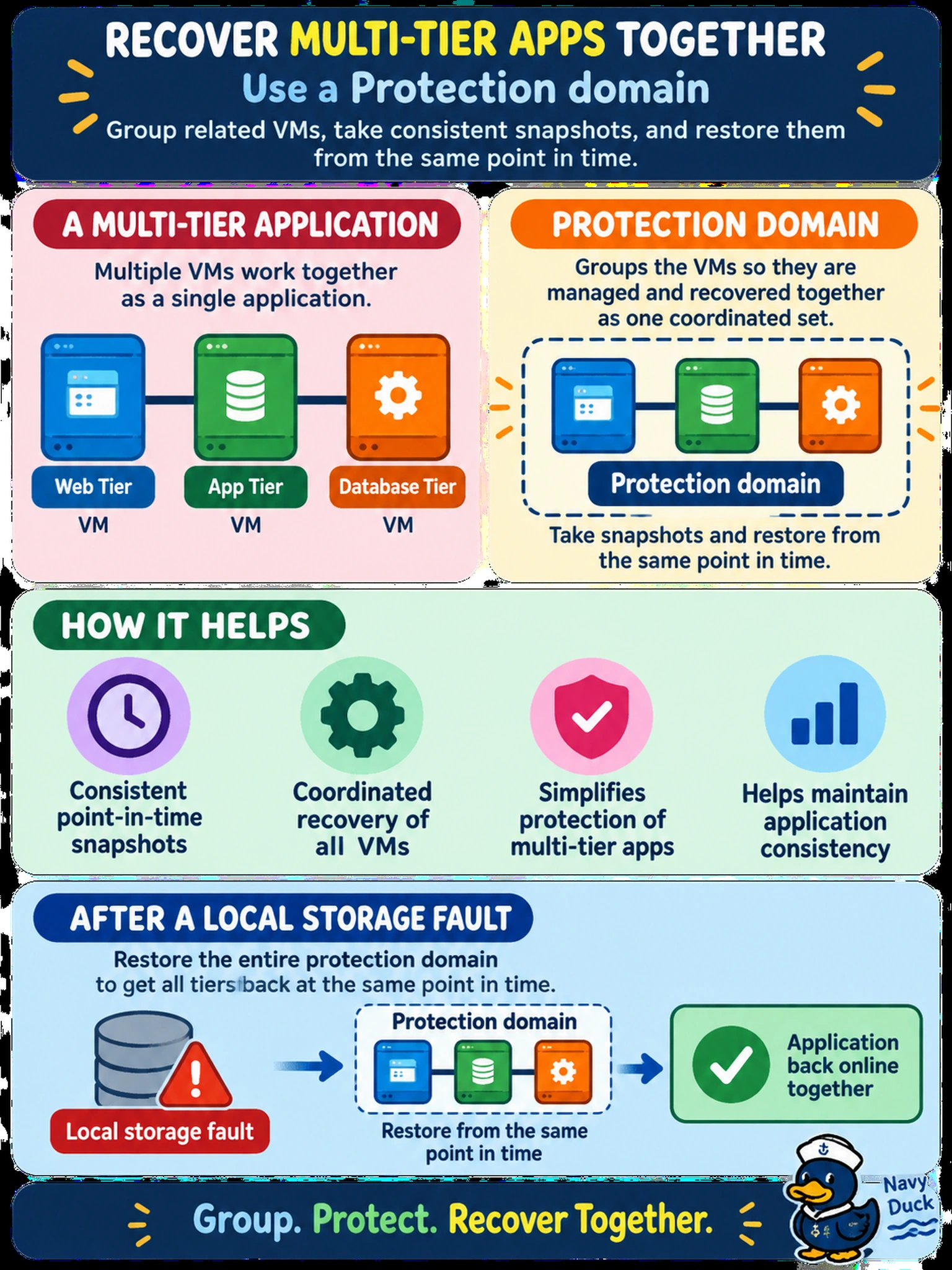
Three VMs hosting a multi-tier application must be recovered together as a single coordinated set after a local storage fault. You need a Nutanix method that groups the VMs and lets you take and restore them from the same point in time. Which should you use?
Select an answer to reveal the explanation.
Short Explanation
Think of a protection domain like a save point for a whole app, not just one VM. If you snapshot each VM separately, you can easily land three machines on three slightly different moments. You use a PD when the group has to come back together.
Full Explanation
A protection domain is the Nutanix construct used to group multiple VMs so that snapshots and restores treat them as one application-consistent unit. When an application requires a common recovery point, the PD snapshot captures the group together, and restoring the PD brings the member VMs back as a coordinated set rather than as unrelated single-machine saves. Taking individual VM snapshots at the same time may look similar, but it does not create one recovery object and does not guarantee that all VMs land on the same consistent moment; clock drift, snapshot queueing, or restore sequencing can leave the tiers misaligned. A recovery plan is designed to orchestrate failover or failback across sites, so it is not the right answer for a local point-in-time recovery method. A snapshot policy applied to each VM only schedules independent snapshot operations; it still protects machines one by one and lacks the grouped consistency and single restore workflow needed for coordinated recovery. Exam caveat: when the requirement names multiple VMs as one application-consistent recovery set, choose the protection domain construct rather than VM-level snapshot tooling. Operational check: confirm every dependent VM is a member of the PD, then perform a non-disruptive restore test into an isolated network to validate the coordinated recovery path.