
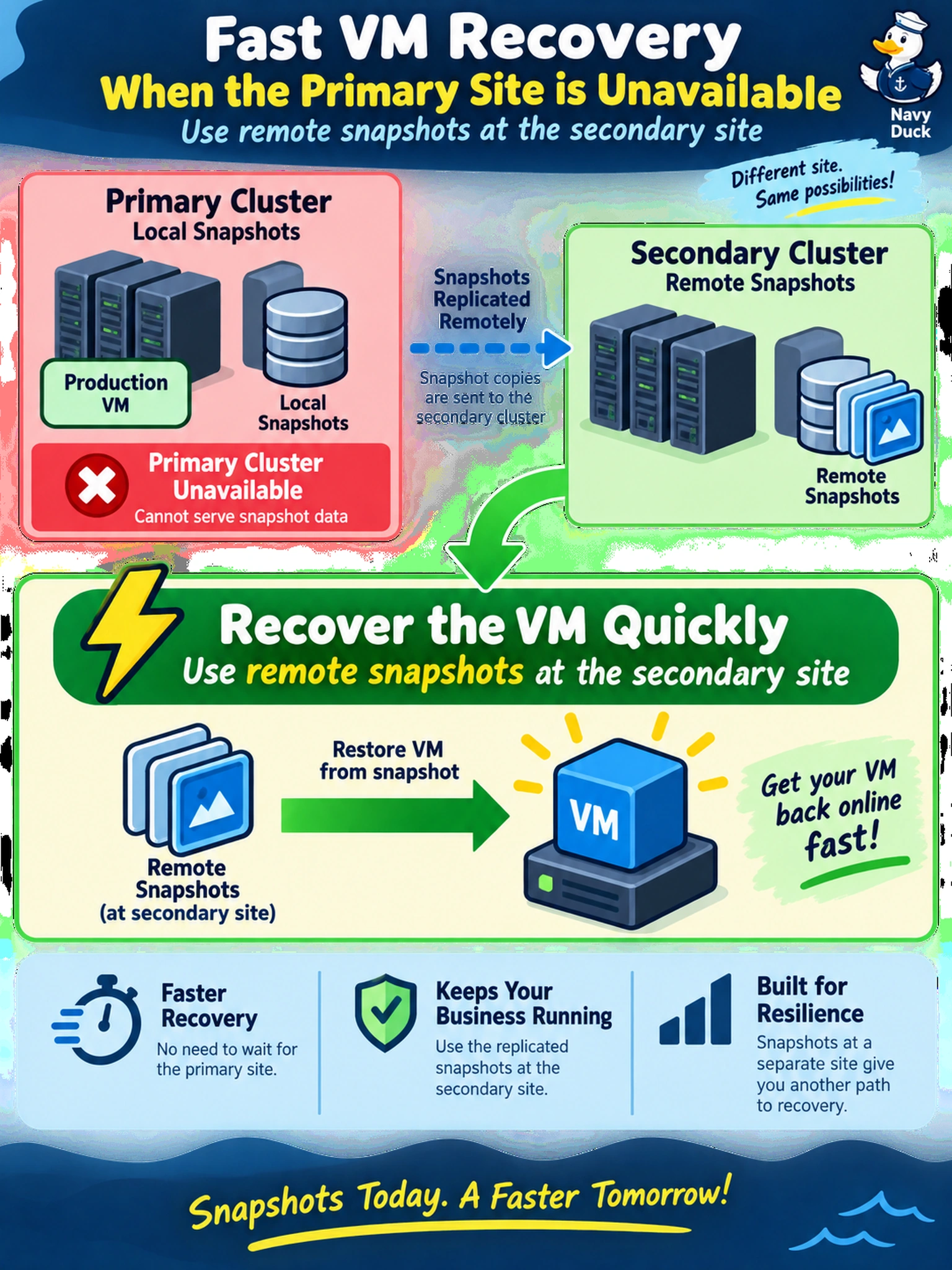
A production VM is protected by a protection domain with local snapshots on the primary cluster and remote snapshots replicated to a secondary cluster. During a maintenance window, the primary cluster becomes completely unreachable and cannot serve snapshot data. You need to recover the VM as quickly as possible without waiting for the primary site to come back online. What should you use?
Select an answer to reveal the explanation.
Short Explanation
Think of remote snapshots as an offsite backup copy. If the primary cluster goes dark, you don't wait for it to come back—you recover the VM from the secondary site's remote snapshots.
Full Explanation
Remote snapshots are snapshot copies replicated from a primary protection domain to a remote cluster. Their purpose is site-level resilience: if the primary cluster, CVMs, or network become unavailable, the secondary site still holds independent snapshot data that can be used to recover protected VMs. This makes remote snapshots at the secondary site the appropriate recovery source when the source site cannot be accessed. Local snapshots retained on the failed primary cluster are not available because the recovery source itself is down, so they cannot satisfy an immediate recovery need. Restoring the VM from the primary CVM after repair (the primary Stargate/controller VM) assumes the original infrastructure and storage metadata are healthy and reachable, which contradicts the stated outage and may delay recovery unnecessarily. Using the protection domain's replication journal for rebuilding the VM is also not the right quick-recovery path; it is not the independent, immediately restorable VM copy that remote snapshots provide. A protection domain with only local snapshot scheduling provides no secondary copy and therefore does not create site independence. Exam caveat: remote snapshots are not the same as asynchronous replication or a protection domain with only local snapshots; the exam may test whether a recovery action depends on source-site availability. Operational check: verify the remote snapshot schedule, remote cluster connectivity, and that protected VMs appear in the remote protection domain before relying on it for recovery.