
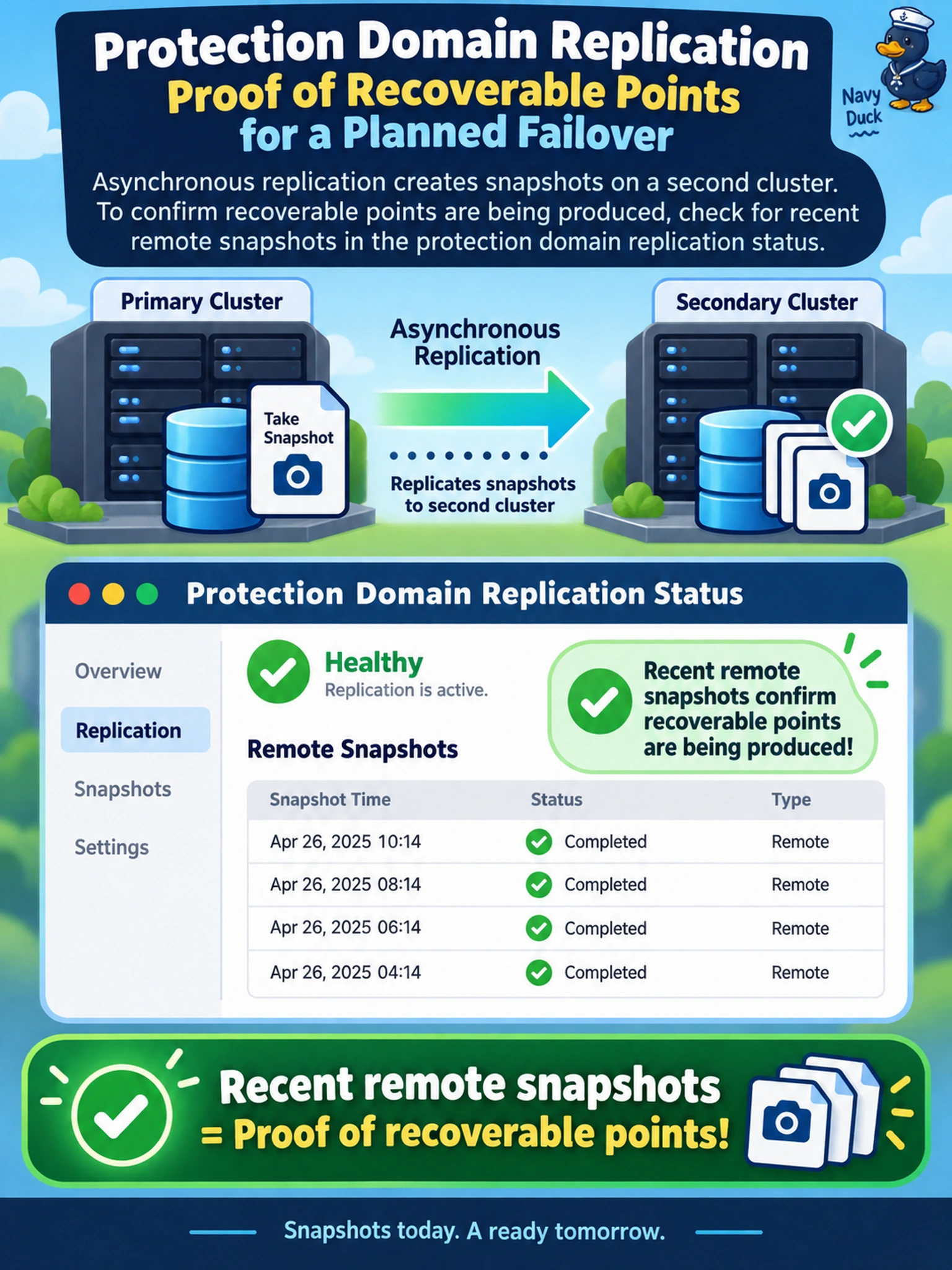
A protection domain replicates asynchronously to a second Nutanix cluster. You must prove that recoverable points are still being produced for a planned failover. Which status gives the strongest confirmation?
Select an answer to reveal the explanation.
Short Explanation
Think of a protection domain like a mailbox: a remote snapshot is proof the letter actually got posted. If PD replication status shows recent remote snapshots, you know recoverable points exist on the target. Don't just check that the source looks healthy — that only proves the sender is alive.
Full Explanation
A protection domain produces recovery points by taking local snapshots and, when configured, replicating them to a target cluster. The authoritative confirmation of recoverability is that the PD reports recent remote snapshots on the target, because that demonstrates both snapshot generation and replication completed. Health alerts, retention settings, and bandwidth headroom are useful supporting signals, but they do not prove that a snapshot exists on the target or that the last replication succeeded. Lack of CVM or Stargate alerts indicates the cluster and data services are healthy, yet replication can still be failing for VM mapping, network path, or PD configuration reasons. An enabled retention policy controls how long snapshots are kept; it does not indicate whether new snapshots were created or copied. Low bandwidth utilization shows the link is not saturated, but it does not confirm that a replication job finished or that remote recovery points are present. Exam caveat: when the question asks for proof of recoverable points, choose evidence of completed remote snapshots rather than general health or policy state. Operational check: review the protection domain snapshot and replication status, verify the latest remote snapshot timestamp, and attempt a test restore from that point.