
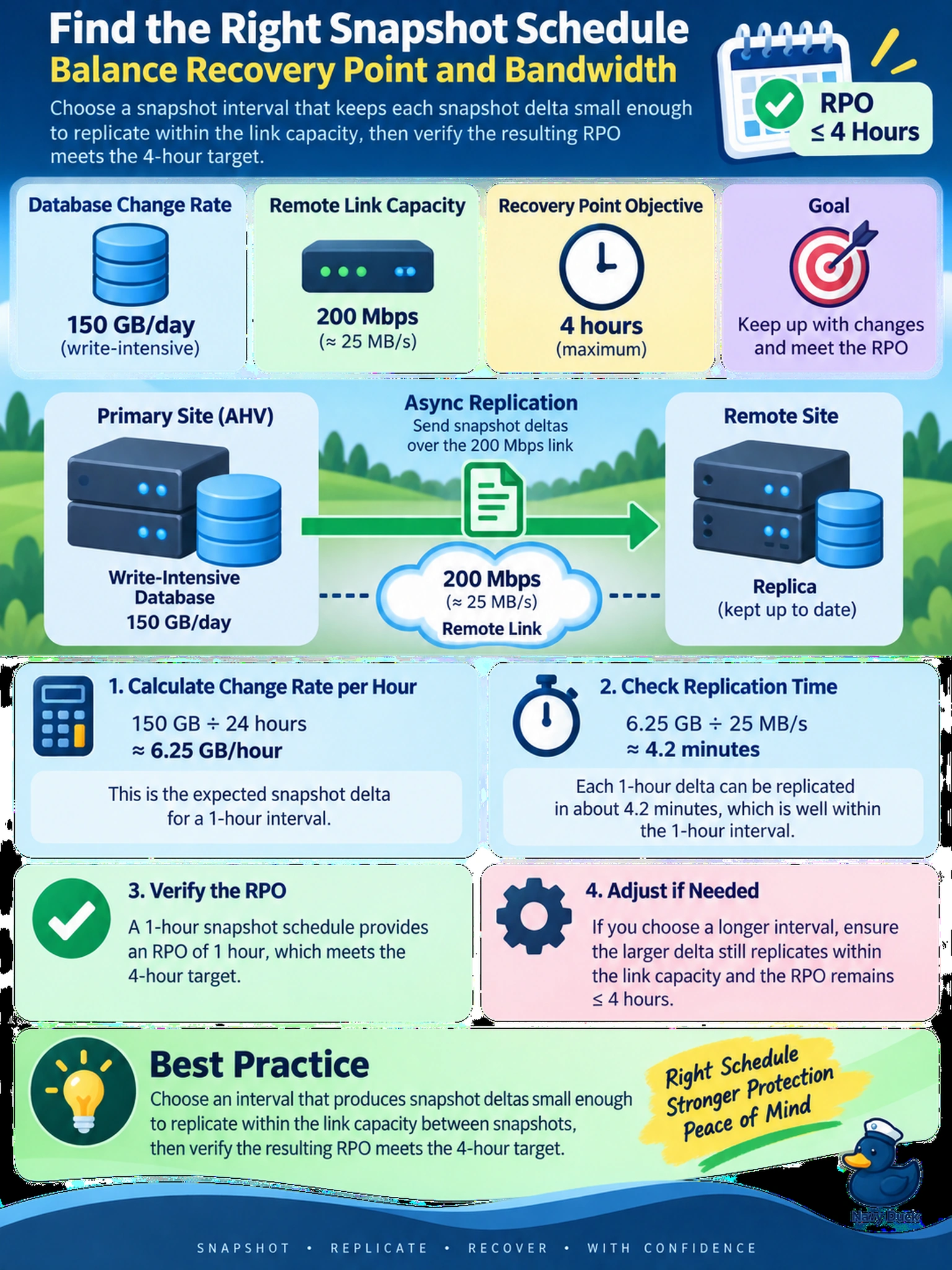
A protection domain on AHV contains a write-intensive database with a 150 GB/day change rate. The remote site has a 200 Mbps link and an RPO of 4 hours. The administrator must set a snapshot schedule for async replication. Which scheduling approach best balances recovery point and bandwidth?
Select an answer to reveal the explanation.
Short Explanation
Think of snapshots like taking photos of a busy highway: if you snap too often, you end up shipping a lot more tiny pictures, not fewer. You want an interval where each change set can actually travel over the link before the next one shows up. The trap is assuming a tighter schedule always improves replication—it’s really just adding pressure.
Full Explanation
Snapshot deltas in Nutanix protection domains represent changed blocks since the last snapshot; async replication transfers those deltas to the remote site. The correct approach sizes the interval around the workload's daily change rate and the available WAN capacity, because each snapshot creates a delta that must complete before the next one to avoid backlog and RPO drift. If change rate is high, a shorter interval can reduce per-delta size, but too many snapshots add metadata overhead and competing transfer windows. A schedule based only on the desired RPO ignores the time needed to move the data, so the remote copy may lag. NearSync is a distinct replication mode with its own latency and consistency requirements, not a setting that removes the relationship between change rate, snapshot cadence, and bandwidth. Hourly snapshots are not inherently efficient; frequency changes the pattern of deltas and can increase total replication pressure. Exam caveat: The exam expects you to reason about change rate, delta transfer time, and RPO rather than memorizing a single fixed interval. Operational check: Calculate estimated delta size from the change rate and interval, compare it to the remote link throughput over that window, and monitor protection domain replication lag after applying the schedule.