
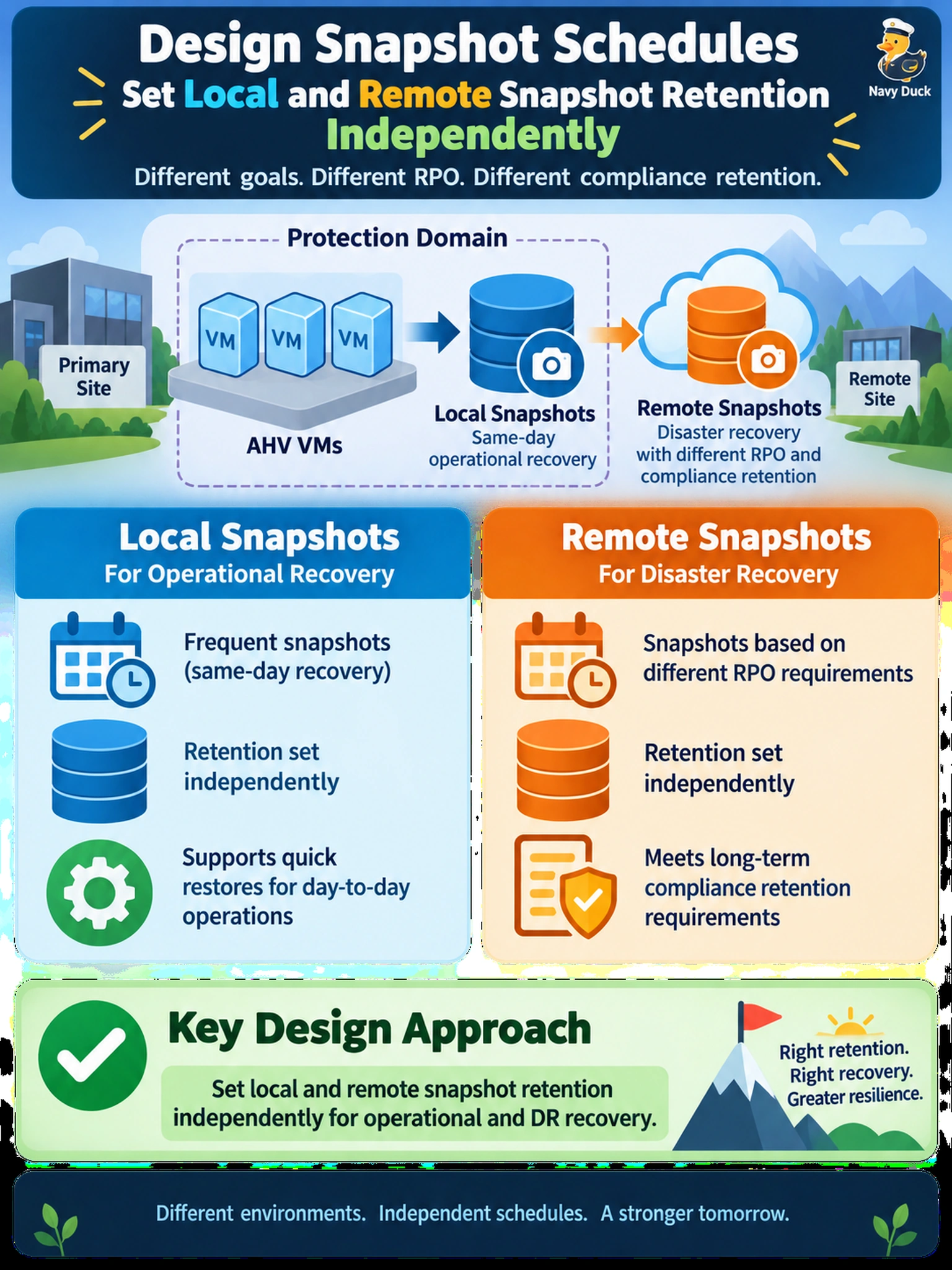
A financial application uses a protection domain with AHV VMs. Local snapshots support same-day operational recovery, while remote snapshots support disaster recovery with a different RPO and compliance retention. The administrator must design snapshot schedules. Which approach should the administrator choose?
Select an answer to reveal the explanation.
Short Explanation
Think of local and remote snapshots like two different safety nets: one catches a fat-finger delete today, the other catches a site failure later. You don't force both nets to use the same mesh size; you set retention for what each recovery need actually demands. The trap is treating replication as if it also copies your operational recovery policy.
Full Explanation
Protection domain snapshot policies separate operational recovery from disaster recovery by allowing local and remote snapshot schedules to have different frequency and retention. Local snapshots are typically short-lived but frequent, giving rapid recovery from accidental deletion or a failed workload change without moving data across the network. Remote snapshots are replicated for site failure and may be retained longer or on a different cadence to satisfy a DR RPO and compliance archive. The wrong approach is forcing one retention value onto both copies; replication transfers snapshot data, but it does not require the source and destination policies to share the same retention window. Retaining only remote snapshots removes the fastest local recovery point and increases dependence on replication health and network latency. Applying one daily 30-day schedule can waste local capacity, miss a tighter operational RPO, and still fail to express the distinct DR retention objective. Exam caveat: snapshot retention is evaluated against the recovery objective for that copy, not against the existence of a protection domain relationship. Operational check: review the protection domain snapshot schedules and compare local and remote retention with the application's RPO, RTO, and compliance requirement.