
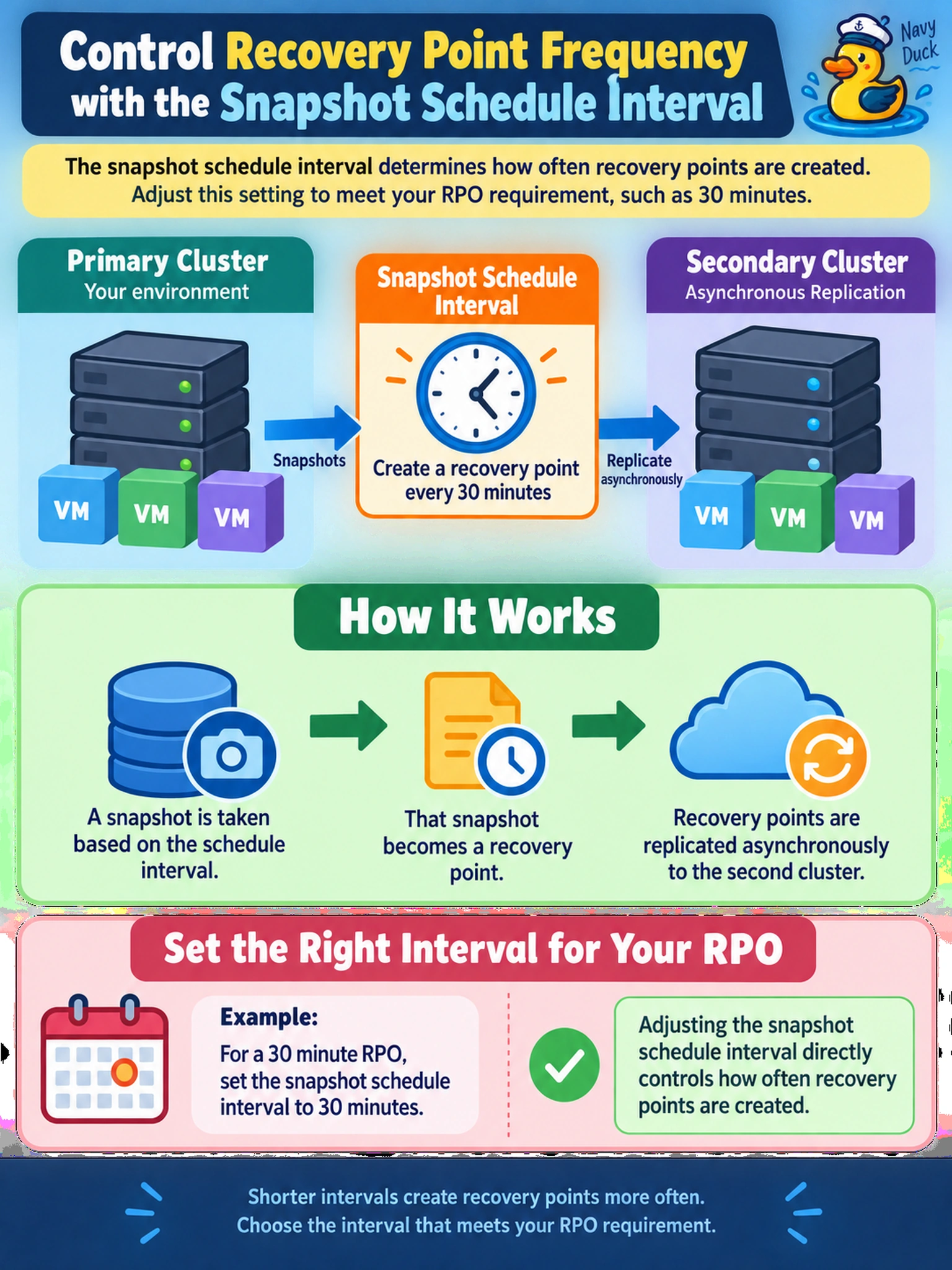
Your AHV protection domain replicates asynchronously to a second Nutanix cluster. Management requires an RPO of 30 minutes for a group of VMs. Which configuration should you adjust first to control how often recovery points are created?
Select an answer to reveal the explanation.
Short Explanation
Think of async replication like taking photos for a time-lapse: the interval between shots sets how old the newest photo can be. If your boss wants no more than 30 minutes of lost work, you tune the snapshot schedule, not the retention count or the network speed. Don't confuse how many photos you keep with how often you take one.
Full Explanation
In Nutanix asynchronous replication, the protection domain snapshot schedule is the primary control for recovery point objective because each scheduled snapshot creates a consistent recovery point and, when remote replication is enabled, the corresponding remote copy. The interval between snapshots therefore determines the maximum age of the newest available recovery point; if the business allows 30 minutes of data loss, the schedule must produce recovery points at least that frequently. A retention policy does not create recovery points; it only determines how long existing snapshots are kept before deletion, so increasing or decreasing retention changes how far back you can roll, not how current the newest point is. A network QoS policy can shape bandwidth or priority for replication traffic, but it does not define the cadence at which snapshots are taken, and sufficient bandwidth alone cannot shorten the interval set by the schedule. A VM disk controller type affects guest I/O behavior and compatibility, not the replication schedule or the frequency of snapshot generation. Exam caveat: For asynchronous protection domains, tune the snapshot schedule to meet RPO, then validate that retention and bandwidth support that schedule. Operational check: Review the protection domain snapshot schedule and confirm that the next scheduled snapshot and current recovery point age satisfy the 30-minute requirement.