
A production VM is protected by a protection domain with local and remote snapshots. An admin must confirm the VM can be recovered if the source cluster and storage are destroyed. Which snapshot must exist at the DR site?
Select an answer to reveal the explanation.
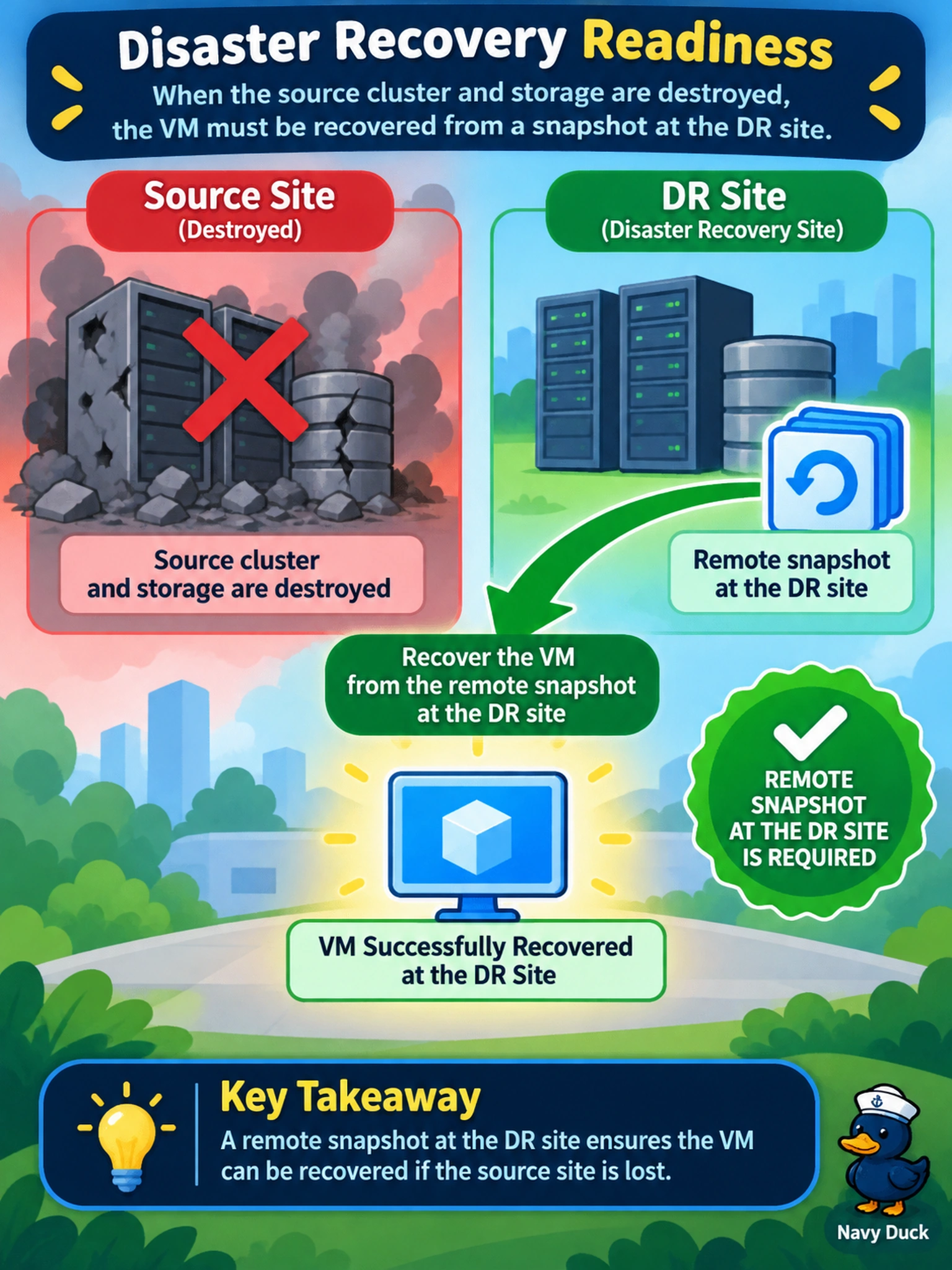
Short Explanation
Think of local snapshots like copies in the burning building: if the source site dies, they die with it. A remote snapshot at the DR site is the one you need when the whole cluster is gone.
Full Explanation
In Nutanix protection domain workflows, a local snapshot is a point-in-time copy retained on the source cluster, while a remote snapshot is transferred and retained at the configured remote site. To survive total loss of the source cluster and storage, recovery data must already exist outside that failure domain, which is why the remote snapshot is the valid artifact. A local snapshot on the source cluster cannot be used after the source site is destroyed because the metadata and data blocks reside there. An application-consistent local snapshot provides better VM state for recovery under normal conditions, but consistency does not move the copy away from the failed source. A crash-consistent local snapshot similarly remains source-local and is vulnerable to the same site-wide loss. Exam caveat: do not confuse snapshot consistency with geographic survivability; consistency affects restore quality, while remote placement affects disaster survivability. Operational check: verify the protection domain shows successful remote snapshot replication and confirm the snapshot is visible from the DR cluster before testing recovery.