
A team must back up and replicate a multi-VM application on AHV so the related VMs can be snapshotted and failed over together as one recoverable set. Which construct should the administrator create?
Select an answer to reveal the explanation.
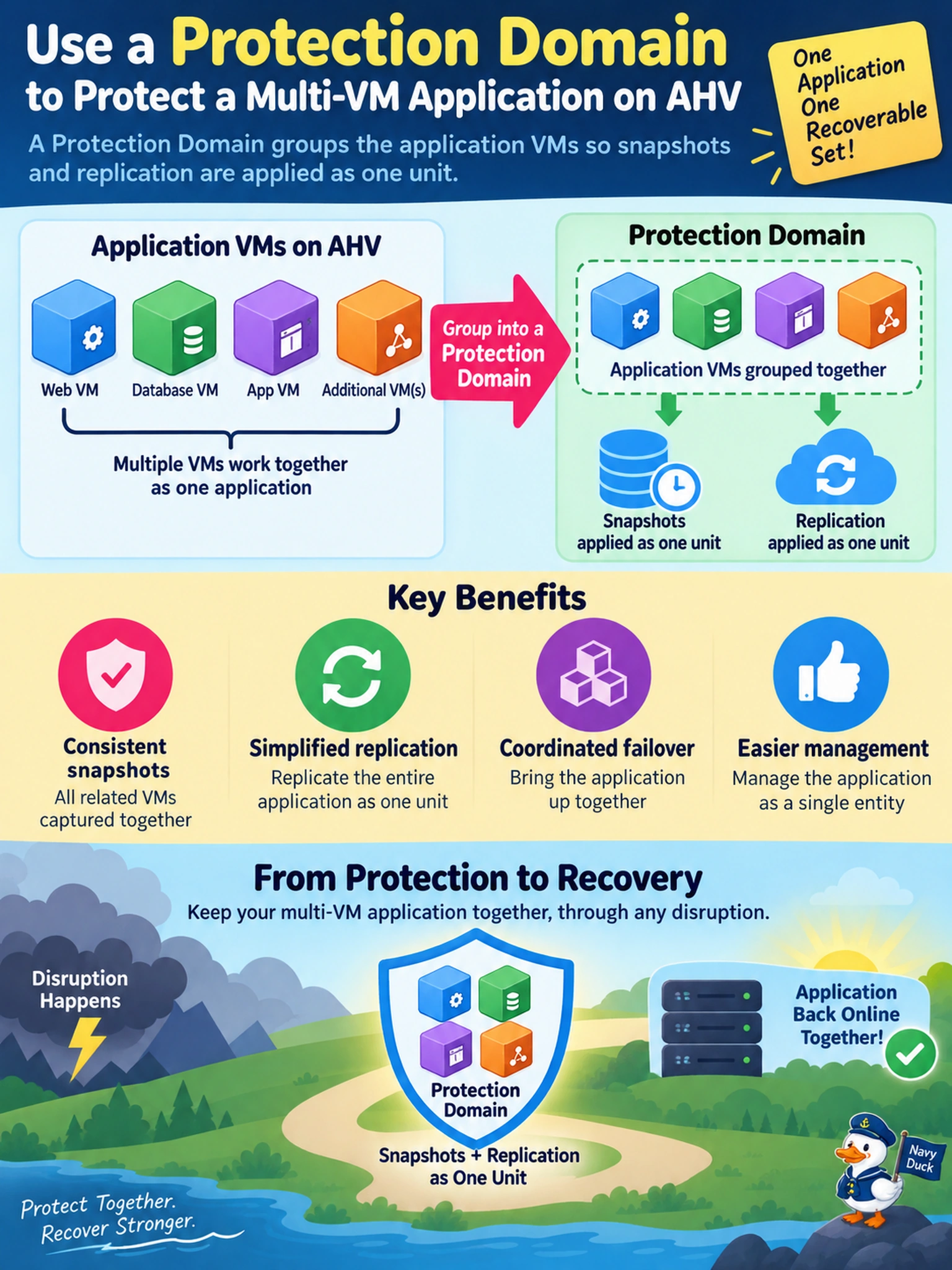
Short Explanation
Think of a Protection Domain like a group photo: you want the whole app in one frame, not a pile of separate snapshots. Tags help you find VMs, but they don't make replication happen as a unit. You group the VMs in a Protection Domain, then snapshots and replication follow that group.
Full Explanation
A Protection Domain is the Nutanix construct that defines a set of virtual machines as one replication and snapshot unit. When related VMs are placed in the same Protection Domain, local snapshots and remote replication policies are applied to the group, giving administrators one object to protect, monitor, and fail over. Categories are useful for classification, search, and policy targeting, but they do not create a snapshot-consistent recovery boundary for replication. A storage container or storage policy controls where and how VM disks are stored, including redundancy and performance characteristics, yet it does not coordinate application VMs for group snapshots or DR operations. A recovery plan can orchestrate startup order and actions during failover, but it depends on an existing Protection Domain or replicated entity rather than serving as the unit that binds VMs for snapshot and replication. Exam caveat: the exam may describe the need as application-consistent group recovery, multi-VM failover, or grouped snapshot scheduling, and the correct construct remains the Protection Domain. Operational check: list the application VMs, confirm they share the intended replication schedule and remote site, then add them to one Protection Domain and verify the Protection Domain reports the expected VM count before taking the first snapshot.