
A hospital department needs self-service VM placement on a specific cluster, a 20 TiB storage quota, and clear ownership reporting. Administrators must separate access control, quota enforcement, and placement constraints. Which Nutanix governance model should you implement?
Select an answer to reveal the explanation.
Short Explanation
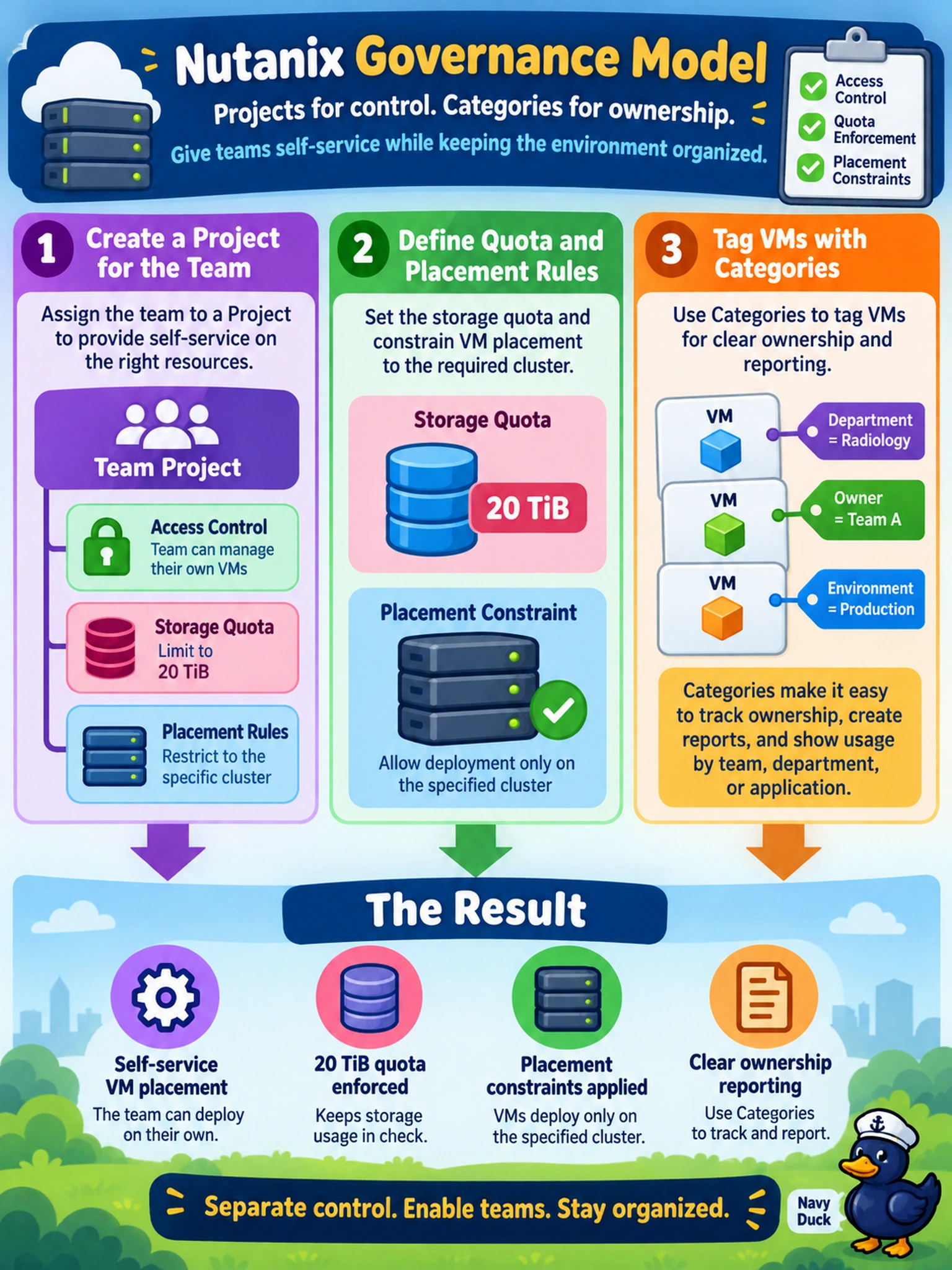
Think of a project like a gated apartment building: access, limits, and placement are controlled by the building manager, not by the apartment number. You put the team in the project, set its quota and placement rules, then use categories as labels for ownership and reporting. Don't confuse a tag with a gatekeeper.
Full Explanation
Projects are the Nutanix governance object that binds users or groups to self-service limits and placement constraints. When you assign a team to a project, you can enforce quota on compute and storage and restrict where VMs are placed, while categories remain metadata tags that classify workloads for ownership, reporting, and policy matching. This separation matters: the project controls who can act and how much they may consume, and categories describe what the workload is. Treating categories as access containers is wrong because a category tag does not authenticate users or create entitlements; it only labels objects. Using one broad project with naming conventions fails because the project must carry quota and placement constraints, and names are not enforced limits. Relying on Prism Element storage policies is also wrong because storage policies do not provide departmental user access, self-service project quotas, or cross-cluster placement governance. Exam caveat: Projects enforce access, quota, and placement; categories classify and support reporting or policy scope. Operational check: create the department project, assign its users or groups, set storage and compute quota plus placement constraints, then apply an ownership category to each VM and validate that out-of-policy placement and quota overruns are blocked.