
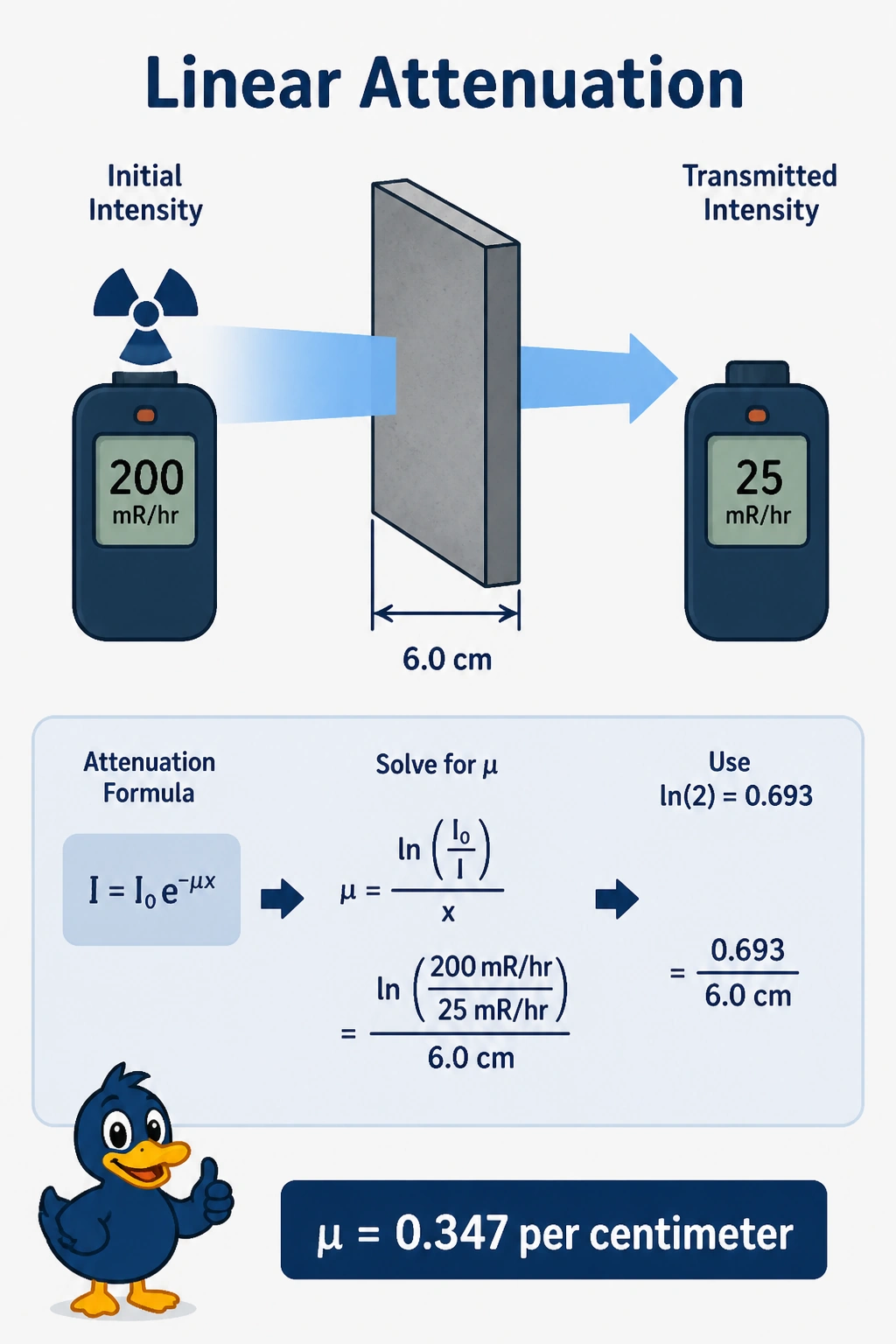
A narrow, monoenergetic gamma beam produces an unshielded exposure rate of 200 mR/hr. Placing a 6.0 cm thick shield in the beam reduces the exposure rate to 25 mR/hr. Using ln(2) equals 0.693, what is the linear attenuation coefficient of the shielding material?
Select an answer to reveal the explanation.
Short Explanation
When a narrow gamma beam drops from 200 to 25 mR/hr, you are looking at three clean half-value layers cutting the field in half three times. Divide that 6.0 cm shield by three to find one HVL, then divide 0.693 by that HVL. The trap is dividing 0.693 by the total 6.0 cm thickness or by 3 instead of 2.0 cm.
Full Explanation
Using narrow-beam exponential attenuation, reducing an exposure rate from 200 mR/hr to 25 mR/hr is a reduction factor of 8, which equals 3 half-value layers (HVLs) because (1/2)^3 = 1/8. Dividing the 6.0 cm shield thickness by 3 HVLs gives an HVL of 2.0 cm, and the linear attenuation coefficient is ln(2) / HVL = 0.693 / 2.0 cm = 0.3465, or 0.347 per centimeter. Choosing 0.116 per centimeter results from dividing 0.693 by the entire 6.0 cm shield thickness, erroneously treating the full shield as a single HVL. Selecting 0.231 per centimeter comes from dividing 0.693 by the number of HVLs (3) rather than by the thickness of one HVL (2.0 cm). Picking 0.693 per centimeter omits dividing by the 2.0 cm HVL altogether, which would only be correct if the HVL were 1.0 cm. As an exam caveat, this calculation assumes narrow-beam geometry with negligible Compton scatter; broad-beam shields require a buildup factor. As an operational check, plug your calculated coefficient back into I = I0 e^(-mu x): 200 e^(-0.3465 6.0) = 200 * 0.125 = 25 mR/hr, confirming the math.
Prefer to study offline? Printable PDF study book + test engine ($7.50, unofficial). These questions stay free here.