
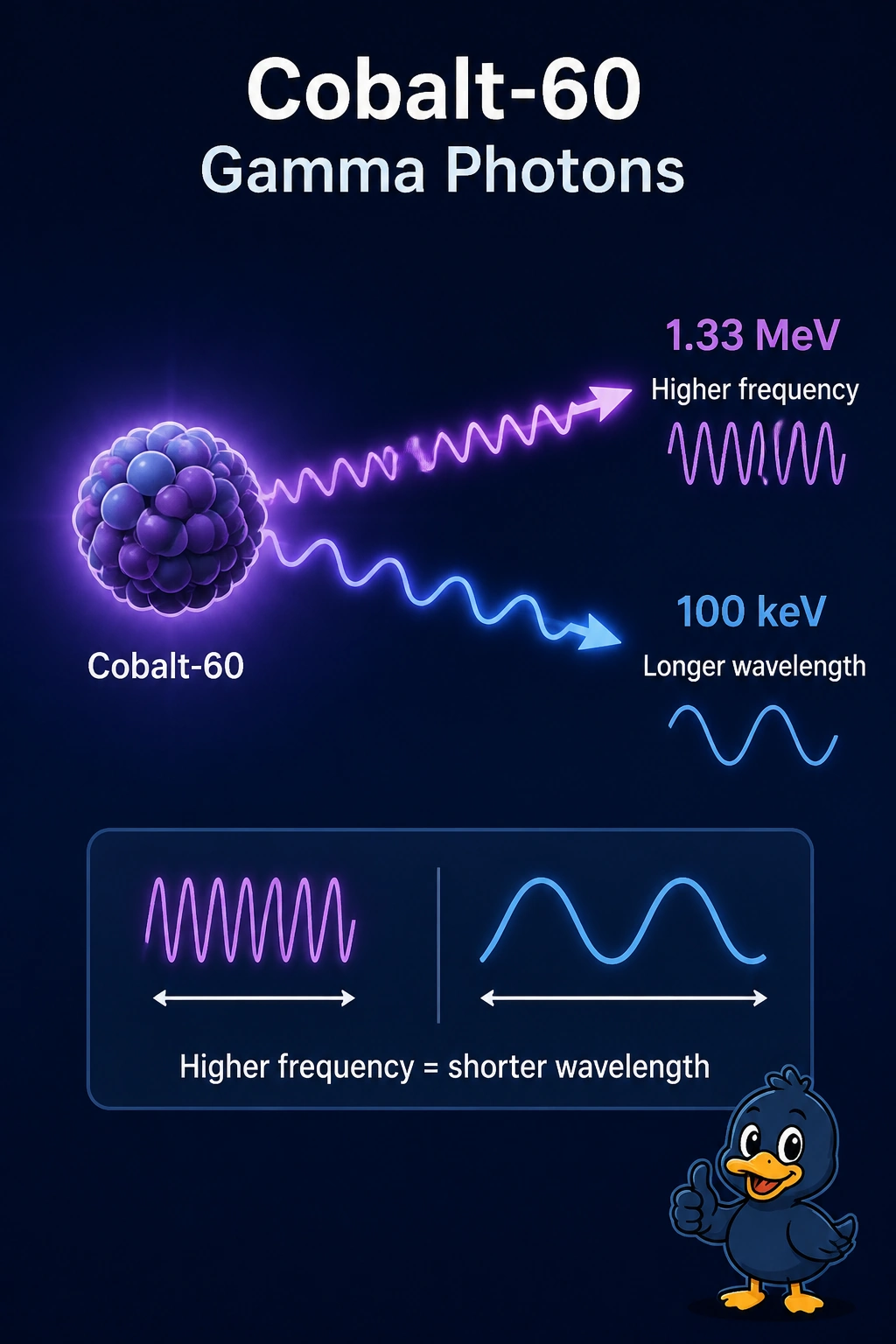
A radiation safety officer is comparing two electromagnetic beams: a 100 keV diagnostic X-ray beam and a 1.33 MeV Cobalt-60 gamma beam. How do the frequency and wavelength of the Cobalt-60 gamma photons compare with those of the diagnostic X-ray photons?
Select an answer to reveal the explanation.
Short Explanation
You can use the constant speed of light in a vacuum to connect these two wave properties: as photon energy and frequency rise, wavelength gets shorter. So the Cobalt-60 photons have higher frequency with a proportionally shorter vacuum wavelength than the diagnostic X-ray photons.
Full Explanation
Photon energy is directly proportional to frequency and inversely proportional to wavelength through the Planck–Einstein relation, so the 1.33 MeV Cobalt-60 gamma photons have higher frequency with a proportionally shorter vacuum wavelength than the 100 keV X-rays. Their energy, and therefore their frequency, is 13.3 times as great; because all electromagnetic radiation travels at the same constant speed of light in a vacuum, their wavelength is 13.3 times shorter. Lower frequency with a longer vacuum wavelength would describe photons with less energy than the X-rays, not the higher-energy gamma photons. Higher frequency with a longer vacuum wavelength cannot satisfy the constant speed-of-light product of frequency and wavelength. Identical frequency with a shorter vacuum wavelength is also impossible in a vacuum: frequency fixes photon energy, and the same frequency must correspond to the same wavelength. A key caveat is that X-rays and gamma rays with the same energy have identical frequency and wavelength in a vacuum; they differ by their origin, atomic versus nuclear. For a practical check when reviewing spectroscopy or shielding data, convert photon energy in keV or MeV before selecting attenuation coefficients.
Prefer to study offline? Printable PDF study book + test engine ($7.50, unofficial). These questions stay free here.