
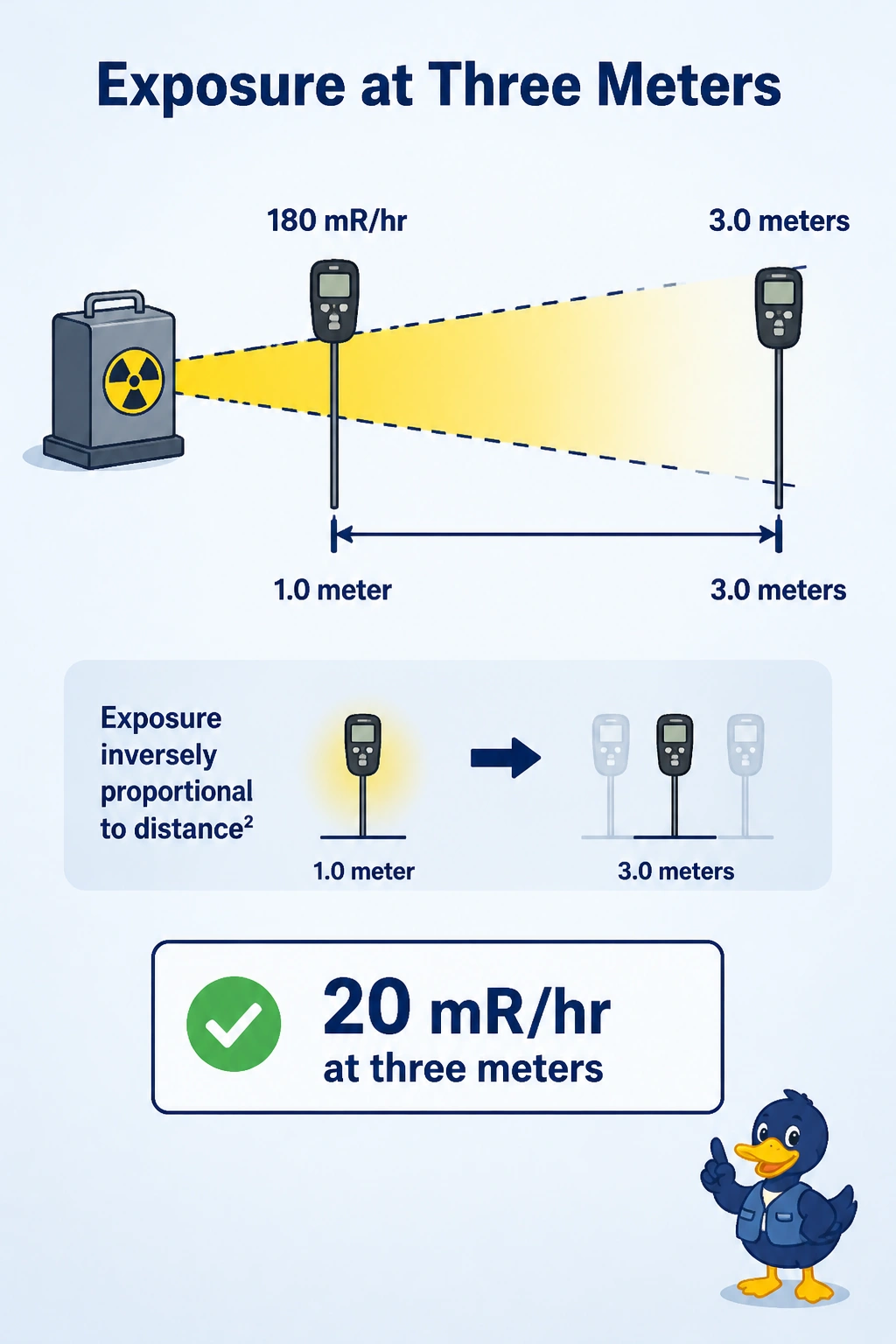
A technologist measures an exposure rate of 180 mR/hr at 1.0 meter from a small, unshielded gamma point source. Assuming negligible air attenuation, what exposure rate should the technologist expect at 3.0 meters from the same source?
Select an answer to reveal the explanation.
Short Explanation
Radiation from a point source spreads out over the surface of a growing sphere, so stepping back pays off faster than you might think. Tripling your distance drops the exposure rate by three squared, not just three. Don't fall into the trap of dividing linearly or multiplying the rate upward!
Full Explanation
For an isotropic point source with minimal air attenuation, exposure rate obeys the inverse square law: I_1 d_1^2 = I_2 d_2^2. Moving from 1.0 meter to 3.0 meters triples the distance, so the intensity decreases by a factor of 3^2, or 9. Dividing 180 mR/hr by 9 gives 20 mR/hr at three meters. Choosing 60 mR/hr at three meters divides 180 mR/hr by 3 linearly, forgetting to square the distance ratio. Choosing 90 mR/hr at three meters simply cuts the initial reading in half, which neither matches the distance ratio nor accounts for spherical divergence. Choosing 1,620 mR/hr at three meters inverts the ratio and multiplies 180 by 9, which would falsely predict a higher exposure rate farther away from the source. As an important caveat, the inverse square law holds accurately only when the distance from the source is large compared to the physical dimensions of the source and detector, and when scatter from nearby walls or floors is negligible. Operationally, verify the predicted 20 mR/hr boundary with a calibrated survey instrument before posting the 3.0-meter perimeter.
Prefer to study offline? Printable PDF study book + test engine ($7.50, unofficial). These questions stay free here.